Buying & Setup Guides
Where to Buy a Bird Feeder Camera
Three real options, and one criterion that outranks price: how easily you can send it back when your router refuses to talk to it.

How this page is funded. Buying through a link here earns us a commission at no extra cost to you. It does not change what we recommend or the order we recommend it in, and we have not handled any of these products ourselves - see how we pick and the full disclosure.
Before the comparison, the disclosure that belongs at the top of a page like this rather than at the bottom: this site earns a commission when you buy through our links, and those links go to Amazon. That is a reason to read what follows skeptically, so here is the argument on its merits and the case against us where it exists.
The criterion that matters most
The return window - and it is not close.
The commonest failure in this category is a camera that will not join your Wi-Fi, and it is not discoverable before purchase. You find out standing in your kitchen with the app timing out. If your router turns out to be genuinely incompatible, or the signal will not reach the feeder site, no amount of research would have prevented it and you need to send the thing back easily.
So buy wherever returns are least painful, even at a slightly higher price. The Wi-Fi guide covers the fixes that usually work first.
The three options
| Amazon | Maker direct | Big-box retail | |
|---|---|---|---|
| Returns | Straightforward, well-established | Varies by maker; often slower | Easy if there is a store nearby |
| Range | Widest - includes small brands with no other channel | That maker only | Narrow, usually one or two models |
| Bundles and accessories | Widest choice of poles, panels and extenders | Maker's own accessories, sometimes bundled | Rarely |
| Price transparency | Visible and changes frequently | Usually stable; a few makers publish list prices | Stable, less competitive |
| Subscription clarity | Often poor - listings bury the plan | Best - the maker's own site usually explains its tiers | Poor |
| Seeing it in person | No | No | Yes - the only real advantage |
Quick picks
Ranked on published specifications and what each one costs to own. Every pick names the buyer it is wrong for.
| # | Product | Best for | Price |
|---|---|---|---|
| 1 |  Birdbuddy Pro Solar The largest published sensor in the category and the only maker that declines to advertise a species count - both of which point the same way. | The best pictures, if you can live with the app | |
| 2 |  Birdfy 2 Pro Solar Two lenses, a stated 9,000mAh battery and a stated 3W panel. Birdfy publishes numbers other makers hide, and the numbers are good. | The most published specification of anything here | |
| 3 | 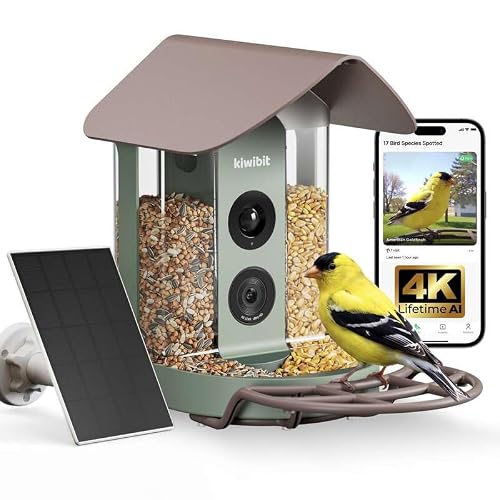 Kiwibit 4K, No-Subscription Edition The same hardware with lifetime AI identification stated on the listing. For a gift, that single line is worth more than any spec on it. | A gift that will never send anyone a bill |
1. The best pictures, if you can live with the app
Birdbuddy Pro Solar
The largest published sensor in the category and the only maker that declines to advertise a species count - both of which point the same way.
A 1/2.7" sensor is a real, checkable number, and it is bigger than anything else in this category will admit to. Sensor area is what governs how a photo looks when a bird lands at dusk, which is when most feeder traffic actually happens. Nobody else publishes the figure, so nobody else can be compared to it.
The thing worth noticing is what is missing. Every rival leads with an AI number - 6,000 species, 10,000 species. Birdbuddy prints none. A maker that does not put a number on its recognition claim is a maker with nothing to walk back, and after you read the species-claim audit that reads as confidence rather than as a gap.
The Wi-Fi position is the one to check before you buy. Birdbuddy's own support documentation says the original camera module requires 2.4GHz and does not work on 5GHz. If your router broadcasts one merged network name, that is the setup that fails - and the fix takes ten minutes once you know about it. It is covered in the Wi-Fi requirements guide.
| Video resolution | 2KSource: Birdbuddy Pro Solar - manufacturer listing on Amazon, retrieved 1 September 2026 |
|---|---|
| Photo resolution | 5MPSource: Birdbuddy Pro Solar - manufacturer listing on Amazon, retrieved 1 September 2026 |
| Sensor size | 1/2.7"The only sensor dimension published by any maker in this roundup.Source: Birdbuddy Pro Solar - manufacturer listing on Amazon, retrieved 1 September 2026 |
| Dynamic range | HDRSource: Birdbuddy Pro Solar - manufacturer listing on Amazon, retrieved 1 September 2026 |
| Wi-Fi band | 2.4GHz for the original camera module; the Birdbuddy 2 module adds 5GHzBirdbuddy's own support pages state the original module does not work on 5GHz.Source: Birdbuddy support: Connectivity and Wi-Fi requirements |
| Solar | Detachable solar roof, rotates 180 degreesSource: Birdbuddy Pro Solar - manufacturer listing on Amazon, retrieved 1 September 2026 |
| Battery capacity | Not publishedNo mAh figure appears on the listing or the support site. |
| Species identified | Not publishedBirdbuddy publishes no species count anywhere we could find. See the AI claims audit. |
| Subscription price | Not publishedNot stated on the listing, and the plan page did not serve us a price. |
What it does well
- Published 1/2.7" sensor with HDR - the only sensor dimension anyone in the category states
- Solar roof detaches and rotates, so the panel can face the sun even when the feeder cannot
- Makes no species-count claim, which is the honest position given the arithmetic
- The largest accessory ecosystem in the category, including perch extenders and nutrition sets
What it does not
- Battery capacity is not published, so runtime cannot be estimated from first principles
- The original camera module is 2.4GHz-only per Birdbuddy's own support pages
- Subscription pricing is not stated on the listing and was not retrievable from the plan page
Skip this: if you want every feature unlocked with no ongoing decision to make. Birdbuddy's premium tier exists, its price is not published where a buyer can find it, and buying into an unpriced subscription is exactly the trap the three-year cost guide was written about.
2. The most published specification of anything here
Birdfy 2 Pro Solar
Two lenses, a stated 9,000mAh battery and a stated 3W panel. Birdfy publishes numbers other makers hide, and the numbers are good.
A 9,000mAh cell paired with a 3W panel is the most generous published power budget in the category, and it is the reason this model turns up in so many yards that get only morning sun. It is also, notably, a number: Birdfy states it, most rivals do not, and a stated number is one you can hold them to.
The dual-lens arrangement is a genuine design decision rather than a spec-sheet flourish. One lens frames the whole feeder, the other pushes in on the perch. What that buys you is a photo where the bird fills the frame without the wide shot becoming useless - which is precisely the complaint people have about single-lens feeders.
The species claim is where to be careful. 6,000+ is a claim by the maker. There are 11,227 bird species on Earth by the current IOC list, and 1,161 in the whole ABA Area. What a 6,000-species model can honestly do in a North American backyard is worked through in the AI claims audit.
Operating range is stated at 14F to 113F. If you live somewhere that spends February below 14F, that is a published limit, not a rumor, and it should decide your purchase.
| Camera system | Dual lens: 1080P wide + 2K auto-tracking close-up, with split viewSource: Birdfy 2 Pro Solar - manufacturer listing on Amazon, retrieved 1 September 2026 |
|---|---|
| Battery capacity | 9,000mAhThe largest published capacity of any feeder on this site, and one of only four published at all.Source: Birdfy 2 Pro Solar - manufacturer listing on Amazon, retrieved 1 September 2026 |
| Solar panel | 3WSource: Birdfy 2 Pro Solar - manufacturer listing on Amazon, retrieved 1 September 2026 |
| Species identified | 6,000+ claimedA claim by the maker, not a verified figure. See the audit.Source: Birdfy 2 - manufacturer listing on Amazon, retrieved 1 September 2026 |
| Operating range | 14F to 113FSource: Birdfy 2 - manufacturer listing on Amazon, retrieved 1 September 2026 |
| Sharing | 20+ accountsSource: Birdfy 2 - manufacturer listing on Amazon, retrieved 1 September 2026 |
| Sensor size | Not publishedResolution is published; the sensor dimension behind it is not. |
| Subscription price | Not published |
What it does well
- 9,000mAh battery and 3W panel, both published - the best documented power budget here
- Dual lens gives a wide frame and a close-up without choosing between them
- Publishes an operating temperature range, which almost nobody else does
- Shares to 20+ accounts, which matters if this is a gift for a household
What it does not
- The 6,000+ species claim is far larger than any North American backyard can exercise
- Sensor dimensions are not published, so image quality cannot be compared to Birdbuddy's
- Subscription pricing is not stated on the listing
Skip this: if you live where winter regularly drops below 14F. Birdfy publishes that as the bottom of the operating range, and a camera that stops in January is a camera you bought for eight months of the year.
3. A gift that will never send anyone a bill
Kiwibit 4K, No-Subscription Edition
The same hardware with lifetime AI identification stated on the listing. For a gift, that single line is worth more than any spec on it.
A gift that arrives with a monthly fee attached is a gift that keeps asking the recipient for money. That is the whole argument for this variant, and it is why it leads the no-subscription roundup.
Read the wording carefully before you buy, though, because it is the wording that matters. The listing says lifetime AI identification, not lifetime cloud storage, and those are different promises. Storage terms in this category change quietly, and a lifetime claim on one feature says nothing about the other.
Everything else is the Kiwibit 4K platform: the same 5,200mAh cell, the same 4K stream, the same 8MP stills.
| Subscription | No subscription; lifetime AI identification stated on the listingSource: Kiwibit no-subscription - manufacturer listing on Amazon, retrieved 1 September 2026 |
|---|---|
| Video resolution | 4K live streamSource: Kiwibit no-subscription - manufacturer listing on Amazon, retrieved 1 September 2026 |
| Photo resolution | 8MPSource: Kiwibit no-subscription - manufacturer listing on Amazon, retrieved 1 September 2026 |
| Solar | Solar poweredSource: Kiwibit no-subscription - manufacturer listing on Amazon, retrieved 1 September 2026 |
| Battery capacity | 5,200mAhPublished for the Kiwibit 4K platform.Source: Kiwibit 4K - manufacturer listing on Amazon, retrieved 1 September 2026 |
| Sensor size | Not published |
| Species identified | Not publishedThis listing states lifetime identification without naming a count. |
What it does well
- Lifetime AI identification stated in writing on the maker's own listing
- Nothing to explain to the person you gave it to
- Same published 4K and 8MP capture as the subscription variant
What it does not
- Lifetime AI is not the same promise as lifetime cloud storage
- No published sensor size
- The species count is not stated on this variant, so it cannot be compared like for like
Skip this: if you want the deepest cloud archive you can get. A no-subscription model is a model with a smaller storage story, and if you plan to keep three years of clips you should read the three-year cost comparison before deciding.
Where buying direct is genuinely better
One case, and it is a real one: understanding the subscription. A maker's own site is where the plan tiers are explained properly, and retail listings are consistently the worst place to work out what you will be charged for. Even if you then buy elsewhere, reading the maker's own pricing page first is worth the five minutes.
FeatherSnap, for instance, publishes retail pricing on its own site - unusual in this category, and a point in its favor regardless of where you buy. The subscription guide explains why that transparency is worth rewarding.
What does not vary
The product. These are not products where the retail channel changes what arrives in the box - there is no meaningful gray market here and no retailer-specific variants worth chasing. So the decision really is about returns, range and price rather than about getting a different thing.
On buying secondhand
Possible, and treat it carefully. Two specific risks: the battery on a used outdoor device that has been through winters is the component most likely to be degraded, and some models bind to an account in ways that make transfer awkward. If you do buy used, confirm the previous owner has removed it from their account before money changes hands.
Timing
Prices in this category move a great deal and discount around the usual retail events. We are not going to print a figure or a percentage here, because a number typed into a page in September is wrong by November - the live price sits on the buy buttons above, stamped with the date we checked it, and disappears entirely if our data goes stale. How we pick explains that mechanism.
If you are buying for a specific date - a birthday, Christmas - order earlier than feels necessary. A camera that arrives and will not pair needs a return window that has not closed, and December is the worst time to discover a router problem. The gift guide covers the rest of that timing. One brand worth knowing about when you are comparing sellers: VicoHome comes from the security-camera aisle rather than the bird aisle, and its listing reads accordingly.
Questions people actually ask
Where is the best place to buy a bird feeder camera?
Wherever returns are easiest, which usually means Amazon - the commonest failure is a Wi-Fi incompatibility you cannot discover until after purchase. Read the maker's own site first to understand the subscription, whatever you decide.
Is it cheaper to buy direct from the manufacturer?
Not usually, though makers run their own promotions. The genuine advantage of buying direct is that the plan tiers are explained properly, which retail listings rarely do.
Can I buy one in a store?
Some big-box retailers carry one or two models. The advantage is seeing it in person; the disadvantage is a much narrower range and generally worse subscription information.
Should I buy a used one?
With care. The battery is the component most likely to be degraded on an outdoor device that has been through winters, and some models bind to the previous owner's account - confirm it has been released before paying.
When do these go on sale?
They discount around the usual retail events. We do not print figures, because prices move weekly - the live price on each buy button is stamped with the date it was checked.