Smart Bird Feeder Cameras
The Best Smart Bird Feeders With a Camera
Ranked on what the makers publish, what they refuse to publish, and what each one costs once the subscription is counted. Every pick names the person who should not buy it.
How this page is funded. Buying through a link here earns us a commission at no extra cost to you. It does not change what we recommend or the order we recommend it in, and we have not handled any of these products ourselves - see how we pick and the full disclosure.
There are more of these than there were, and they are more similar than the marketing suggests. Almost all of them are a 2.4GHz camera on a plastic hopper with a solar roof, running an app that identifies species and asks for money after the first year. The differences that survive contact with a real backyard are narrow, and they are not the ones on the front of the box.
So this ranking is built on four things: what the maker publishes about the optics, which Wi-Fi band the camera can join, what the app costs on an ongoing basis, and how the thing is powered. Where a maker declines to publish one of those, we print that it declined - and in this category that is frequently the most informative row in the table.
Quick picks
Ranked on published specifications and what each one costs to own. Every pick names the buyer it is wrong for.
| # | Product | Best for | Price |
|---|---|---|---|
| 1 |  Birdbuddy Pro Solar The largest published sensor in the category and the only maker that declines to advertise a species count - both of which point the same way. | The best pictures, if you can live with the app | |
| 2 |  Birdfy 2 Pro Solar Two lenses, a stated 9,000mAh battery and a stated 3W panel. Birdfy publishes numbers other makers hide, and the numbers are good. | The most published specification of anything here | |
| 3 |  Kiwibit Smart Bird Feeder (4K) 4K, 8MP, a stated 5,200mAh cell and a stated 3W panel, with an IP65 rating and a real temperature range. Then it claims 10,000+ species. | The most published specification per dollar | |
| 4 |  FeatherSnap Scout Dual 1L bins let you run sunflower and nyjer at once, which changes what turns up. FeatherSnap is also the only maker in this roundup that publishes its own price. | Two seed types, and the only published retail price here | |
| 5 |  Birdfy 4K Full-Metal, Dual-Band The only established brand publishing dual-band 2.4/5GHz support, plus a metal body and a lifetime-free AI claim. That first fact is why it is on this list. | The only one that will join a 5GHz network | |
| 6 | 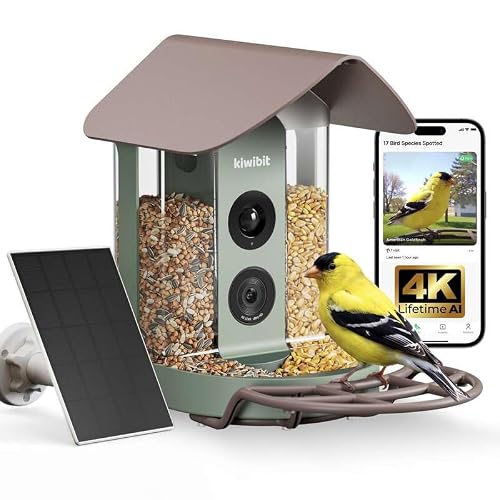 Kiwibit 4K, No-Subscription Edition The same hardware with lifetime AI identification stated on the listing. For a gift, that single line is worth more than any spec on it. | A gift that will never send anyone a bill | |
| 7 |  Netvue Birdfy Lite The entry Birdfy: adjustable brackets, free cloud storage stated on the listing, and the same 6,000+ species claim as its expensive siblings. | The cheapest way into the category | |
| 8 |  Happy Birdy 2.5K The only feeder here rated IP67 rather than IP65, with wall mount and pole strap included and a free AI claim. | An IP67 rating and the mounts in the box | $149.99 - View on Amazon #ad Price checked October 17, 2026. How this is funded |
1. The best pictures, if you can live with the app
Birdbuddy Pro Solar
The largest published sensor in the category and the only maker that declines to advertise a species count - both of which point the same way.
A 1/2.7" sensor is a real, checkable number, and it is bigger than anything else in this category will admit to. Sensor area is what governs how a photo looks when a bird lands at dusk, which is when most feeder traffic actually happens. Nobody else publishes the figure, so nobody else can be compared to it.
The thing worth noticing is what is missing. Every rival leads with an AI number - 6,000 species, 10,000 species. Birdbuddy prints none. A maker that does not put a number on its recognition claim is a maker with nothing to walk back, and after you read the species-claim audit that reads as confidence rather than as a gap.
The Wi-Fi position is the one to check before you buy. Birdbuddy's own support documentation says the original camera module requires 2.4GHz and does not work on 5GHz. If your router broadcasts one merged network name, that is the setup that fails - and the fix takes ten minutes once you know about it. It is covered in the Wi-Fi requirements guide.
| Video resolution | 2KSource: Birdbuddy Pro Solar - manufacturer listing on Amazon, retrieved 1 September 2026 |
|---|---|
| Photo resolution | 5MPSource: Birdbuddy Pro Solar - manufacturer listing on Amazon, retrieved 1 September 2026 |
| Sensor size | 1/2.7"The only sensor dimension published by any maker in this roundup.Source: Birdbuddy Pro Solar - manufacturer listing on Amazon, retrieved 1 September 2026 |
| Dynamic range | HDRSource: Birdbuddy Pro Solar - manufacturer listing on Amazon, retrieved 1 September 2026 |
| Wi-Fi band | 2.4GHz for the original camera module; the Birdbuddy 2 module adds 5GHzBirdbuddy's own support pages state the original module does not work on 5GHz.Source: Birdbuddy support: Connectivity and Wi-Fi requirements |
| Solar | Detachable solar roof, rotates 180 degreesSource: Birdbuddy Pro Solar - manufacturer listing on Amazon, retrieved 1 September 2026 |
| Battery capacity | Not publishedNo mAh figure appears on the listing or the support site. |
| Species identified | Not publishedBirdbuddy publishes no species count anywhere we could find. See the AI claims audit. |
| Subscription price | Not publishedNot stated on the listing, and the plan page did not serve us a price. |
What it does well
- Published 1/2.7" sensor with HDR - the only sensor dimension anyone in the category states
- Solar roof detaches and rotates, so the panel can face the sun even when the feeder cannot
- Makes no species-count claim, which is the honest position given the arithmetic
- The largest accessory ecosystem in the category, including perch extenders and nutrition sets
What it does not
- Battery capacity is not published, so runtime cannot be estimated from first principles
- The original camera module is 2.4GHz-only per Birdbuddy's own support pages
- Subscription pricing is not stated on the listing and was not retrievable from the plan page
Skip this: if you want every feature unlocked with no ongoing decision to make. Birdbuddy's premium tier exists, its price is not published where a buyer can find it, and buying into an unpriced subscription is exactly the trap the three-year cost guide was written about.
2. The most published specification of anything here
Birdfy 2 Pro Solar
Two lenses, a stated 9,000mAh battery and a stated 3W panel. Birdfy publishes numbers other makers hide, and the numbers are good.
A 9,000mAh cell paired with a 3W panel is the most generous published power budget in the category, and it is the reason this model turns up in so many yards that get only morning sun. It is also, notably, a number: Birdfy states it, most rivals do not, and a stated number is one you can hold them to.
The dual-lens arrangement is a genuine design decision rather than a spec-sheet flourish. One lens frames the whole feeder, the other pushes in on the perch. What that buys you is a photo where the bird fills the frame without the wide shot becoming useless - which is precisely the complaint people have about single-lens feeders.
The species claim is where to be careful. 6,000+ is a claim by the maker. There are 11,227 bird species on Earth by the current IOC list, and 1,161 in the whole ABA Area. What a 6,000-species model can honestly do in a North American backyard is worked through in the AI claims audit.
Operating range is stated at 14F to 113F. If you live somewhere that spends February below 14F, that is a published limit, not a rumor, and it should decide your purchase.
| Camera system | Dual lens: 1080P wide + 2K auto-tracking close-up, with split viewSource: Birdfy 2 Pro Solar - manufacturer listing on Amazon, retrieved 1 September 2026 |
|---|---|
| Battery capacity | 9,000mAhThe largest published capacity of any feeder on this site, and one of only four published at all.Source: Birdfy 2 Pro Solar - manufacturer listing on Amazon, retrieved 1 September 2026 |
| Solar panel | 3WSource: Birdfy 2 Pro Solar - manufacturer listing on Amazon, retrieved 1 September 2026 |
| Species identified | 6,000+ claimedA claim by the maker, not a verified figure. See the audit.Source: Birdfy 2 - manufacturer listing on Amazon, retrieved 1 September 2026 |
| Operating range | 14F to 113FSource: Birdfy 2 - manufacturer listing on Amazon, retrieved 1 September 2026 |
| Sharing | 20+ accountsSource: Birdfy 2 - manufacturer listing on Amazon, retrieved 1 September 2026 |
| Sensor size | Not publishedResolution is published; the sensor dimension behind it is not. |
| Subscription price | Not published |
What it does well
- 9,000mAh battery and 3W panel, both published - the best documented power budget here
- Dual lens gives a wide frame and a close-up without choosing between them
- Publishes an operating temperature range, which almost nobody else does
- Shares to 20+ accounts, which matters if this is a gift for a household
What it does not
- The 6,000+ species claim is far larger than any North American backyard can exercise
- Sensor dimensions are not published, so image quality cannot be compared to Birdbuddy's
- Subscription pricing is not stated on the listing
Skip this: if you live where winter regularly drops below 14F. Birdfy publishes that as the bottom of the operating range, and a camera that stops in January is a camera you bought for eight months of the year.
3. The most published specification per dollar
Kiwibit Smart Bird Feeder (4K)
4K, 8MP, a stated 5,200mAh cell and a stated 3W panel, with an IP65 rating and a real temperature range. Then it claims 10,000+ species.
Kiwibit publishes more of its own numbers than anyone else here, and the ones it publishes are good: a 5,200mAh cell, a 3W adjustable panel, IP65, and an operating range of -4F to 122F. That last figure is 18 degrees colder at the bottom than Birdfy's, which is the difference between a camera that works through a Minnesota February and one that does not.
This is also the brand formerly sold as Beako. If you have read a review of a Beako feeder, you have read a review of this. The rename is why searches for the old name land here.
And then there is the 10,000+ figure. There are 11,227 bird species in the world by the current IOC list and 1,161 in the entire ABA Area. A claim of 10,000+ on a device pointed at a six-inch perch in North America is a claim about a training set, not about your backyard. It is not a lie, but it is not information either - here is what the number can honestly mean.
What it does well
- Publishes battery, panel wattage, ingress rating and temperature range - unusually complete
- -4F to 122F is the widest published operating range on this page
- 4K and 8MP stills give genuine cropping room
- Free live view, playback and motion alerts per the maker's listing
What it does not
- The 10,000+ species claim is 8.6x the entire ABA Area list
- Sensor size is not published, so the 8MP figure has no context
- The Beako rename means older reviews are filed under a brand name that no longer exists
Skip this: if the species number is what sold you on it. Buy it for the battery, the panel and the temperature range, which are real published figures you can hold the maker to.
4. Two seed types, and the only published retail price here
FeatherSnap Scout
Dual 1L bins let you run sunflower and nyjer at once, which changes what turns up. FeatherSnap is also the only maker in this roundup that publishes its own price.
The dual bin is the reason to buy this one. Sunflower brings cardinals and chickadees; nyjer brings finches. A single-chamber feeder makes you choose which half of your yard's birds you photograph. Two chambers means you stop choosing, and the variety in the camera roll goes up immediately.
1080p and 4MP are the lowest capture figures in this roundup, and it is worth being clear about what that costs you: you cannot crop hard. For a full-frame shot of a bird on a perch it is entirely adequate. For a portrait of a goldfinch's head, it is not.
FeatherSnap is 2.4GHz, per its own listing. Same caveat as most of this category, same ten-minute fix - see the Wi-Fi guide.
One thing genuinely worth crediting: FeatherSnap publishes a price on its own website. Almost nobody in this category does, which is a small thing that says something.
What it does well
- Two independent 1L seed chambers - the only feeder here that can run two seed types
- Pole, strap and wall mount all included, so there is no second purchase
- 170 degree lens catches birds arriving at the edge of the tray
- The maker publishes its own retail price, which almost none of its rivals do
What it does not
- 1080p video and 4MP stills are the lowest capture figures in this roundup
- AI identification is behind the Premium tier, whose price is not published
- 2.4GHz only
Skip this: if you want to crop in hard on individual birds. 4MP does not give you the pixels, and the Kiwibit at 8MP or a 4K model will.
5. The only one that will join a 5GHz network
Birdfy 4K Full-Metal, Dual-Band
The only established brand publishing dual-band 2.4/5GHz support, plus a metal body and a lifetime-free AI claim. That first fact is why it is on this list.
Dual-band support sounds like a minor line on a spec sheet and is in fact the most consequential difference on this page. The single most common way a smart feeder fails is that the buyer's router broadcasts one merged network name across both bands, the camera can only see 2.4GHz, and pairing simply never completes. A camera that speaks both bands cannot fail that way.
It is also the only feeder here that pairs a no-subscription AI claim with a metal body. Those two features usually sit on opposite ends of the price range, which is what makes this model awkward to categorise and easy to recommend.
4K on a feeder camera is more about cropping than about resolution. You are photographing a five-inch bird at eighteen inches; the extra pixels let you crop to the head without the picture falling apart. Whether the sensor behind them is any good is unknowable, because the sensor dimension is not published.
| Wi-Fi bands | Dual-band 2.4GHz and 5GHzThe only feeder in this roundup whose listing states 5GHz support.Source: Birdfy 4K dual-band - manufacturer listing on Amazon, retrieved 1 September 2026 |
|---|---|
| Video resolution | 4K UHD with HDRSource: Birdfy 4K dual-band - manufacturer listing on Amazon, retrieved 1 September 2026 |
| AI subscription | Lifetime free AI bird ID, no subscriptionSource: Birdfy 4K dual-band - manufacturer listing on Amazon, retrieved 1 September 2026 |
| Body | Full metal, chew-resistantSource: Birdfy 4K dual-band - manufacturer listing on Amazon, retrieved 1 September 2026 |
| Solar | Solar poweredSource: Birdfy 4K dual-band - manufacturer listing on Amazon, retrieved 1 September 2026 |
| Sharing | 20+ family membersSource: Birdfy 4K dual-band - manufacturer listing on Amazon, retrieved 1 September 2026 |
| Battery capacity | Not published |
| Sensor size | Not published |
What it does well
- Publishes dual-band 2.4/5GHz support - the merged-SSID problem simply does not apply
- Lifetime free AI bird ID stated on the listing, with no subscription
- Full-metal, chew-resistant body
- 4K gives real cropping headroom on a small subject
What it does not
- No published sensor size, so 4K is a pixel count with no context
- No published battery capacity
- A metal body is heavier, which matters for what you hang it from
Skip this: if you already know your network splits its bands and you have a 2.4GHz SSID you can point a camera at. In that case dual-band is a feature you have paid for and will never use, and one of the cheaper picks does the same job.
6. A gift that will never send anyone a bill
Kiwibit 4K, No-Subscription Edition
The same hardware with lifetime AI identification stated on the listing. For a gift, that single line is worth more than any spec on it.
A gift that arrives with a monthly fee attached is a gift that keeps asking the recipient for money. That is the whole argument for this variant, and it is why it leads the no-subscription roundup.
Read the wording carefully before you buy, though, because it is the wording that matters. The listing says lifetime AI identification, not lifetime cloud storage, and those are different promises. Storage terms in this category change quietly, and a lifetime claim on one feature says nothing about the other.
Everything else is the Kiwibit 4K platform: the same 5,200mAh cell, the same 4K stream, the same 8MP stills.
| Subscription | No subscription; lifetime AI identification stated on the listingSource: Kiwibit no-subscription - manufacturer listing on Amazon, retrieved 1 September 2026 |
|---|---|
| Video resolution | 4K live streamSource: Kiwibit no-subscription - manufacturer listing on Amazon, retrieved 1 September 2026 |
| Photo resolution | 8MPSource: Kiwibit no-subscription - manufacturer listing on Amazon, retrieved 1 September 2026 |
| Solar | Solar poweredSource: Kiwibit no-subscription - manufacturer listing on Amazon, retrieved 1 September 2026 |
| Battery capacity | 5,200mAhPublished for the Kiwibit 4K platform.Source: Kiwibit 4K - manufacturer listing on Amazon, retrieved 1 September 2026 |
| Sensor size | Not published |
| Species identified | Not publishedThis listing states lifetime identification without naming a count. |
What it does well
- Lifetime AI identification stated in writing on the maker's own listing
- Nothing to explain to the person you gave it to
- Same published 4K and 8MP capture as the subscription variant
What it does not
- Lifetime AI is not the same promise as lifetime cloud storage
- No published sensor size
- The species count is not stated on this variant, so it cannot be compared like for like
Skip this: if you want the deepest cloud archive you can get. A no-subscription model is a model with a smaller storage story, and if you plan to keep three years of clips you should read the three-year cost comparison before deciding.
7. The cheapest way into the category
Netvue Birdfy Lite
The entry Birdfy: adjustable brackets, free cloud storage stated on the listing, and the same 6,000+ species claim as its expensive siblings.
The Lite exists to get you into the category for as little as possible, and it does that job. What it does not do is publish its capture resolution, which is a meaningful omission on a product whose entire purpose is taking pictures.
The free-cloud-storage line is the most interesting thing on the listing, because free storage is the feature that most often turns out to be the subscription hook. Read the current terms at the point of purchase rather than trusting a review - ours included.
If your budget is the constraint, this or one of the picks in the under-$100 roundup is where to look. If image quality is the constraint, look at the flagship roundup instead.
| Species identified | 6,000+ claimedA claim by the maker.Source: Birdfy Lite - manufacturer listing on Amazon, retrieved 1 September 2026 |
|---|---|
| Cloud storage | Free cloud storage stated on the listingSource: Birdfy Lite - manufacturer listing on Amazon, retrieved 1 September 2026 |
| Mounting | Adjustable bracketsSource: Birdfy Lite - manufacturer listing on Amazon, retrieved 1 September 2026 |
| Smart home | Works with AlexaSource: Birdfy Lite - manufacturer listing on Amazon, retrieved 1 September 2026 |
| Video resolution | Not publishedThe Lite listing does not state a capture resolution. |
| Battery capacity | Not published |
| Solar | Not publishedSolar is sold separately on this model. |
What it does well
- The lowest barrier to entry in the Birdfy line
- Free cloud storage stated on the maker's own listing
- Adjustable brackets suit an awkward mounting spot
- Alexa support, which none of the premium models here advertise
What it does not
- No published capture resolution at all - unusual and unhelpful
- Solar is a separate purchase
- Carries the same 6,000+ species claim as the flagship, which is telling
Skip this: if the photographs are the point. A feeder camera that will not state its own resolution is a feeder camera you are buying blind, and for a small step up the Birdfy 2 Pro publishes everything.
8. An IP67 rating and the mounts in the box
Happy Birdy 2.5K
The only feeder here rated IP67 rather than IP65, with wall mount and pole strap included and a free AI claim.
#ad Price checked October 17, 2026. How this is funded
IP67 versus IP65 is not marketing noise. IP65 means protected against water jets; IP67 means survivable under temporary immersion. On something bolted to a post through a winter of freeze and thaw, that extra digit is the one that matters.
Mounts in the box is worth real money. Several feeders on this page arrive without any way to attach them to anything, and the pole is a $30 afterthought - see the poles and mounts roundup for what that actually costs.
The 10,000+ free-AI claim carries the same caveat as every other 10,000+ claim on this site. It is a claim about a model, not a promise about your garden.
| Ingress rating | IP67One step above the IP65 that is standard in this category.Source: Happy Birdy - manufacturer listing on Amazon, retrieved 1 September 2026 |
|---|---|
| Video resolution | 2.5K HDSource: Happy Birdy - manufacturer listing on Amazon, retrieved 1 September 2026 |
| Night vision | InfraredSource: Happy Birdy - manufacturer listing on Amazon, retrieved 1 September 2026 |
| Species identified | 10,000+ claimed, free appA claim by the maker.Source: Happy Birdy - manufacturer listing on Amazon, retrieved 1 September 2026 |
| Mounting | Wall mount and pole strap kit includedSource: Happy Birdy - manufacturer listing on Amazon, retrieved 1 September 2026 |
| Solar | Solar power panelsSource: Happy Birdy - manufacturer listing on Amazon, retrieved 1 September 2026 |
| Battery capacity | Not published |
| Wi-Fi band | Not published |
What it does well
- IP67 - the highest published ingress rating in this roundup
- Wall mount and pole strap included, so there is no second purchase
- Infrared night vision
- AI identification claimed as free, with no subscription
What it does not
- No published battery capacity or Wi-Fi band
- 10,000+ species is a claim, not a verified capability
- A smaller brand with a shorter track record than Birdfy or Birdbuddy
Skip this: if you want the largest support and accessory ecosystem behind your purchase. That is Birdbuddy and Birdfy, and it matters more than people expect three years in.
How to choose between the top three
The first three picks are genuinely close, and they are close in different directions. A short version:
| If you care most about | Buy | Because |
|---|---|---|
| Picture quality | Birdbuddy Pro Solar | The only model in the category publishing a sensor dimension (1/2.7"), plus HDR. Sensor and dynamic range beat resolution on a backlit perch. |
| Knowing what you bought | Birdfy 2 Pro Solar | Publishes more of its own specification than anything else here, which is itself a signal about the maker. |
| Specification per dollar | Kiwibit Smart Bird Feeder | 4K, and the most published detail per dollar of any pick - though the 10,000-species claim needs the context below. |
| Never paying again | Kiwibit 4K No-Subscription | The listing claims no subscription at all. See the no-subscription roundup. |
What the species numbers are worth
Three picks here advertise an identification count: 6,000 species for the Birdfy models, 10,000 for Kiwibit and FeatherSnap. Set those against the reference checklists. The IOC World Bird List recognizes 11,227 species worldwide, 164 of them extinct - so roughly 11,063 living species exist on Earth. A 10,000-species claim is a claim to identify about nine in ten birds alive.
The relevant number for a feeder in a US backyard is different by two orders of magnitude. The ABA checklist for all of North America north of Mexico is 1,161 species, and the birds that will actually use a seed feeder in a given yard number in the dozens. Every app in this roundup covers that set. The species count is therefore not a differentiator, and treating it as one is how buyers end up paying for the wrong thing. The full audit is here.
The subscription question
Identification is the feature most often held behind a recurring plan, which is awkward, because identification is the feature the category is sold on. Of the eight picks above, two claim no subscription of any kind, one requires the paid tier for identification, three offer an optional plan whose price is not published on the listing, and two say nothing about a subscription at all.
That last group is the one to be careful with. "Says nothing" is not the same as "free", and we do not record it as free. The cost guide runs the three-year arithmetic on every model here where the maker publishes enough to run it.
What we would buy
For most people in a sunny yard who want the best pictures and will tolerate an app: the Birdbuddy Pro Solar. For someone who wants the specification sheet to be complete before they spend: the Birdfy 2 Pro. For a gift, or for anyone who reacts badly to recurring charges: the Kiwibit no-subscription model, covered in more detail in the gift roundup. If the feeder site is shaded, ignore all of the above and read the solar roundup first, because a solar roof in shade is a smaller battery you still have to charge. Two newer entries sit just outside this ranking: the 4K field, judged on what qualifies the badge, and the VicoHome, which is a security-camera brand's answer to the same question. Two more sit just outside this ranking: the Happy Birdy, which publishes more at its price than anything here, and the Birdfy 2, which publishes the least of any Birdfy.
Questions people actually ask
Which smart bird feeder is best overall?
On published specifications, the Birdbuddy Pro Solar - it is the only one publishing a sensor size, and it pairs that with HDR. If you want the most complete specification sheet rather than the best optics, the Birdfy 2 Pro publishes more about itself than anything else here.
Is a 4K bird feeder camera worth it over 2K?
Less than the number suggests. A small lens cropped to a perch a few inches away, compressed for upload over a 2.4GHz link, does not deliver four times the useful detail. Sensor size and dynamic range matter more for a bird backlit against the sky, and only one maker in the category publishes a sensor dimension at all.
Do all smart bird feeders need 2.4GHz Wi-Fi?
Almost all of them. The one exception among these picks is the Birdfy 4K Full-Metal, which publishes dual-band support and will join a 5GHz network. Everything else here is 2.4GHz-only, which matters if your router publishes both bands under one name. The 5GHz roundup collects every model we have found that publishes dual-band.
How long does the battery last?
Where it is published at all, makers state a range rather than a figure, and it depends almost entirely on how many clips the camera records - which depends on how busy your feeder is. A solar roof in direct sun makes the question mostly moot; a solar roof in shade does not.
Can squirrels get into these?
Yes, unless the feeder is specifically built against them, and most camera feeders are not. Squirrel defense is a different product category with its own compromises, covered in the squirrel-proof roundup.
Have you tested these feeders?
No, and we say so on every page. We compile published manufacturer specifications, name the figures makers decline to publish, and do the cost arithmetic. Anyone in this category claiming hands-on results for a dozen feeders is making a claim we are not going to make.
Sources
- IOC World Bird List v15.2 (13 April 2026), International Ornithologists' Union
- ABA Checklist v8.19 (January 2026), American Birding Association
- Birdbuddy support: Birdbuddy 2 Specifications
- Birdbuddy support: Birdbuddy Pro vs. Birdbuddy 2 feature and specs comparison
- Birdfy (Netvue) official site
- FeatherSnap official store, prices retrieved 4 September 2026
- Birdbuddy Pro Solar - manufacturer listing on Amazon, retrieved 1 September 2026