Buying & Setup Guides
What Birds Actually Visit Feeders
Your camera's app claims it can name 10,000 species. Here is the real roster, from the people who count feeder birds for a living - and it is a couple of dozen, most of which change when you move state.
How this page is funded. Buying through a link here earns us a commission at no extra cost to you. It does not change what we recommend or the order we recommend it in, and we have not handled any of these products ourselves - see how we pick and the full disclosure.
Every feeder camera in this category is sold on a species number. Six thousand, ten thousand, more than ten thousand. Those numbers are technically claims about a classifier and practically claims about nothing, and the reason is simple: hardly anybody selling you one has told you how many species are actually going to land on your feeder.
Somebody has counted, though. Project FeederWatch, run by the Cornell Lab of Ornithology, has thousands of participants recording what turns up at their feeders through the winter season, and it publishes the results by state. That data is the subject of this page, and it answers the question the product listings avoid.
The short answer: dozens, and they are local
Take three states with published Top 25 lists for the 2023-24 season - New York, California and Arizona. That is 75 list positions in total. They contain 55 distinct species, and only four birds appear on all three lists: the House Finch, the Mourning Dove, the House Sparrow and the Dark-eyed Junco.
Four. Out of seventy-five slots. Everything else about your feeder's guest list is a function of where you live, and no amount of model capacity changes that - a classifier trained on ten thousand species is still only ever going to be asked about the two dozen in your yard.
Quick picks
Ranked on published specifications and what each one costs to own. Every pick names the buyer it is wrong for.
| # | Product | Best for | Price |
|---|---|---|---|
| 1 |  FeatherSnap Scout Dual 1L bins let you run sunflower and nyjer at once, which changes what turns up. FeatherSnap is also the only maker in this roundup that publishes its own price. | Two seed types, and the only published retail price here | |
| 2 |  Birdbuddy Pro Solar The largest published sensor in the category and the only maker that declines to advertise a species count - both of which point the same way. | The best pictures, if you can live with the app | |
| 3 |  Kiwibit Smart Bird Feeder (4K) 4K, 8MP, a stated 5,200mAh cell and a stated 3W panel, with an IP65 rating and a real temperature range. Then it claims 10,000+ species. | The most published specification per dollar |
1. Two seed types, and the only published retail price here
FeatherSnap Scout
Dual 1L bins let you run sunflower and nyjer at once, which changes what turns up. FeatherSnap is also the only maker in this roundup that publishes its own price.
The dual bin is the reason to buy this one. Sunflower brings cardinals and chickadees; nyjer brings finches. A single-chamber feeder makes you choose which half of your yard's birds you photograph. Two chambers means you stop choosing, and the variety in the camera roll goes up immediately.
1080p and 4MP are the lowest capture figures in this roundup, and it is worth being clear about what that costs you: you cannot crop hard. For a full-frame shot of a bird on a perch it is entirely adequate. For a portrait of a goldfinch's head, it is not.
FeatherSnap is 2.4GHz, per its own listing. Same caveat as most of this category, same ten-minute fix - see the Wi-Fi guide.
One thing genuinely worth crediting: FeatherSnap publishes a price on its own website. Almost nobody in this category does, which is a small thing that says something.
What it does well
- Two independent 1L seed chambers - the only feeder here that can run two seed types
- Pole, strap and wall mount all included, so there is no second purchase
- 170 degree lens catches birds arriving at the edge of the tray
- The maker publishes its own retail price, which almost none of its rivals do
What it does not
- 1080p video and 4MP stills are the lowest capture figures in this roundup
- AI identification is behind the Premium tier, whose price is not published
- 2.4GHz only
Skip this: if you want to crop in hard on individual birds. 4MP does not give you the pixels, and the Kiwibit at 8MP or a 4K model will.
2. The best pictures, if you can live with the app
Birdbuddy Pro Solar
The largest published sensor in the category and the only maker that declines to advertise a species count - both of which point the same way.
A 1/2.7" sensor is a real, checkable number, and it is bigger than anything else in this category will admit to. Sensor area is what governs how a photo looks when a bird lands at dusk, which is when most feeder traffic actually happens. Nobody else publishes the figure, so nobody else can be compared to it.
The thing worth noticing is what is missing. Every rival leads with an AI number - 6,000 species, 10,000 species. Birdbuddy prints none. A maker that does not put a number on its recognition claim is a maker with nothing to walk back, and after you read the species-claim audit that reads as confidence rather than as a gap.
The Wi-Fi position is the one to check before you buy. Birdbuddy's own support documentation says the original camera module requires 2.4GHz and does not work on 5GHz. If your router broadcasts one merged network name, that is the setup that fails - and the fix takes ten minutes once you know about it. It is covered in the Wi-Fi requirements guide.
| Video resolution | 2KSource: Birdbuddy Pro Solar - manufacturer listing on Amazon, retrieved 1 September 2026 |
|---|---|
| Photo resolution | 5MPSource: Birdbuddy Pro Solar - manufacturer listing on Amazon, retrieved 1 September 2026 |
| Sensor size | 1/2.7"The only sensor dimension published by any maker in this roundup.Source: Birdbuddy Pro Solar - manufacturer listing on Amazon, retrieved 1 September 2026 |
| Dynamic range | HDRSource: Birdbuddy Pro Solar - manufacturer listing on Amazon, retrieved 1 September 2026 |
| Wi-Fi band | 2.4GHz for the original camera module; the Birdbuddy 2 module adds 5GHzBirdbuddy's own support pages state the original module does not work on 5GHz.Source: Birdbuddy support: Connectivity and Wi-Fi requirements |
| Solar | Detachable solar roof, rotates 180 degreesSource: Birdbuddy Pro Solar - manufacturer listing on Amazon, retrieved 1 September 2026 |
| Battery capacity | Not publishedNo mAh figure appears on the listing or the support site. |
| Species identified | Not publishedBirdbuddy publishes no species count anywhere we could find. See the AI claims audit. |
| Subscription price | Not publishedNot stated on the listing, and the plan page did not serve us a price. |
What it does well
- Published 1/2.7" sensor with HDR - the only sensor dimension anyone in the category states
- Solar roof detaches and rotates, so the panel can face the sun even when the feeder cannot
- Makes no species-count claim, which is the honest position given the arithmetic
- The largest accessory ecosystem in the category, including perch extenders and nutrition sets
What it does not
- Battery capacity is not published, so runtime cannot be estimated from first principles
- The original camera module is 2.4GHz-only per Birdbuddy's own support pages
- Subscription pricing is not stated on the listing and was not retrievable from the plan page
Skip this: if you want every feature unlocked with no ongoing decision to make. Birdbuddy's premium tier exists, its price is not published where a buyer can find it, and buying into an unpriced subscription is exactly the trap the three-year cost guide was written about.
3. The most published specification per dollar
Kiwibit Smart Bird Feeder (4K)
4K, 8MP, a stated 5,200mAh cell and a stated 3W panel, with an IP65 rating and a real temperature range. Then it claims 10,000+ species.
Kiwibit publishes more of its own numbers than anyone else here, and the ones it publishes are good: a 5,200mAh cell, a 3W adjustable panel, IP65, and an operating range of -4F to 122F. That last figure is 18 degrees colder at the bottom than Birdfy's, which is the difference between a camera that works through a Minnesota February and one that does not.
This is also the brand formerly sold as Beako. If you have read a review of a Beako feeder, you have read a review of this. The rename is why searches for the old name land here.
And then there is the 10,000+ figure. There are 11,227 bird species in the world by the current IOC list and 1,161 in the entire ABA Area. A claim of 10,000+ on a device pointed at a six-inch perch in North America is a claim about a training set, not about your backyard. It is not a lie, but it is not information either - here is what the number can honestly mean.
What it does well
- Publishes battery, panel wattage, ingress rating and temperature range - unusually complete
- -4F to 122F is the widest published operating range on this page
- 4K and 8MP stills give genuine cropping room
- Free live view, playback and motion alerts per the maker's listing
What it does not
- The 10,000+ species claim is 8.6x the entire ABA Area list
- Sensor size is not published, so the 8MP figure has no context
- The Beako rename means older reviews are filed under a brand name that no longer exists
Skip this: if the species number is what sold you on it. Buy it for the battery, the panel and the temperature range, which are real published figures you can hold the maker to.
New York: the roster most people picture
This is the classic eastern feeder scene, from 1,246 FeederWatch sites. The percentage is the share of those sites that reported the bird at least once in the season.
| # | Species | % of sites |
|---|---|---|
| 1 | Blue Jay | 93.70 |
| 2 | Dark-eyed Junco | 92.68 |
| 3 | Black-capped Chickadee | 92.05 |
| 4 | Northern Cardinal | 91.34 |
| 5 | Downy Woodpecker | 90.71 |
| 6 | Mourning Dove | 89.13 |
| 7 | White-breasted Nuthatch | 82.13 |
| 8 | Red-bellied Woodpecker | 81.42 |
| 9 | Tufted Titmouse | 81.10 |
| 10 | American Goldfinch | 81.02 |
| 11 | House Finch | 76.77 |
| 12 | Hairy Woodpecker | 67.87 |
| 13 | European Starling | 66.06 |
| 14 | House Sparrow | 64.33 |
| 15 | American Robin | 62.91 |
Read the top of that list carefully, because it settles an argument the marketing keeps having. Six species were reported by roughly nine sites in ten. These are not rarities requiring a ten-thousand-class model to identify - they are the birds any field guide's first chapter covers, and every app in this category names them correctly.
The lower half of the New York list is where it gets more interesting for a camera owner: Common Grackle, Red-winged Blackbird, Song Sparrow, White-throated Sparrow, American Crow, Carolina Wren, Brown-headed Cowbird, Purple Finch, Chipping Sparrow, American Tree Sparrow. Sparrows are where backyard identification genuinely is hard, and where an app earns its keep - not on telling a cardinal from a blue jay.
Arizona: almost none of the same birds
Now the same table for Arizona, from 177 sites. If you have only ever seen an eastern feeder list, this is the useful shock.
| # | Species | % of sites |
|---|---|---|
| 1 | House Finch | 89.84 |
| 2 | Mourning Dove | 79.14 |
| 3 | Lesser Goldfinch | 70.05 |
| 4 | House Sparrow | 68.45 |
| 5 | Anna's Hummingbird | 67.91 |
| 6 | Gila Woodpecker | 67.38 |
| 7 | Curve-billed Thrasher | 64.71 |
| 8 | White-crowned Sparrow | 60.43 |
| 9 | Gambel's Quail | 57.75 |
| 10 | Verdin | 56.15 |
| 11 | Abert's Towhee | 50.27 |
| 12 | Cooper's Hawk | 48.66 |
| 13 | Northern Cardinal | 45.45 |
| 14 | Yellow-rumped Warbler | 43.32 |
| 15 | White-winged Dove | 42.78 |
Compare the two lists directly and the New York and Arizona top 25s share five species between them. The Blue Jay, the Black-capped Chickadee, the Tufted Titmouse and the Downy Woodpecker - four of New York's top five - do not appear on Arizona's list at all. Arizona's instead includes a quail, a roadrunner, two hummingbird species and a Pyrrhuloxia.
There is also a bird at number twelve on the Arizona list that is not there to eat seed. A Cooper's Hawk at a feeder is hunting the birds at the feeder, and it was reported by roughly half of Arizona's FeederWatch sites. Nobody's product listing mentions that your camera will eventually film a predation event, and it is worth knowing before you set one up where a child will watch it.
California: a third roster again
From 728 sites: House Finch (85.03%), Anna's Hummingbird (78.07%), White-crowned Sparrow and Dark-eyed Junco (both 69.39%), Mourning Dove (68.45%), Lesser Goldfinch (67.65%), California Towhee (66.31%) and California Scrub-Jay (65.51%) lead, followed by Yellow-rumped Warbler, Oak Titmouse, American Crow, Golden-crowned Sparrow, Spotted Towhee, Black Phoebe and Bewick's Wren.
Ten species in California's top 25 appear on neither of the other two lists - Oak Titmouse, California Towhee, California Scrub-Jay, Chestnut-backed Chickadee, Bushtit, Nuttall's Woodpecker among them. This is the point of the whole page in one line: the answer to "what birds will my camera film" is a regional question, and the honest version of it is a list of about twenty-five names that you can look up for your own state in an afternoon.
What this means for the AI species claim
Set the FeederWatch numbers against the marketing. A maker claiming 10,000+ identifiable species is claiming near-total coverage of the roughly 11,063 living species on Earth, against an ABA checklist of 1,161 for the whole of North America, against a state top-25 of twenty-five.
So the species count is not a differentiator between products, because every app in this category handles the two dozen birds in your yard. What would differentiate them is accuracy on the genuinely hard calls - the sparrows in the bottom half of the New York list, the two hummingbird species in Arizona, female finches - and not one maker publishes an accuracy figure for any of it. The full audit of those claims is here, and it is the argument this site is built on.
Seed decides your roster more than the camera does
Here is the lever people underuse. You do not have much control over which species live near you, and you have a great deal of control over which of them come to your feeder - and it is exercised with a bag of seed rather than a specification sheet.
Project FeederWatch is direct about what each seed does:
| Seed | What it brings | FeederWatch's own wording |
|---|---|---|
| Black-oil sunflower | The broadest range - the default first bag | "The most common type of seed offered at feeders in North America", preferred by "cardinals, chickadees, finches, and sparrows". |
| Nyjer | Finches, and close to nothing else | Popular "largely due to its ability to attract finches including American Goldfinch, Pine Siskin, and Common Redpoll". |
| Safflower | Cardinals and other big-billed birds | "Safflower attracts cardinals and other big-billed birds. However, in our experience, most birds prefer sunflower seeds over safflower." |
| Millet | Small ground-foraging birds | "Millet is a favored food of many smaller, ground foraging birds." |
| Cracked corn | Doves, quail, sparrows | "Cracked corn will attract doves, quail, and sparrows." |
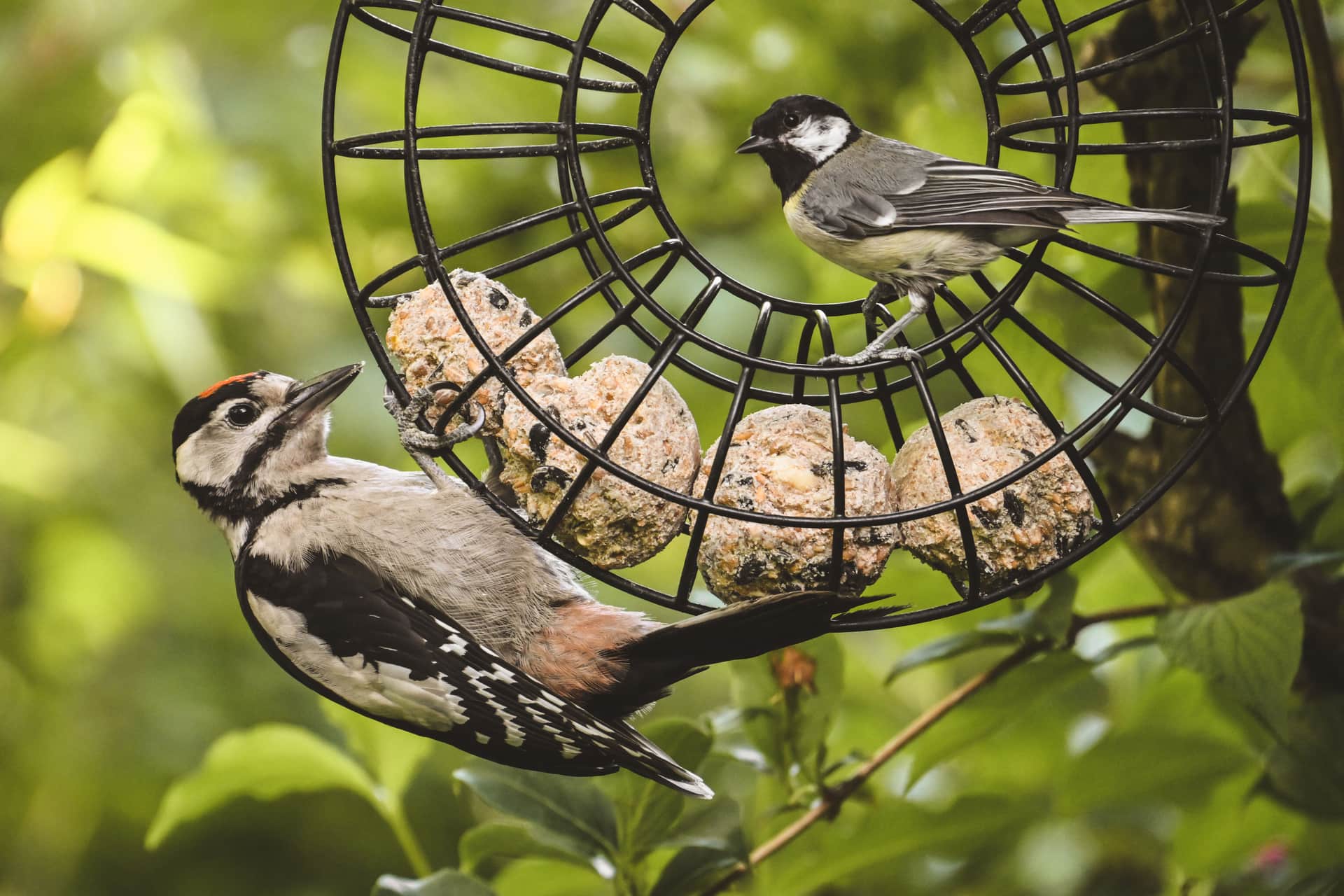
| Suet | Woodpeckers, nuthatches, chickadees | "Suet is a good choice for attracting insect-eating birds." |
| Milo | Mostly nothing, in the East | "Unfortunately, it is not a favorite of most birds, and the seed often goes to waste." Western birds take it more readily than eastern ones. |
Two practical consequences for a camera owner. The first is that cheap mixed birdseed is a bad buy for a feeder you are filming: it is padded with milo and cracked corn, and FeederWatch is blunt that milo mostly goes to waste. Birds sort through it and flick the rest onto the ground, so a meaningful share of the bag ends up out of frame.
The second is that a single-chamber feeder makes you choose one roster. Sunflower gets you the cardinals and chickadees at the top of the New York list; nyjer gets you goldfinches and siskins and very little else. That is the reason the FeatherSnap leads the picks on this page rather than on any other - two independent seed chambers is the only hardware feature in this category that directly addresses what this page is about, and the full review is honest about what it costs you elsewhere, including 1080p capture and identification locked behind the paid tier.
What the counts do not tell you
Three honest limits on the data above, because a page that quotes numbers should say where they stop.
- It is a winter survey. FeederWatch runs through the cold months, which is when feeder traffic peaks and when the roster is most stable. Summer looks different, and migration weeks look different again - a bird bath will show you passage warblers that a seed feeder never will, which is the argument in bird bath camera versus feeder camera.
- It counts participants' sites, not yards in general. FeederWatchers are people sufficiently interested to enroll in a survey, and their feeders are likely better sited and better maintained than average.
- "% of sites" is not abundance. A species reported at 90% of sites was seen at least once by nine feeders in ten. It does not follow that it is the bird you will film most often.
How to look up your own state
This is the genuinely useful thing to do before you buy a camera, and it takes about five minutes. FeederWatch publishes the Top 25 by state and province, and it also runs a Common Feeder Birds tool covering roughly a hundred species that filters by region, by food type and by feeder type - so you can work backwards from the birds you want to the seed and the feeder style that suit them.
Doing that before ordering answers two questions the product pages cannot. Whether the birds you are hoping to film are seed eaters at all - if your target is a woodpecker you are shopping for a suet arrangement, not a hopper. And whether you need the identification feature you are about to pay for, because if your local list is twenty-five species you already recognize, an unpriced subscription is buying you a label you do not need. The three-year cost guide has the arithmetic on that.
So what should you actually buy
Nothing on this page changes the ranking in the main roundup - it changes which of its criteria should matter to you.
If your local list is short and familiar, weight image quality and ignore the species claims entirely; the Birdbuddy publishes the only sensor dimension anyone states and that is the specification that decides a backlit photograph. If your list is long or includes the confusing groups - sparrows, western hummingbirds, female finches - identification is worth something to you, and then the question becomes what it costs, which is what the buying guide works through. And if what you actually want is more species rather than better pictures of the same ones, the answer is a second seed type, not a better sensor - the seed roundup sets out which seed brings which birds, cited to FeederWatch throughout.
Questions people actually ask
How many bird species will actually visit my feeder?
Roughly a couple of dozen over a season, and which ones depends heavily on where you live. Project FeederWatch's published Top 25 lists for New York, California and Arizona contain 55 distinct species between them and share only four: House Finch, Mourning Dove, House Sparrow and Dark-eyed Junco.
What is the most common feeder bird?
It depends on the state, which is the point. In New York's 2023-24 FeederWatch season the Blue Jay led at 93.70% of sites; in Arizona and California it was the House Finch, at 89.84% and 85.03%. Only a handful of species appear near the top everywhere.
Does a 10,000-species AI claim actually help?
Not for identifying your feeder birds - every app in this category handles a state top-25 list. It would matter for the genuinely hard calls, such as sparrows or similar female finches, and no maker publishes an accuracy figure for those.
What seed brings the most species?
Black-oil sunflower, which FeederWatch describes as the most common seed offered in North America and the preference of cardinals, chickadees, finches and sparrows. Nyjer is close to finch-only, and safflower is taken by cardinals while being largely ignored by squirrels and blackbirds.
Is cheap mixed birdseed worth it?
Not for a feeder you are filming. Bargain mixes are padded with milo, which FeederWatch says is not a favorite of most birds and often goes to waste - birds flick it out of the feeder, so a good share of the bag ends up on the ground rather than in frame.
Will a hawk show up at my feeder?
Possibly. A Cooper's Hawk was reported at roughly half of Arizona's FeederWatch sites in 2023-24, and it is at a feeder to hunt the birds there. Worth knowing before you set a camera up somewhere a child will watch it.
Where can I look up the birds in my own state?
Project FeederWatch publishes Top 25 lists by state and province, and a Common Feeder Birds tool covering about a hundred species that filters by region, food type and feeder type. Both are linked in the sources below.
Sources
- Project FeederWatch Top 25 Feeder Birds, New York, 2023-24 season (1,246 participants), Cornell Lab of Ornithology
- Project FeederWatch Top 25 Feeder Birds, Arizona, 2023-24 season (177 participants), Cornell Lab of Ornithology
- Project FeederWatch Top 25 Feeder Birds, California, 2023-24 season (728 participants), Cornell Lab of Ornithology
- Project FeederWatch: Feeding Birds - seed types and what they attract
- Project FeederWatch: Common Feeder Birds, filterable by region, food and feeder type
- Project FeederWatch, Cornell Lab of Ornithology
- ABA Checklist v8.19 (January 2026), American Birding Association
- IOC World Bird List v15.2 (13 April 2026), International Ornithologists' Union