Buying & Setup Guides
What to Buy With a Bird Feeder Camera
Half of these arrive with no way to attach them to anything. Here is what you will genuinely need in week one, what can wait, and what is a waste of money.
How this page is funded. Buying through a link here earns us a commission at no extra cost to you. It does not change what we recommend or the order we recommend it in, and we have not handled any of these products ourselves - see how we pick and the full disclosure.
There is a specific, predictable disappointment that happens about ten minutes after a feeder camera arrives. The box contains a feeder, a camera, a charging cable and a strap - and no pole. The tree you had in mind turns out to be forty feet from the router, or on the wrong side of the house, or the only branch at the right height puts the sun directly behind the bird.
None of that is a defect. It is just that a feeder camera is half a product until it is mounted somewhere sensible, and the listings do not make that obvious. This page is what to buy alongside it, in order of how much difference each one makes.
Before anything: check what is in the box
This varies more than you would expect and it changes what you need. Some models include a wall mount and a pole strap; some include a pole stand outright; several include a strap and nothing else. Two of the picks in the flagship roundup ship with mounting hardware and most do not.
So read the accessory list on your specific model before ordering anything below. Buying a pole you did not need is a cheap mistake; discovering on a Saturday morning that you cannot hang the thing is an annoying one.
1. A pole - the purchase that changes your photographs
This is the one that matters, and it matters for a reason that is not obvious: a pole is not really about height, it is about control. Hanging a feeder from an available branch means accepting whatever height, angle and background that branch happens to offer. A pole lets you choose all three.
Three things you get to control once the feeder is on a post rather than a tree:
- Height, which decides whether you are photographing birds or squirrels. Too low and every clip has a rodent in it; too high and the camera looks at the underside of everything.
- Aspect, which decides whether your birds are lit or silhouetted. A feeder facing into the morning sun produces backlit clips all week, and no camera in this category recovers from that.
- Distance from the router, which decides whether the thing works at all. Nearly everything here is 2.4GHz-only, and moving a feeder fifteen feet closer to the house fixes more 'battery problems' than people expect - a camera on a weak signal retries and burns power doing it. The Wi-Fi guide covers that properly.
Quick picks
Ranked on published specifications and what each one costs to own. Every pick names the buyer it is wrong for.
| # | Product | Best for | Price |
|---|---|---|---|
| 1 |  Adjustable Smart Feeder Pole, 32-92 inch 32 to 92 inches of adjustment and stated Birdbuddy compatibility. Being able to move the feeder up a foot in week two is worth more than any spec. | Height you can change after you have seen what happens | $25.99 - View on Amazon #ad Price checked October 17, 2026. How this is funded |
| 2 | 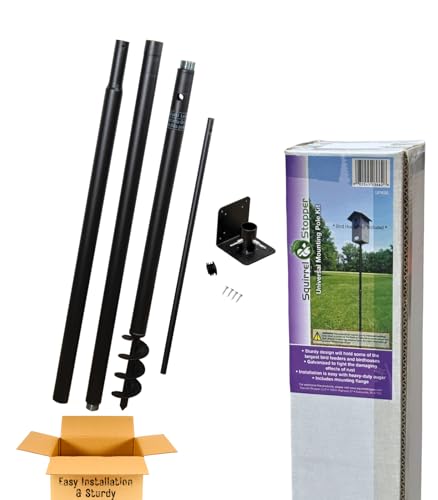 Squirrel Stopper Universal Mounting Pole Kit 55 inches of steel rated to 30 lb with threaded connections and top or side mounting. The only pole here that states what it can hold. | A published load rating, which almost nothing else has | $60.96 - View on Amazon #ad Price checked October 17, 2026. How this is funded |
| 3 |  AJEIDYK Pole Mount & Solar Adapter An adjustable 1-inch pole mount that carries the camera and its solar panel on the same bracket - Birdbuddy-specific, where the universal bracket it replaces fitted anything. | Pole-mounting a Birdbuddy and its solar panel together | $35.29 - View on Amazon #ad Price checked October 17, 2026. How this is funded |
| 4 |  XXL Seed Extender for Birdbuddy More seed capacity on the feeder whose capacity is its main practical complaint. | Cutting refills on a busy Birdbuddy | $28.99 - View on Amazon #ad Price checked October 17, 2026. How this is funded |
1. Height you can change after you have seen what happens
Adjustable Smart Feeder Pole, 32-92 inch
32 to 92 inches of adjustment and stated Birdbuddy compatibility. Being able to move the feeder up a foot in week two is worth more than any spec.
#ad Price checked October 17, 2026. How this is funded
Almost nobody gets feeder height right on the first attempt. Too low and you are photographing squirrels; too high and the camera looks at the underside of every bird. An adjustable pole lets you fix that in five minutes instead of buying a second pole.
The compatibility claim names Birdbuddy specifically, which is the mount most people need and the one most generic poles get wrong.
Load rating is not published, which on a pole holding a camera through a windy week is the number you would actually want. Check the poles and mounts roundup for the alternatives that do publish one.
| Height range | 32 to 92 inches, adjustableSource: Adjustable smart feeder pole - manufacturer listing on Amazon, retrieved 1 September 2026 |
|---|---|
| Compatibility | Stated compatible with Birdbuddy and a variety of smart birdhouse stylesSource: Adjustable smart feeder pole - manufacturer listing on Amazon, retrieved 1 September 2026 |
| Build | Heavy duty stand and mount kitSource: Adjustable smart feeder pole - manufacturer listing on Amazon, retrieved 1 September 2026 |
| Load rating | Not published |
| Pole diameter | Not published |
What it does well
- Wide 32-92 inch adjustment range
- Explicit Birdbuddy compatibility
- One purchase covers experimenting with placement
What it does not
- No published load rating
- No published pole diameter, which matters for baffle compatibility
- Generic branding with limited support
Skip this: if you need a load figure you can rely on. The Squirrel Stopper pole publishes 30 lb, which is the kind of number a heavy metal feeder deserves.
2. A published load rating, which almost nothing else has
Squirrel Stopper Universal Mounting Pole Kit
55 inches of steel rated to 30 lb with threaded connections and top or side mounting. The only pole here that states what it can hold.
#ad Price checked October 17, 2026. How this is funded
A 30 lb rating is enormous for this job and that is the point. A full metal feeder with a wet camera on top, taking a gust across an open lawn, puts more load on a pole than people expect - and a pole that flexes ruins every photograph it takes.
Threaded connections rather than friction-fit sections is the other quiet advantage. Friction joints work loose over a season; threads do not.
It is a fixed 55 inches, so decide your height before you dig. If you want to experiment, the adjustable pole is the trade.
| Load rating | Holds up to 30 lbThe only published load figure among the poles here.Source: Squirrel Stopper pole kit - manufacturer listing on Amazon, retrieved 1 September 2026 |
|---|---|
| Height | 55 inchesSource: Squirrel Stopper pole kit - manufacturer listing on Amazon, retrieved 1 September 2026 |
| Material | Heavy-duty steel, rust resistantSource: Squirrel Stopper pole kit - manufacturer listing on Amazon, retrieved 1 September 2026 |
| Mounting | Threaded connections, top or side mountSource: Squirrel Stopper pole kit - manufacturer listing on Amazon, retrieved 1 September 2026 |
| Adjustability | Not publishedFixed height rather than telescoping. |
What it does well
- Published 30 lb load rating - the only pole here that states one
- Threaded connections that will not work loose
- Top or side mounting suits feeders and boxes alike
- Rust-resistant steel
What it does not
- Fixed height, no adjustment after installation
- 55 inches is short if squirrels are jumping from a fence
- Heavier to install than a telescoping pole
Skip this: if you have not settled on a spot. Fixed height plus a driven base is a commitment, and an adjustable pole is the better first purchase.
3. Pole-mounting a Birdbuddy and its solar panel together
AJEIDYK Pole Mount & Solar Adapter
An adjustable 1-inch pole mount that carries the camera and its solar panel on the same bracket - Birdbuddy-specific, where the universal bracket it replaces fitted anything.
#ad Price checked October 17, 2026. How this is funded
Aim is the specification nobody thinks about until the feeder is up. The only place you can mount it faces east; the light is behind the bird all morning; every photograph is a silhouette. A rotating bracket separates where the feeder can go from where the camera has to look.
It also carries the solar panel, which is the other half of the same problem: the best place for the feeder and the best place for the panel are rarely the same place. Note what changed here, though - the universal bracket this replaced is discontinued, and this one is sold for Birdbuddy specifically. If you own something else, check the fit before ordering rather than assuming.
No load rating published, so pair it with judgment about what you are hanging.
| Compatibility | Birdbuddy camera and solar panelThe bracket this replaces was sold as universal. This one names one brand, which is a real narrowing and the reason the entry was renamed.Source: AJEIDYK pole mount adapter - manufacturer listing on Amazon, retrieved 1 September 2026 |
|---|---|
| Mounting | Adjustable 1-inch pole bracketsSource: AJEIDYK pole mount adapter - manufacturer listing on Amazon, retrieved 1 September 2026 |
| Solar | Carries the solar panel on the same mountSource: AJEIDYK pole mount adapter - manufacturer listing on Amazon, retrieved 1 September 2026 |
| Rotation | Not publishedThe bracket this replaces published 180 degrees. This listing says "adjustable" without a figure. |
| Surfaces | Not publishedPole only, as published. The previous bracket also claimed tree and wall. |
| Weather rating | Not published |
| Load rating | Not published |
What it does well
- Carries the camera and its solar panel on one bracket
- Adjustable, so mounting position does not fix camera aim
- Cheap relative to the camera it is holding up
What it does not
- Birdbuddy-specific, where the bracket it replaces was universal
- Pole only - no published tree or wall mounting
- No published rotation figure, weather rating or load rating
- One more joint to work loose over a season
Skip this: if you do not own a Birdbuddy, or if your feeder already faces the right way. It solves one specific problem on one brand, and otherwise it is a bracket in a drawer.
4. Cutting refills on a busy Birdbuddy
XXL Seed Extender for Birdbuddy
More seed capacity on the feeder whose capacity is its main practical complaint.
#ad Price checked October 17, 2026. How this is funded
Birdbuddy does not publish its seed capacity, and in practice a busy feeder in cold weather is the thing owners refill most often. An extender is the cheapest fix.
Transparent is the right choice: you can see the level from a window instead of walking out to check.
Note that the added volume is not published, so 'XXL' is a marketing size rather than a measurement.
| Compatibility | Birdbuddy smart feederSource: XXL seed extender - manufacturer listing on Amazon, retrieved 1 September 2026 |
|---|---|
| Finish | Transparent with an orange roofSource: XXL seed extender - manufacturer listing on Amazon, retrieved 1 September 2026 |
| Added capacity | Not publishedDescribed as XXL without a stated volume. |
What it does well
- Directly addresses the most common Birdbuddy complaint
- Transparent, so the level is visible from indoors
- Cheap relative to the feeder
What it does not
- Added capacity is not published
- A third-party accessory on a first-party feeder
- More seed sitting outdoors means more chance of it going damp
Skip this: if your feeder is somewhere wet. A bigger hopper means seed sitting longer, and damp seed is worse than an empty feeder.
Adjustable or fixed? The honest answer for a first pole
Buy adjustable for your first pole. Almost nobody gets feeder height right on the first attempt, and being able to raise it a foot in week two - after you have seen what actually turns up and what the light does - is worth more than any specification on a fixed pole.
Fixed steel poles win on rigidity, and rigidity is not a trivial concern: a pole that flexes in wind ruins every clip it takes, and a heavy metal feeder with a wet camera on top in a gust puts more load on a post than people assume. The one fixed pole among the picks above publishes a 30 lb load rating, which is the only load figure anyone here states - and a published number is worth paying attention to on a component whose whole job is not moving.
So: adjustable first, fixed later once you know where the feeder is going to live. The poles and mounts roundup ranks the options in more detail.
2. A rotating bracket, if your mounting spot is fixed
This solves one specific and very common problem: the only place you can put the feeder faces the wrong way.
A rotating mount separates where the feeder can physically go from where the camera has to look, which means a wall, a tree or an existing post stops dictating your composition. The bracket in the picks above rotates 180 degrees and also takes a solar panel - useful, because the best place for the feeder and the best place for a panel are rarely the same place.
Skip it if your feeder already faces somewhere sensible. It solves one problem well and is a bracket in a drawer if you do not have that problem.
3. Seed, which is a bigger lever than any accessory
Nobody thinks of seed as an accessory purchase, and it is the one that most changes what appears on camera. Seed type is the main control an ordinary person has over which species visit.
| Seed | Who it brings | Worth knowing |
|---|---|---|
| Black oil sunflower | Cardinals, chickadees, titmice, house finches, nuthatches | The general-purpose choice, and the right first bag. |
| Nyjer (thistle) | Goldfinches, pine siskins | Close to species-specific. Almost nothing else touches it. |
| Safflower | Cardinals, some finches | Largely ignored by grackles, starlings and squirrels, which is why experienced feeder-watchers use it. |
| Mixed 'wild bird' seed | Fewer species than the bag implies | Usually padded with milo and cracked corn that most feeder birds discard - it ends up on the ground, not on camera. |
| Suet | Woodpeckers, nuthatches, wrens | Cold-weather food. It melts and goes rancid in heat. |
The practical version: start with black oil sunflower, and if grackles or squirrels dominate your footage, switch to safflower before you buy any hardware to fight them. It is the cheapest fix available and it works on the eating problem rather than the chewing problem - a distinction the squirrel-proof roundup spends a page on.
4. A seed extender, but only for a busy feeder
Capacity is the underrated specification in this category. A busy feeder in a cold week empties fast, and a camera pointed at an empty tray photographs nothing. If you are refilling every couple of days in January, an extender is the cheapest fix - and a transparent one lets you check the level from a window instead of walking out to look.
The caveat is real though: a bigger hopper means seed sitting outdoors longer, and damp seed is worse than an empty feeder. If your feeder is somewhere wet, buy a smaller refill habit instead of a bigger hopper.
What we would not bother with
A second camera, immediately. The usual instinct after a good first month is to add a hummingbird or nest box camera. Wait a season. Both are seasonal products - nest boxes in particular film an empty box for most of the year - and the right time to buy either is dictated by the calendar rather than by enthusiasm.
A subscription you have not costed. The plan is frequently the largest line item in owning one of these, and several makers do not publish what theirs costs. Work through the three-year arithmetic before you agree to anything recurring, and know that some models in the no-subscription roundup avoid the question entirely.
A baffle, before you have a squirrel problem. Squirrel defense is worth buying when you have observed the specific failure - chewing is one problem, sitting on the tray and eating is a different one, and the right response depends on which you actually have.
The week-one shopping list
- An adjustable pole, unless your feeder shipped with a mount and you already have the right spot.
- A bag of black oil sunflower.
- A rotating bracket, only if the mounting position is fixed and faces the wrong way.
- Nothing else until you have watched a month of footage and know what your actual problem is.
That last line is the point of the page. Almost every accessory in this category solves a specific problem, and you do not know which problems you have until the feeder has been up for a few weeks. The setup guide covers getting through those first weeks without the mistakes that make them longer. And since seed is the biggest lever on this list, the seed roundup now ranks the options for a small hopper and a close lens. Suet is the one addition that changes which species turn up rather than how many - though it needs a holder or a second cage, because camera feeders do not take it.
One purchase that replaces most of this list
If the feeder you already own is working - right height, right seed, birds using it - the cheapest useful upgrade may be a camera rather than a camera feeder. Cameras you add to a feeder you already own cost a fraction of a camera feeder, clamp to the station the birds already trust, and leave your mount, your seed and your refill habit exactly as they are.
The one thing to check before any of this, accessory or camera: do bird feeder cameras need Wi-Fi? Every one of them does, permanently and not just at setup, and the far end of a long garden defeats more of these purchases than any accessory on this page fixes.
Questions people actually ask
Do bird feeder cameras come with a pole?
Usually not. Most ship with a strap and a wall mount at best, and several include nothing at all. Check the accessory list for your specific model before ordering - a couple do include a pole stand.
What is the most useful accessory for a bird feeder camera?
A pole, and not because of height. A pole lets you control height, which way the feeder faces, and how far it is from the router - which between them decide whether your clips are of birds, of squirrels, or of nothing because the camera cannot hold a signal.
Should I buy an adjustable or fixed pole?
Adjustable for a first pole. Nobody gets the height right initially, and being able to change it in week two is worth more than the extra rigidity of a fixed post. Fixed steel is the better long-term answer once you know the spot.
What seed should I use in a smart bird feeder?
Black oil sunflower to start - it brings the widest range of common feeder birds. Switch to safflower if grackles, starlings or squirrels dominate your footage; they largely ignore it and cardinals do not.
Is cheap mixed birdseed a false economy?
Generally yes. Bargain mixes are padded with milo and cracked corn that most feeder birds discard, so a good proportion of the bag ends up on the ground rather than in front of the camera.
Do I need a bigger seed hopper?
Only if you are refilling every couple of days. An extender is a cheap fix for a busy feeder, but a bigger hopper means seed sitting outdoors longer - and damp seed is worse than an empty feeder.
Sources
- Adjustable smart feeder pole - manufacturer listing on Amazon, retrieved 1 September 2026
- Squirrel Stopper universal mounting pole kit - manufacturer listing on Amazon, retrieved 1 September 2026
- AJEIDYK pole mount adapter - manufacturer listing on Amazon, retrieved 1 September 2026
- Project FeederWatch, Cornell Lab of Ornithology
- Audubon: how to feed birds and keep feeders clean