Smart Bird House Cameras
What a Nest Box Camera Actually Shows You
The best footage in this whole category, and the shortest season. Here is the honest calendar - including the parts the product listings leave out.
How this page is funded. Buying through a link here earns us a commission at no extra cost to you. It does not change what we recommend or the order we recommend it in, and we have not handled any of these products ourselves - see how we pick and the full disclosure.
Nest box cameras produce the best footage anything on this site is capable of, and they are the product most likely to disappoint the person who buys one. Both of those statements are true at once, and the gap between them is entirely about expectations.
So this page is a calendar rather than a review. What follows is what a nest box camera films, in what order, and for how long - and what it films for the rest of the year, which is nothing at all.
First, the number that matters
A nest box is occupied for roughly four to six weeks per brood, during a breeding season that runs approximately March to July across most of the United States. A newly installed box is frequently ignored in its first season entirely.
That is the whole product. It is not a fault, it is biology, and no camera specification changes it. If you buy one in April expecting footage in May, the most likely outcome is an empty box - not because the camera failed but because the birds decided where to nest before your box existed. The installation timing guide is the fix for that, and it is worth reading before you order rather than after.
Quick picks
Ranked on published specifications and what each one costs to own. Every pick names the buyer it is wrong for.
| # | Product | Best for | Price |
|---|---|---|---|
| 1 | 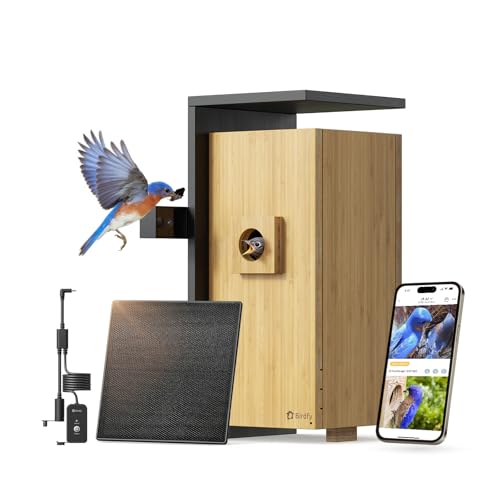 Netvue Birdfy Nest (dual-cam) Two 1080p cameras - one in the nest chamber, one on the entrance - with a 60 degree adjustable angle and identification paid for up front. This is the whole nesting season. | Inside the box and outside it, at once | $279.99 - View on Amazon #ad Price checked October 17, 2026. How this is funded |
| 2 |  4MP Color Night Vision Bird House 4MP with full-color night vision rather than infrared gray, plus a published IP66 rating - a real difference on a subject that is only ever in the dark. | Color at night inside the box | $69.00 - View on Amazon #ad Price checked October 17, 2026. How this is funded |
| 3 |  Birdfy Smart Bird House (Lifetime AI) Auto-records the nesting stages and flags them, with lifetime AI and a remote control so you never have to open the box. | Nesting-stage alerts, paid once | $239.99 - View on Amazon #ad Price checked October 17, 2026. How this is funded |
1. Inside the box and outside it, at once
Netvue Birdfy Nest (dual-cam)
Two 1080p cameras - one in the nest chamber, one on the entrance - with a 60 degree adjustable angle and identification paid for up front. This is the whole nesting season.
#ad Price checked October 17, 2026. How this is funded
A nest box camera is a completely different proposition to a feeder camera and it is worth understanding before you buy. A feeder gives you a hundred short visits a day. A nest box gives you nothing for weeks, then one continuous story - building, laying, hatching, fledging - that runs for about six weeks and does not repeat until next year. See what you actually see in a nest box.
The second camera is the whole product. The interior lens gives you the nest itself; the entrance lens gives you the arrivals, the fledging morning and - the part nobody warns you about - any competitor trying to take the box. One camera gives you half the story.
What is not published is the entrance hole diameter, and that is the specification that decides everything. Hole size is what selects your tenant - and gets it wrong. Hole size by species has the numbers; measure the box when it arrives.
| Cameras | Two: one inside the chamber, one facing the entranceSource: Birdfy Nest dual-cam - manufacturer listing on Amazon, retrieved 1 September 2026 |
|---|---|
| Video resolution | Dual 1080PSource: Birdfy Nest dual-cam - manufacturer listing on Amazon, retrieved 1 September 2026 |
| AI identification | Lifetime free AI bird ID stated on the listingBirdfy moved this line onto lifetime identification; it was previously sold with an optional recurring plan.Source: Birdfy Nest dual-cam - manufacturer listing on Amazon, retrieved 1 September 2026 |
| Camera angle | 60 degrees adjustable on bothSource: Birdfy Nest dual-cam - manufacturer listing on Amazon, retrieved 1 September 2026 |
| Audio | Built-inSource: Birdfy Nest dual-cam - manufacturer listing on Amazon, retrieved 1 September 2026 |
| Night vision | Not publishedNot stated on the current listing. |
| Solar | Not publishedNot stated on the current listing. |
| Entrance hole diameter | Not publishedThis is the specification that decides which species can use the box. |
| Battery capacity | Not published |
What it does well
- Two cameras cover the chamber and the entrance simultaneously
- Lifetime AI identification stated on the listing - nothing recurring
- Built-in audio - nestlings are far louder than people expect
- 60 degree adjustable angle on both cameras
What it does not
- Entrance hole diameter is not published, and it decides which species can nest
- 1080p on both cameras, with no higher option
- Night vision and solar are not stated on the current listing
- A nest box is empty most of the year
Skip this: if you want something to watch year-round. A nest box is spectacular for six weeks and inert for the other forty-six; a feeder camera is the opposite trade.
2. Color at night inside the box
4MP Color Night Vision Bird House
4MP with full-color night vision rather than infrared gray, plus a published IP66 rating - a real difference on a subject that is only ever in the dark.
#ad Price checked October 17, 2026. How this is funded
Full-color night vision inside a nest chamber is a bigger deal than the same feature outdoors. The interior of a box is dark essentially all the time, so an infrared camera renders the entire nesting season in gray. Color shows you egg markings and nestling plumage as they develop.
4MP is modest against a feeder camera, and it matters far less here: a nest box camera sits four inches from its subject, in a fixed frame, with lighting it provides itself. The more interesting number is the IP66 rating, which is published on this listing and on neither of the branded boxes above.
The trade is the brand. This is a generic listing rather than an established camera maker, and these are app-dependent devices where company continuity is part of what you are buying. It is on this page because a category with one serious supplier is worse for buyers than one with two. Single camera, so you get the chamber or the entrance, not both - the Birdfy dual-cam is the answer to that.
What it does well
- Full-color night vision, unusual on an interior nest camera
- Published IP66 rating - the only weather figure among the nest boxes here
- 4MP at four inches is more than adequate
- The cheapest way into a nest box camera on this site
What it does not
- One camera, so no entrance view
- A generic listing with no brand track record behind the app
- No published hole diameter, battery or Wi-Fi band
- AI recognition is claimed without any stated scope
Skip this: if you want the entrance activity as well as the chamber, or if you would rather buy from a maker whose record you can check. Half the nesting story happens at the hole, and the dual-camera Birdfy covers both.
3. Nesting-stage alerts, paid once
Birdfy Smart Bird House (Lifetime AI)
Auto-records the nesting stages and flags them, with lifetime AI and a remote control so you never have to open the box.
#ad Price checked October 17, 2026. How this is funded
Nesting-stage detection is the one AI feature in this whole category that is unambiguously worth having. You cannot watch a nest box continuously for six weeks, and the moments that matter - first egg, hatch day, fledging - last minutes. A system that flags them is the difference between seeing the season and missing it.
The remote control deserves more credit than it gets. Opening an occupied nest box can cause abandonment. Being able to change a setting from ten feet away means you never have to weigh a settings change against the birds.
Hole diameter is still unpublished. Same caveat as every box in this category: measure it, then read hole size by species.
| AI | Lifetime AI identification stated on the listingSource: Birdfy Bird House lifetime AI - manufacturer listing on Amazon, retrieved 1 September 2026 |
|---|---|
| Recording | Auto-records nesting stages with alertsSource: Birdfy Bird House lifetime AI - manufacturer listing on Amazon, retrieved 1 September 2026 |
| Night vision | YesSource: Birdfy Bird House lifetime AI - manufacturer listing on Amazon, retrieved 1 September 2026 |
| Power | Battery and solarSource: Birdfy Bird House lifetime AI - manufacturer listing on Amazon, retrieved 1 September 2026 |
| Control | Remote control, so the box is not openedSource: Birdfy Bird House lifetime AI - manufacturer listing on Amazon, retrieved 1 September 2026 |
| Entrance hole diameter | Not published |
| Battery capacity | Not published |
What it does well
- Nesting-stage alerts - the most genuinely useful AI feature in this category
- Remote control means the box never has to be opened once occupied
- Lifetime AI with no subscription
- Battery and solar
What it does not
- Entrance hole diameter not published
- No published battery capacity
- Nesting-stage detection is only exercised for a few weeks a year
Skip this: if you have not yet worked out which species you are trying to attract. Install timing and hole size decide whether anything moves in at all, and no camera compensates for an empty box.
The season, week by week
Prospecting - late winter into early spring
The first thing you film is not nesting. It is inspection: a bird landing at the hole, putting its head in, leaving. Sometimes several different birds over several weeks, sometimes several species. This is the stage most people miss because they installed the box too late for it to happen.
It is also when you find out whether you have a competition problem. Prospecting is contested, and an entrance camera will show you a house sparrow returning repeatedly to a box you meant for chickadees.
Nest building - roughly one to two weeks
Genuinely good footage, and the most consistently active period you will get. Material arrives beakful by beakful - moss, grass, hair, plant down - and the nest cup takes shape from a flat scatter into a deep, deliberately shaped structure. Watching a chickadee line a cup is the sort of thing people who bought these cameras for the eggs end up rewatching.
Laying and incubation - roughly two weeks
The quietest and most misleading stretch. Eggs appear, typically one a day. Then the female sits, and largely keeps sitting, for around a fortnight.
Expect very little to happen and expect to worry about it. This is the phase where owners conclude the box has been abandoned, because from the inside an incubating bird is a motionless shape on a nest. It is also the phase where an infrared camera hurts most: eggs in monochrome are gray ovals, and their markings - often the clearest way to tell whose they are - are invisible. This is the strongest argument for a color night vision model.
Hatching and nestlings - roughly two to three weeks
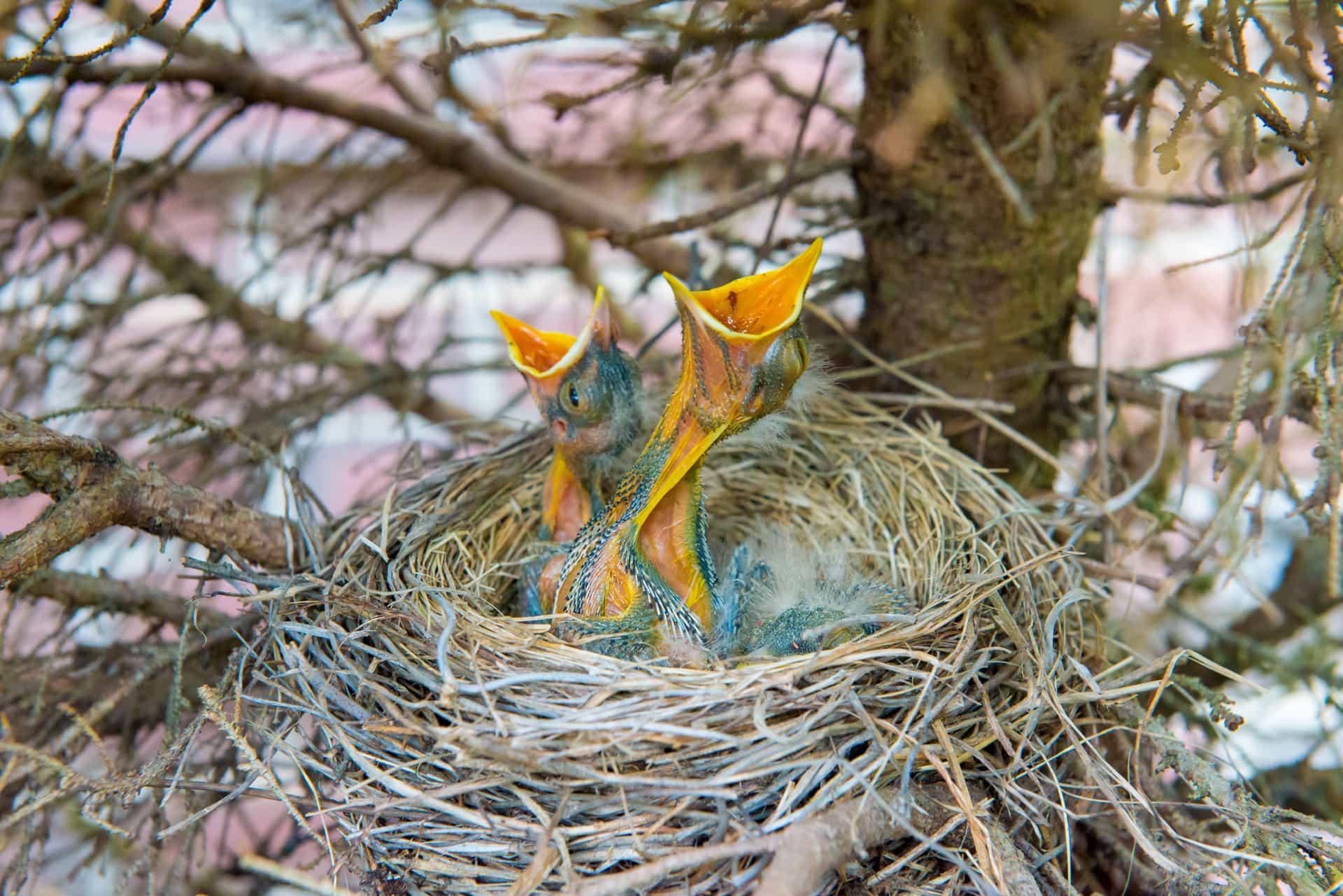
This is the part the camera was bought for, and it delivers. Nestlings hatch blind and almost featherless, and the change day to day is dramatic in a way you cannot see from outside a box: eyes open, pin feathers push through, plumage comes in, and a heap of pink becomes a crowded box of recognizable birds.
Feeding visits run constantly through daylight, which is also when your storage and your battery take the strain. A busy brood generates a great deal of triggered video, and if you are on a limited cloud plan this is the fortnight that fills it.
Fledging - one morning
And then it ends, usually faster than people expect. The young leave, often within a short window on a single morning, and the box is empty. If your camera is inside only, you get the departure from behind; the entrance view is what shows you the actual first flight.
Some species will raise a second brood in the same season, which is the best outcome available and not something you can rely on.
The part the listings never mention
Nesting does not always succeed. Boxes get raided by predators, broods fail in bad weather, eggs do not hatch, and non-native competitors sometimes take a box violently.
A camera does not cause any of that, but it does mean you watch it. Anyone buying a nest box camera for a child should know that in advance - it is a real possibility rather than a remote one, and it is the single thing about this category that product marketing never says out loud. It is also, for what it is worth, the reason predator guards are standard advice: NestWatch recommends cone or stovepipe baffles precisely because boxes are less concealed than natural cavities and some predators learn to raid them.
Interior or entrance: what each one gives you
| Stage | Interior camera | Entrance camera |
|---|---|---|
| Prospecting | Head appearing at the hole | The full story, including competitors |
| Nest building | Excellent - the cup taking shape | Material arriving |
| Laying and incubation | Eggs, and a sitting bird | Very little |
| Nestlings | Excellent - the daily change | Feeding arrivals and departures |
| Fledging | The box emptying | The actual first flight |
| Predation or competition | The aftermath | The attempt, which is what you want to see |
The honest summary of that table: the interior gives you more of the season, the entrance gives you the two or three most dramatic moments in it. The dual-camera Birdfy Nest covers both and is the reason it tops the roundup.
Two practical things the nestling weeks do to your setup
Storage. Feeding visits during the nestling stage run through every daylight hour, and a motion-triggered camera four inches from the action records almost all of them. This is the fortnight that fills a cloud allowance or an SD card, and it happens to be the fortnight you least want to lose. Check what your plan actually holds before the hatch rather than during it - the subscription cost guide covers how those tiers are usually structured.
Power. The same burst of activity is the heaviest demand the battery sees all year, and you cannot open the box to charge anything without risking the brood. Whatever state the camera is in when the eggs hatch is what it has to finish the season on. If your model is solar, this is also when a shaded box shows the difference; if it is not, charge it fully during prospecting and then leave it alone.
What happens at the end, and what to do about it
Some species raise a second brood in the same box in the same season. If that is going to happen it usually happens quickly, so leave the box alone for a few weeks after fledging rather than clearing it out the same afternoon.
Once the season is genuinely over, the used nest gets removed - old material holds parasites - and that visit is the one at which you also check the drainage holes, the predator guard and the camera's charge and signal. Do it in autumn, then do not touch the box again until the following autumn.
What you film for the other forty-six weeks
An empty box. That is the answer, and pretending otherwise is how this category generates disappointed buyers.
If you want a camera that produces something most days of the year, a feeder is that product - it peaks in winter, which is exactly when the nest box is dormant. Many people end up with both for precisely this reason, and the two seasons dovetail almost perfectly. The flagship feeder roundup is where that starts.
There is a cheaper way to find out whether the six weeks are worth it to you. If a birdhouse is already standing in the garden, a camera module that fits inside it costs a fraction of a new smart box - the WIWACAM review covers the one to buy, and the retrofit roundup ranks it against the solar alternative. The footage is identical, because it is the same cavity.
Questions people actually ask
How long do birds use a nest box?
Roughly four to six weeks per brood, in a season running approximately March to July across most of the US. Some species raise a second brood. The rest of the year the box is empty.
Will birds definitely use my nest box?
No. A newly installed box is frequently ignored in its first season, particularly if it went up after birds had already chosen nest sites. Installing in autumn or winter substantially improves the odds.
What is the best part of the season to film?
The nestling stage - roughly two to three weeks in which blind, featherless young become recognizable birds. The daily change is dramatic and it is invisible from outside the box.
Why does nothing happen during incubation?
Because incubation is a bird sitting still for about a fortnight. It is the phase where owners wrongly conclude the box has been abandoned. It is normal and it passes.
Do I need a camera on the entrance as well as inside?
Not strictly, but the entrance is where the two most dramatic moments happen - fledging and any competition for the box. The interior camera covers more of the season; the entrance camera covers the highlights.
Can nesting fail on camera?
Yes, and it is a real possibility rather than a remote one - predation, weather, unhatched eggs, or eviction by a non-native competitor. Worth knowing before you buy one for a child.