Smart Bird House Cameras
When to Install a Nest Box
The most common reason a nest box camera films nothing all year is not the camera. It is that the box went up after the birds had already decided where to nest.
How this page is funded. Buying through a link here earns us a commission at no extra cost to you. It does not change what we recommend or the order we recommend it in, and we have not handled any of these products ourselves - see how we pick and the full disclosure.
Here is the mistake, and it is the commonest one in this hub. Somebody buys a nest box camera in spring, because spring is when you think about birds nesting. They install it in April. Nothing uses it, all year. They conclude the product does not work.
The product worked fine. The timing did not. By April the birds in your garden have already inspected the available cavities and decided where they are nesting, and a box that appeared last week was not on the list.
The dates, from the people who monitor nests for a living
NestWatch, the nest-monitoring project run by the Cornell Lab of Ornithology, gives two deadlines: in the south, place your nest boxes by February, and in northern regions, place your nest boxes by mid to late March.
Those are deadlines rather than targets. Earlier is better, and the reason is straightforward: the longer a box has been standing, the more chance it has been found, inspected and mentally filed as an option before the decision gets made.
Which is why fall is the real answer
If you can, put the box up in autumn - before the ground freezes if you are digging a post in, and months before anything starts prospecting. A box that has weathered a winter also smells less like a new object and looks more like part of the landscape.
For a camera specifically, an autumn install has a second advantage that nobody mentions: it gives you a full off-season to find out that the Wi-Fi does not reach, the mount is loose, the app will not pair, or the battery drains faster than you expected. Discovering any of that in March means fixing it during the exact weeks when opening the box would drive off a prospecting bird. The Wi-Fi requirements guide is the one to work through while it still costs you nothing.
Quick picks
Ranked on published specifications and what each one costs to own. Every pick names the buyer it is wrong for.
| # | Product | Best for | Price |
|---|---|---|---|
| 1 | 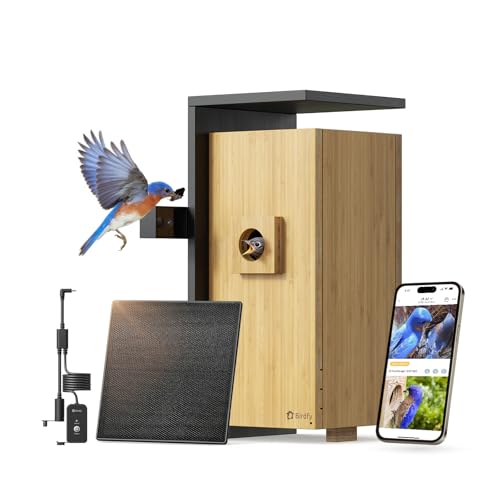 Netvue Birdfy Nest (dual-cam) Two 1080p cameras - one in the nest chamber, one on the entrance - with a 60 degree adjustable angle and identification paid for up front. This is the whole nesting season. | Inside the box and outside it, at once | $279.99 - View on Amazon #ad Price checked October 17, 2026. How this is funded |
| 2 |  Birdfy Smart Bird House (Lifetime AI) Auto-records the nesting stages and flags them, with lifetime AI and a remote control so you never have to open the box. | Nesting-stage alerts, paid once | $239.99 - View on Amazon #ad Price checked October 17, 2026. How this is funded |
| 3 |  4MP Color Night Vision Bird House 4MP with full-color night vision rather than infrared gray, plus a published IP66 rating - a real difference on a subject that is only ever in the dark. | Color at night inside the box | $69.00 - View on Amazon #ad Price checked October 17, 2026. How this is funded |
1. Inside the box and outside it, at once
Netvue Birdfy Nest (dual-cam)
Two 1080p cameras - one in the nest chamber, one on the entrance - with a 60 degree adjustable angle and identification paid for up front. This is the whole nesting season.
#ad Price checked October 17, 2026. How this is funded
A nest box camera is a completely different proposition to a feeder camera and it is worth understanding before you buy. A feeder gives you a hundred short visits a day. A nest box gives you nothing for weeks, then one continuous story - building, laying, hatching, fledging - that runs for about six weeks and does not repeat until next year. See what you actually see in a nest box.
The second camera is the whole product. The interior lens gives you the nest itself; the entrance lens gives you the arrivals, the fledging morning and - the part nobody warns you about - any competitor trying to take the box. One camera gives you half the story.
What is not published is the entrance hole diameter, and that is the specification that decides everything. Hole size is what selects your tenant - and gets it wrong. Hole size by species has the numbers; measure the box when it arrives.
| Cameras | Two: one inside the chamber, one facing the entranceSource: Birdfy Nest dual-cam - manufacturer listing on Amazon, retrieved 1 September 2026 |
|---|---|
| Video resolution | Dual 1080PSource: Birdfy Nest dual-cam - manufacturer listing on Amazon, retrieved 1 September 2026 |
| AI identification | Lifetime free AI bird ID stated on the listingBirdfy moved this line onto lifetime identification; it was previously sold with an optional recurring plan.Source: Birdfy Nest dual-cam - manufacturer listing on Amazon, retrieved 1 September 2026 |
| Camera angle | 60 degrees adjustable on bothSource: Birdfy Nest dual-cam - manufacturer listing on Amazon, retrieved 1 September 2026 |
| Audio | Built-inSource: Birdfy Nest dual-cam - manufacturer listing on Amazon, retrieved 1 September 2026 |
| Night vision | Not publishedNot stated on the current listing. |
| Solar | Not publishedNot stated on the current listing. |
| Entrance hole diameter | Not publishedThis is the specification that decides which species can use the box. |
| Battery capacity | Not published |
What it does well
- Two cameras cover the chamber and the entrance simultaneously
- Lifetime AI identification stated on the listing - nothing recurring
- Built-in audio - nestlings are far louder than people expect
- 60 degree adjustable angle on both cameras
What it does not
- Entrance hole diameter is not published, and it decides which species can nest
- 1080p on both cameras, with no higher option
- Night vision and solar are not stated on the current listing
- A nest box is empty most of the year
Skip this: if you want something to watch year-round. A nest box is spectacular for six weeks and inert for the other forty-six; a feeder camera is the opposite trade.
2. Nesting-stage alerts, paid once
Birdfy Smart Bird House (Lifetime AI)
Auto-records the nesting stages and flags them, with lifetime AI and a remote control so you never have to open the box.
#ad Price checked October 17, 2026. How this is funded
Nesting-stage detection is the one AI feature in this whole category that is unambiguously worth having. You cannot watch a nest box continuously for six weeks, and the moments that matter - first egg, hatch day, fledging - last minutes. A system that flags them is the difference between seeing the season and missing it.
The remote control deserves more credit than it gets. Opening an occupied nest box can cause abandonment. Being able to change a setting from ten feet away means you never have to weigh a settings change against the birds.
Hole diameter is still unpublished. Same caveat as every box in this category: measure it, then read hole size by species.
| AI | Lifetime AI identification stated on the listingSource: Birdfy Bird House lifetime AI - manufacturer listing on Amazon, retrieved 1 September 2026 |
|---|---|
| Recording | Auto-records nesting stages with alertsSource: Birdfy Bird House lifetime AI - manufacturer listing on Amazon, retrieved 1 September 2026 |
| Night vision | YesSource: Birdfy Bird House lifetime AI - manufacturer listing on Amazon, retrieved 1 September 2026 |
| Power | Battery and solarSource: Birdfy Bird House lifetime AI - manufacturer listing on Amazon, retrieved 1 September 2026 |
| Control | Remote control, so the box is not openedSource: Birdfy Bird House lifetime AI - manufacturer listing on Amazon, retrieved 1 September 2026 |
| Entrance hole diameter | Not published |
| Battery capacity | Not published |
What it does well
- Nesting-stage alerts - the most genuinely useful AI feature in this category
- Remote control means the box never has to be opened once occupied
- Lifetime AI with no subscription
- Battery and solar
What it does not
- Entrance hole diameter not published
- No published battery capacity
- Nesting-stage detection is only exercised for a few weeks a year
Skip this: if you have not yet worked out which species you are trying to attract. Install timing and hole size decide whether anything moves in at all, and no camera compensates for an empty box.
3. Color at night inside the box
4MP Color Night Vision Bird House
4MP with full-color night vision rather than infrared gray, plus a published IP66 rating - a real difference on a subject that is only ever in the dark.
#ad Price checked October 17, 2026. How this is funded
Full-color night vision inside a nest chamber is a bigger deal than the same feature outdoors. The interior of a box is dark essentially all the time, so an infrared camera renders the entire nesting season in gray. Color shows you egg markings and nestling plumage as they develop.
4MP is modest against a feeder camera, and it matters far less here: a nest box camera sits four inches from its subject, in a fixed frame, with lighting it provides itself. The more interesting number is the IP66 rating, which is published on this listing and on neither of the branded boxes above.
The trade is the brand. This is a generic listing rather than an established camera maker, and these are app-dependent devices where company continuity is part of what you are buying. It is on this page because a category with one serious supplier is worse for buyers than one with two. Single camera, so you get the chamber or the entrance, not both - the Birdfy dual-cam is the answer to that.
What it does well
- Full-color night vision, unusual on an interior nest camera
- Published IP66 rating - the only weather figure among the nest boxes here
- 4MP at four inches is more than adequate
- The cheapest way into a nest box camera on this site
What it does not
- One camera, so no entrance view
- A generic listing with no brand track record behind the app
- No published hole diameter, battery or Wi-Fi band
- AI recognition is claimed without any stated scope
Skip this: if you want the entrance activity as well as the chamber, or if you would rather buy from a maker whose record you can check. Half the nesting story happens at the hole, and the dual-camera Birdfy covers both.
What to get right while the box is still empty
Everything below is easy in November and impossible in May, because once a bird is prospecting or nesting, opening the box risks the brood.
The off-season checklist
- 1
Check the entrance hole diameter
Measure it. The hole decides which species can use the box and which competitors can take it - NestWatch notes European Starlings need at least 9/16" and House Sparrows need 1 1/4", so a smaller hole excludes them. If your box did not publish a size, this is when you find out what you bought. The hole size guide has the figures by species.
- 2
Confirm ventilation and drainage
NestWatch specifies two 5/8" ventilation holes on each side wall near the top - four in total - and at least four drainage holes of 3/8" to 1/2" in the floor. A box without them cooks or floods, and adding them is a five-minute job with a drill in the off-season.
- 3
Remove any perch
NestWatch is direct about this: a perch is unnecessary for the birds and can actually help predators gain access to the box. If yours has a decorative dowel under the hole, take it off.
- 4
Fit a predator guard
Boxes are less concealed than natural cavities and some predators learn to raid them. NestWatch recommends cone baffles of roughly three feet in diameter, stovepipe baffles eight inches across and 24 to 36 inches long, or a Noel guard at the entrance.
- 5
Set the height and the aspect
Mounting height varies by species - roughly three to six feet for Eastern Bluebirds, far higher for kestrels and screech-owls. Aspect matters too: for chickadees, face the hole away from the prevailing wind.
- 6
Prove the camera end of it
Pair the camera, check the signal at the actual mounting point rather than at the back door, and confirm the charge behavior over a few weeks of short winter days. Whatever state it is in when a bird moves in is the state it stays in.
Spacing, if you are putting up more than one
More boxes is not straightforwardly better, because many species are territorial about nest sites. NestWatch's spacing guidance varies widely by species - on the order of 300 feet for Eastern Bluebirds and about 35 feet for Tree Swallows, with a paired-box approach placing two boxes 15 to 25 feet apart where both species are present.
For most gardens the practical consequence is simple: one box, sited well, beats three crowded together.
If you have already missed the window
Put it up anyway, and adjust what you expect. A box installed in May might still be used - by a second brood, by a late nester, or by nothing at all. What it will definitely do is be standing and weathered when the next season's prospecting starts, which is the whole point.
It is also the reason not to judge this category on one season. What a nest box camera actually shows you walks through the calendar in detail, and the honest headline is that year one is frequently a blank and year two frequently is not.
Why a first-season blank is not a failure
Even a perfectly timed, correctly sized, well-sited box is frequently ignored in its first year. That is worth saying plainly, because it is the point at which most people conclude they wasted their money.
Cavity nesters are conservative about nest sites, and a box that has stood through a winter reads differently to a bird than one that appeared last month. Weathering helps. So does the box simply having been present during the previous autumn and winter, when the birds that will nest near you were already moving through the area and noting what was there.
The practical consequence is that the correct unit of judgment for this product is two seasons, not one. If you buy a nest box camera expecting a return on it within twelve weeks, this category will disappoint you no matter which model you choose - and that expectation, rather than any specification, is what the roundup tries hardest to set correctly.
Cleaning, and when to do it
The off-season is also when a used box gets emptied out. Old nesting material holds parasites, and clearing it is standard practice between seasons - which conveniently is the same visit at which you check the drainage, the guard and the camera. Do it once, in fall, and then leave the box entirely alone from prospecting through fledging.
Questions people actually ask
When should I put up a nest box?
NestWatch's deadlines are: in the south, by February; in northern regions, by mid to late March. Autumn is better than either - it gives birds months to find the box before they decide where to nest.
Is it too late to put up a nest box in spring?
Often, yes, for that season - by April most birds have already chosen a site. Put it up anyway. A box standing and weathered through the following winter is far more likely to be used next year.
Why does installing early matter so much?
Because cavity choice is a decision birds make once per season, after inspecting what is available. A box that appeared last week was not among the options being considered.
Should a nest box have a perch?
No. NestWatch states plainly that a perch is unnecessary for the birds and can help predators gain access to the box. If yours has one, remove it.
How many drainage and ventilation holes does a nest box need?
NestWatch specifies two 5/8" ventilation holes on each side wall near the top - four in total - and at least four drainage holes of 3/8" to 1/2" in the floor.
How far apart should nest boxes be?
It depends heavily on species - roughly 300 feet for Eastern Bluebirds, about 35 feet for Tree Swallows, with paired boxes 15 to 25 feet apart where both are present. For most gardens, one well-sited box beats several crowded ones.