Smart Bird House Cameras
Nest Box Hole Sizes
The most consequential measurement in this hub, and it is not a camera specification. An eighth of an inch decides which birds can use the box and which ones can take it from them.
How this page is funded. Buying through a link here earns us a commission at no extra cost to you. It does not change what we recommend or the order we recommend it in, and we have not handled any of these products ourselves - see how we pick and the full disclosure.
If you read one page in this hub, make it this one. The entrance hole diameter matters more to what you will film than every camera specification combined, and it is the thing buyers pay least attention to.
Why an eighth of an inch matters
A nest box hole is a filter. Any bird that physically fits can use the box; any bird that does not, cannot. That is the entire mechanism, and it is remarkably precise - the difference between a box that houses chickadees and a box that houses house sparrows can be an eighth of an inch.
This matters beyond simply choosing your species, because of competition. House sparrows and European starlings are non-native, aggressive cavity nesters, and they will evict native birds from a box - destroying eggs and killing nestlings in the process. They are also, being non-native, not protected in the United States in the way native migratory birds are.
A correctly-sized hole is the main defense against that. Too large, and the box you installed for chickadees becomes a starling box - and you will have installed a camera to film it happening.
Hole sizes by species
| Species | Hole diameter | Notes |
|---|---|---|
| Black-capped / Carolina chickadee | 1 1/8" | Small enough to exclude house sparrows, which is the main reason to choose it. |
| House wren | 1 1/8" | Will use a range of sizes; the small hole keeps competitors out. |
| Tufted titmouse | 1 1/4" | A common feeder visitor that will also use a box. |
| White-breasted nuthatch | 1 1/4" | Also uses a similar hole to the titmouse. |
| Eastern bluebird | 1 1/2" | The classic nest box species. A round 1 1/2" hole is the standard. |
| Western / mountain bluebird | 1 9/16" | Slightly larger than the eastern species. |
| Tree swallow | 1 3/8" to 1 1/2" | Overlaps with bluebirds and often competes for the same boxes. |
| Downy woodpecker | 1 1/4" | Will use a box packed with wood shavings. |
| Northern flicker | 2 1/2" | Much larger box and hole; also admits starlings, which is unavoidable at this size. |
| Screech owl / American kestrel | 3" | A different scale of box entirely, and a genuinely different project. |
Quick picks
Ranked on published specifications and what each one costs to own. Every pick names the buyer it is wrong for.
| # | Product | Best for | Price |
|---|---|---|---|
| 1 | 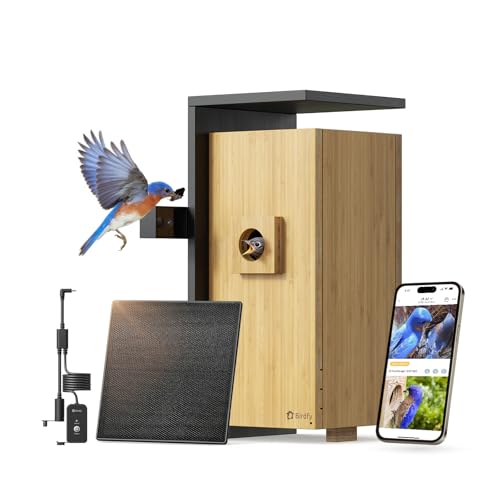 Netvue Birdfy Nest (dual-cam) Two 1080p cameras - one in the nest chamber, one on the entrance - with a 60 degree adjustable angle and identification paid for up front. This is the whole nesting season. | Inside the box and outside it, at once | $279.99 - View on Amazon #ad Price checked October 17, 2026. How this is funded |
| 2 |  4MP Color Night Vision Bird House 4MP with full-color night vision rather than infrared gray, plus a published IP66 rating - a real difference on a subject that is only ever in the dark. | Color at night inside the box | $69.00 - View on Amazon #ad Price checked October 17, 2026. How this is funded |
| 3 |  Birdfy Smart Bird House (Lifetime AI) Auto-records the nesting stages and flags them, with lifetime AI and a remote control so you never have to open the box. | Nesting-stage alerts, paid once | $239.99 - View on Amazon #ad Price checked October 17, 2026. How this is funded |
1. Inside the box and outside it, at once
Netvue Birdfy Nest (dual-cam)
Two 1080p cameras - one in the nest chamber, one on the entrance - with a 60 degree adjustable angle and identification paid for up front. This is the whole nesting season.
#ad Price checked October 17, 2026. How this is funded
A nest box camera is a completely different proposition to a feeder camera and it is worth understanding before you buy. A feeder gives you a hundred short visits a day. A nest box gives you nothing for weeks, then one continuous story - building, laying, hatching, fledging - that runs for about six weeks and does not repeat until next year. See what you actually see in a nest box.
The second camera is the whole product. The interior lens gives you the nest itself; the entrance lens gives you the arrivals, the fledging morning and - the part nobody warns you about - any competitor trying to take the box. One camera gives you half the story.
What is not published is the entrance hole diameter, and that is the specification that decides everything. Hole size is what selects your tenant - and gets it wrong. Hole size by species has the numbers; measure the box when it arrives.
| Cameras | Two: one inside the chamber, one facing the entranceSource: Birdfy Nest dual-cam - manufacturer listing on Amazon, retrieved 1 September 2026 |
|---|---|
| Video resolution | Dual 1080PSource: Birdfy Nest dual-cam - manufacturer listing on Amazon, retrieved 1 September 2026 |
| AI identification | Lifetime free AI bird ID stated on the listingBirdfy moved this line onto lifetime identification; it was previously sold with an optional recurring plan.Source: Birdfy Nest dual-cam - manufacturer listing on Amazon, retrieved 1 September 2026 |
| Camera angle | 60 degrees adjustable on bothSource: Birdfy Nest dual-cam - manufacturer listing on Amazon, retrieved 1 September 2026 |
| Audio | Built-inSource: Birdfy Nest dual-cam - manufacturer listing on Amazon, retrieved 1 September 2026 |
| Night vision | Not publishedNot stated on the current listing. |
| Solar | Not publishedNot stated on the current listing. |
| Entrance hole diameter | Not publishedThis is the specification that decides which species can use the box. |
| Battery capacity | Not published |
What it does well
- Two cameras cover the chamber and the entrance simultaneously
- Lifetime AI identification stated on the listing - nothing recurring
- Built-in audio - nestlings are far louder than people expect
- 60 degree adjustable angle on both cameras
What it does not
- Entrance hole diameter is not published, and it decides which species can nest
- 1080p on both cameras, with no higher option
- Night vision and solar are not stated on the current listing
- A nest box is empty most of the year
Skip this: if you want something to watch year-round. A nest box is spectacular for six weeks and inert for the other forty-six; a feeder camera is the opposite trade.
2. Color at night inside the box
4MP Color Night Vision Bird House
4MP with full-color night vision rather than infrared gray, plus a published IP66 rating - a real difference on a subject that is only ever in the dark.
#ad Price checked October 17, 2026. How this is funded
Full-color night vision inside a nest chamber is a bigger deal than the same feature outdoors. The interior of a box is dark essentially all the time, so an infrared camera renders the entire nesting season in gray. Color shows you egg markings and nestling plumage as they develop.
4MP is modest against a feeder camera, and it matters far less here: a nest box camera sits four inches from its subject, in a fixed frame, with lighting it provides itself. The more interesting number is the IP66 rating, which is published on this listing and on neither of the branded boxes above.
The trade is the brand. This is a generic listing rather than an established camera maker, and these are app-dependent devices where company continuity is part of what you are buying. It is on this page because a category with one serious supplier is worse for buyers than one with two. Single camera, so you get the chamber or the entrance, not both - the Birdfy dual-cam is the answer to that.
What it does well
- Full-color night vision, unusual on an interior nest camera
- Published IP66 rating - the only weather figure among the nest boxes here
- 4MP at four inches is more than adequate
- The cheapest way into a nest box camera on this site
What it does not
- One camera, so no entrance view
- A generic listing with no brand track record behind the app
- No published hole diameter, battery or Wi-Fi band
- AI recognition is claimed without any stated scope
Skip this: if you want the entrance activity as well as the chamber, or if you would rather buy from a maker whose record you can check. Half the nesting story happens at the hole, and the dual-camera Birdfy covers both.
3. Nesting-stage alerts, paid once
Birdfy Smart Bird House (Lifetime AI)
Auto-records the nesting stages and flags them, with lifetime AI and a remote control so you never have to open the box.
#ad Price checked October 17, 2026. How this is funded
Nesting-stage detection is the one AI feature in this whole category that is unambiguously worth having. You cannot watch a nest box continuously for six weeks, and the moments that matter - first egg, hatch day, fledging - last minutes. A system that flags them is the difference between seeing the season and missing it.
The remote control deserves more credit than it gets. Opening an occupied nest box can cause abandonment. Being able to change a setting from ten feet away means you never have to weigh a settings change against the birds.
Hole diameter is still unpublished. Same caveat as every box in this category: measure it, then read hole size by species.
| AI | Lifetime AI identification stated on the listingSource: Birdfy Bird House lifetime AI - manufacturer listing on Amazon, retrieved 1 September 2026 |
|---|---|
| Recording | Auto-records nesting stages with alertsSource: Birdfy Bird House lifetime AI - manufacturer listing on Amazon, retrieved 1 September 2026 |
| Night vision | YesSource: Birdfy Bird House lifetime AI - manufacturer listing on Amazon, retrieved 1 September 2026 |
| Power | Battery and solarSource: Birdfy Bird House lifetime AI - manufacturer listing on Amazon, retrieved 1 September 2026 |
| Control | Remote control, so the box is not openedSource: Birdfy Bird House lifetime AI - manufacturer listing on Amazon, retrieved 1 September 2026 |
| Entrance hole diameter | Not published |
| Battery capacity | Not published |
What it does well
- Nesting-stage alerts - the most genuinely useful AI feature in this category
- Remote control means the box never has to be opened once occupied
- Lifetime AI with no subscription
- Battery and solar
What it does not
- Entrance hole diameter not published
- No published battery capacity
- Nesting-stage detection is only exercised for a few weeks a year
Skip this: if you have not yet worked out which species you are trying to attract. Install timing and hole size decide whether anything moves in at all, and no camera compensates for an empty box.
What to check on a camera nest box
Most camera nest boxes publish a hole size, and it is usually the general-purpose measurement. Before ordering, decide which species you actually want and check the box matches - it is far easier to buy the right hole than to modify one afterwards, and enlarging a hole is a one-way operation.
If a listing does not publish the hole diameter at all, that is a meaningful omission on the single most consequential dimension of the product, and we would treat it the way we treat every other unpublished specification in the roundup: as a gap rather than a detail.
The other dimensions that matter
- Interior floor size. Roughly 4x4 inches suits chickadees and wrens; around 5x5 suits bluebirds. Too large a cavity is harder for the birds to keep warm.
- Depth below the hole. Six to eight inches from the hole down to the floor for most small species. Too shallow puts nestlings within reach of a predator at the entrance.
- No perch. A perch below the entrance is purely decorative and actively harmful - it gives predators and competing birds something to hold onto. Boxes sold with perches are designed for buyers rather than birds.
- Ventilation and drainage. Gaps near the top and holes in the floor. A sealed box overheats in summer sun and holds water after rain.
Where the box goes
Covered properly in the installation guide, but the short version: mount it on a smooth pole with a predator baffle rather than on a tree trunk, at roughly five to six feet, facing away from prevailing weather and out of full afternoon sun. And put it up in autumn or winter, not spring - birds choose sites well before they lay. For bluebirds specifically, the bluebird roundup applies these figures to what is actually on sale - and finds that no camera box publishes a hole diameter at all.
Owls, where the same rule is worse
Hole diameter decides the occupant for a screech owl exactly as it does for a chickadee, and the camera-equipped owl boxes are even quieter about it: not one of the three on sale publishes a diameter at all. Owl box cameras sets out what they do publish, and why buying a plain box from a maker who gives the dimension and adding a camera yourself is the only route that guarantees the number.
That is the general lesson of this page. Where a camera box will not tell you the hole size, a plain box plus a retrofit camera module lets you choose the dimension and the camera separately, and usually for less money.
Questions people actually ask
What size hole for a bluebird house?
1 1/2 inches for eastern bluebirds, 1 9/16 inches for western and mountain bluebirds. This is also the default on most commercial camera boxes.
What hole size keeps house sparrows out?
1 1/8 inches. That admits chickadees, wrens and other small cavity nesters while excluding house sparrows, which is the main reason to choose the smaller hole.
Should a nest box have a perch?
No. A perch below the entrance gives predators and competing birds something to grip. Boxes with perches are designed to appeal to buyers rather than to suit birds.
Can I make the hole bigger later?
You can, and it is one-way - so start small. It is much easier to enlarge a hole than to shrink one, and the small hole is the one that excludes aggressive competitors.
How deep should the box be?
Six to eight inches from the bottom of the entrance hole to the floor for most small species. Shallower than that puts nestlings within reach of anything at the entrance.