Buying & Setup Guides
Setting Up a Smart Bird Feeder
Getting the position right, getting it connected, and getting through the first fortnight - when the commonest problem is a feeder that works perfectly and has no birds on it.
How this page is funded. Buying through a link here earns us a commission at no extra cost to you. It does not change what we recommend or the order we recommend it in, and we have not handled any of these products ourselves - see how we pick and the full disclosure.
The feeder has arrived. Most of what decides whether you are happy with it over the next year happens in the first afternoon, and one of the most important parts is knowing what not to worry about.
Siting: four requirements that fight each other
This is the decision that matters most and the one people spend least time on. Four things want different positions.
| Requirement | Wants |
|---|---|
| Wi-Fi | Close to the house, few walls between - see the Wi-Fi guide |
| Light for the camera | Sun behind the camera, not behind the bird; foliage as backdrop |
| Solar charging | Open sky overhead for most of the day - fights the shade the birds prefer |
| Birds feeling safe | Within about ten feet of cover, so there is somewhere to escape to |
| Squirrel defense | Eight to ten feet clear of any launch point, on a baffled pole |
In most gardens you cannot satisfy all of these perfectly, so resolve them in this order: Wi-Fi first (a feeder that will not connect is not a feeder), then birds feeling safe (a feeder nothing visits is not a feeder either), then light, then solar, then squirrels - because squirrels are solvable with a baffled pole almost anywhere.
Quick picks
Ranked on published specifications and what each one costs to own. Every pick names the buyer it is wrong for.
| # | Product | Best for | Price |
|---|---|---|---|
| 1 |  Birdbuddy Pro Solar The largest published sensor in the category and the only maker that declines to advertise a species count - both of which point the same way. | The best pictures, if you can live with the app | |
| 2 | 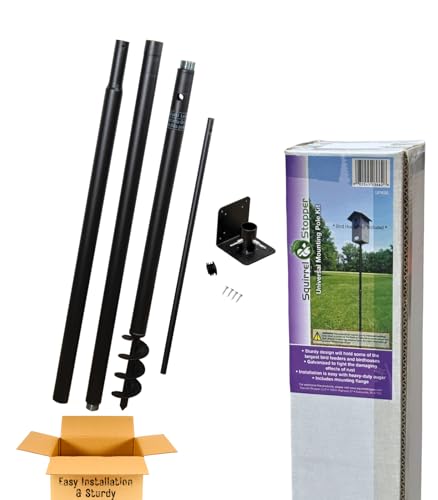 Squirrel Stopper Universal Mounting Pole Kit 55 inches of steel rated to 30 lb with threaded connections and top or side mounting. The only pole here that states what it can hold. | A published load rating, which almost nothing else has | $60.96 - View on Amazon #ad Price checked October 17, 2026. How this is funded |
| 3 |  Adjustable Smart Feeder Pole, 32-92 inch 32 to 92 inches of adjustment and stated Birdbuddy compatibility. Being able to move the feeder up a foot in week two is worth more than any spec. | Height you can change after you have seen what happens | $25.99 - View on Amazon #ad Price checked October 17, 2026. How this is funded |
1. The best pictures, if you can live with the app
Birdbuddy Pro Solar
The largest published sensor in the category and the only maker that declines to advertise a species count - both of which point the same way.
A 1/2.7" sensor is a real, checkable number, and it is bigger than anything else in this category will admit to. Sensor area is what governs how a photo looks when a bird lands at dusk, which is when most feeder traffic actually happens. Nobody else publishes the figure, so nobody else can be compared to it.
The thing worth noticing is what is missing. Every rival leads with an AI number - 6,000 species, 10,000 species. Birdbuddy prints none. A maker that does not put a number on its recognition claim is a maker with nothing to walk back, and after you read the species-claim audit that reads as confidence rather than as a gap.
The Wi-Fi position is the one to check before you buy. Birdbuddy's own support documentation says the original camera module requires 2.4GHz and does not work on 5GHz. If your router broadcasts one merged network name, that is the setup that fails - and the fix takes ten minutes once you know about it. It is covered in the Wi-Fi requirements guide.
| Video resolution | 2KSource: Birdbuddy Pro Solar - manufacturer listing on Amazon, retrieved 1 September 2026 |
|---|---|
| Photo resolution | 5MPSource: Birdbuddy Pro Solar - manufacturer listing on Amazon, retrieved 1 September 2026 |
| Sensor size | 1/2.7"The only sensor dimension published by any maker in this roundup.Source: Birdbuddy Pro Solar - manufacturer listing on Amazon, retrieved 1 September 2026 |
| Dynamic range | HDRSource: Birdbuddy Pro Solar - manufacturer listing on Amazon, retrieved 1 September 2026 |
| Wi-Fi band | 2.4GHz for the original camera module; the Birdbuddy 2 module adds 5GHzBirdbuddy's own support pages state the original module does not work on 5GHz.Source: Birdbuddy support: Connectivity and Wi-Fi requirements |
| Solar | Detachable solar roof, rotates 180 degreesSource: Birdbuddy Pro Solar - manufacturer listing on Amazon, retrieved 1 September 2026 |
| Battery capacity | Not publishedNo mAh figure appears on the listing or the support site. |
| Species identified | Not publishedBirdbuddy publishes no species count anywhere we could find. See the AI claims audit. |
| Subscription price | Not publishedNot stated on the listing, and the plan page did not serve us a price. |
What it does well
- Published 1/2.7" sensor with HDR - the only sensor dimension anyone in the category states
- Solar roof detaches and rotates, so the panel can face the sun even when the feeder cannot
- Makes no species-count claim, which is the honest position given the arithmetic
- The largest accessory ecosystem in the category, including perch extenders and nutrition sets
What it does not
- Battery capacity is not published, so runtime cannot be estimated from first principles
- The original camera module is 2.4GHz-only per Birdbuddy's own support pages
- Subscription pricing is not stated on the listing and was not retrievable from the plan page
Skip this: if you want every feature unlocked with no ongoing decision to make. Birdbuddy's premium tier exists, its price is not published where a buyer can find it, and buying into an unpriced subscription is exactly the trap the three-year cost guide was written about.
2. A published load rating, which almost nothing else has
Squirrel Stopper Universal Mounting Pole Kit
55 inches of steel rated to 30 lb with threaded connections and top or side mounting. The only pole here that states what it can hold.
#ad Price checked October 17, 2026. How this is funded
A 30 lb rating is enormous for this job and that is the point. A full metal feeder with a wet camera on top, taking a gust across an open lawn, puts more load on a pole than people expect - and a pole that flexes ruins every photograph it takes.
Threaded connections rather than friction-fit sections is the other quiet advantage. Friction joints work loose over a season; threads do not.
It is a fixed 55 inches, so decide your height before you dig. If you want to experiment, the adjustable pole is the trade.
| Load rating | Holds up to 30 lbThe only published load figure among the poles here.Source: Squirrel Stopper pole kit - manufacturer listing on Amazon, retrieved 1 September 2026 |
|---|---|
| Height | 55 inchesSource: Squirrel Stopper pole kit - manufacturer listing on Amazon, retrieved 1 September 2026 |
| Material | Heavy-duty steel, rust resistantSource: Squirrel Stopper pole kit - manufacturer listing on Amazon, retrieved 1 September 2026 |
| Mounting | Threaded connections, top or side mountSource: Squirrel Stopper pole kit - manufacturer listing on Amazon, retrieved 1 September 2026 |
| Adjustability | Not publishedFixed height rather than telescoping. |
What it does well
- Published 30 lb load rating - the only pole here that states one
- Threaded connections that will not work loose
- Top or side mounting suits feeders and boxes alike
- Rust-resistant steel
What it does not
- Fixed height, no adjustment after installation
- 55 inches is short if squirrels are jumping from a fence
- Heavier to install than a telescoping pole
Skip this: if you have not settled on a spot. Fixed height plus a driven base is a commitment, and an adjustable pole is the better first purchase.
3. Height you can change after you have seen what happens
Adjustable Smart Feeder Pole, 32-92 inch
32 to 92 inches of adjustment and stated Birdbuddy compatibility. Being able to move the feeder up a foot in week two is worth more than any spec.
#ad Price checked October 17, 2026. How this is funded
Almost nobody gets feeder height right on the first attempt. Too low and you are photographing squirrels; too high and the camera looks at the underside of every bird. An adjustable pole lets you fix that in five minutes instead of buying a second pole.
The compatibility claim names Birdbuddy specifically, which is the mount most people need and the one most generic poles get wrong.
Load rating is not published, which on a pole holding a camera through a windy week is the number you would actually want. Check the poles and mounts roundup for the alternatives that do publish one.
| Height range | 32 to 92 inches, adjustableSource: Adjustable smart feeder pole - manufacturer listing on Amazon, retrieved 1 September 2026 |
|---|---|
| Compatibility | Stated compatible with Birdbuddy and a variety of smart birdhouse stylesSource: Adjustable smart feeder pole - manufacturer listing on Amazon, retrieved 1 September 2026 |
| Build | Heavy duty stand and mount kitSource: Adjustable smart feeder pole - manufacturer listing on Amazon, retrieved 1 September 2026 |
| Load rating | Not published |
| Pole diameter | Not published |
What it does well
- Wide 32-92 inch adjustment range
- Explicit Birdbuddy compatibility
- One purchase covers experimenting with placement
What it does not
- No published load rating
- No published pole diameter, which matters for baffle compatibility
- Generic branding with limited support
Skip this: if you need a load figure you can rely on. The Squirrel Stopper pole publishes 30 lb, which is the kind of number a heavy metal feeder deserves.
Setup, in order
The first afternoon
- 1
Charge it fully indoors first
Even solar models. Hanging a partly-charged camera in January and waiting for a small panel to fill it is how a good feeder gets a bad first impression.
- 2
Pair it indoors, next to the router
Do this before mounting anything. If the pairing is going to fail, you want to find out standing in the kitchen rather than up a ladder - and the fix is in the Wi-Fi guide.
- 3
Check the signal at the feeder site
Stand there with a phone. One or two bars through an exterior wall means a camera that keeps dropping and drains its battery on retries.
- 4
Mount it, then look at the app before you walk away
Check the actual frame. The perch should fill a useful part of it and the background should be foliage rather than sky. Adjusting now takes seconds; adjusting later means taking it down.
- 5
Fill it with black oil sunflower seed
The single most widely-taken seed among North American feeder birds, and the right default for a new feeder. Experiment later.
- 6
Turn the notifications down
The default settings on a busy feeder will send you dozens of alerts a day and you will mute the app within a week. Set it to a digest, or to notify only on new species, and keep the pleasure of it.
The first three weeks, which is where people panic
The most common support question about these products is not technical. It is 'why are there no birds?'
Because they have not found it yet. A new feeder in a new position takes days to weeks to be discovered and trusted - birds locate food by watching each other and by patrolling familiar routes, and a novel object in a garden is treated with suspicion before it is treated as a food source. Two weeks of nothing is entirely normal. Longer is normal in a garden with no established feeding history.
What actually helps:
- Move it nearer cover. The most common single fix. A feeder in the middle of an open lawn is a place a small bird feels exposed.
- Scatter a little seed on the ground beneath it for the first week. Ground-feeding species find it, and their activity draws attention to the feeder above.
- Put it where birds already go. Near an existing shrub they use, or near where you have seen them.
- Wait longer than feels reasonable. Three weeks before changing anything, then change one thing at a time.
Seed, briefly
Black oil sunflower is the correct default: it is taken by the widest range of feeder birds - cardinals, chickadees, finches, titmice, nuthatches, jays - and its thin shell suits small beaks.
After that, seed is the main lever you have over which birds visit. Safflower is taken by cardinals and largely ignored by grackles, starlings and squirrels. Nyjer brings goldfinches and pine siskins and little else. Mixed supermarket seed is mostly filler that gets thrown to the ground. That relationship is why the dual-hopper FeatherSnap is a genuinely differentiated product rather than a gimmick.
Maintenance
Clean the feeder periodically - every couple of weeks in warm weather, and immediately if seed has got wet and clumped or you see any sick birds. Damp seed grows mold, and a dirty feeder concentrating birds is a disease transmission point. Keep the lens clean too: a smeared or pollen-dusted lens is the commonest cause of a camera that seems to have got worse.
And check the battery in the app periodically over the first month, particularly in winter. A steady decline in a solar model usually means the position is shadier than it looked, or the signal is weak enough that the camera is burning power on retries.
Questions people actually ask
How long until birds use a new feeder?
Days to weeks, and two weeks of nothing is normal. In a garden with no history of feeding it can take longer. Move it nearer cover and scatter a little seed underneath rather than assuming something is broken.
Where should I put a smart bird feeder?
In Wi-Fi range first, within about ten feet of cover second, with the sun behind the camera third. Then worry about solar and squirrels - the latter is solvable almost anywhere with a baffled pole.
What seed should I use?
Black oil sunflower as the default - it is taken by the widest range of feeder birds. Safflower deters grackles and squirrels; nyjer brings goldfinches. Avoid cheap mixes that are mostly filler.
How high should the feeder be?
About five feet is comfortable for you to refill and reasonable for the birds. Height matters less than distance from launch points if squirrels are the concern.
How often should I clean it?
Every couple of weeks in warm weather, and immediately if the seed gets wet or you see sick birds. Clean the lens at the same time - a dirty lens is the usual reason a camera seems to have deteriorated.
Should I take it down in summer or winter?
No. Feeding year-round is fine and winter is when it is most valuable. Just keep it clean and keep the seed dry.