Smart Bird House Cameras
4MP Color Night Vision Bird House
One camera, inside the box, in color rather than infrared gray. On a subject that is only ever in the dark, that single choice matters more than any other specification here.
How this page is funded. Buying through a link here earns us a commission at no extra cost to you. It does not change what we recommend or the order we recommend it in, and we have not handled any of these products ourselves - see how we pick and the full disclosure.
Every camera in this hub is pointed at the same thing: the inside of a wooden box with no windows. That is an unusual imaging problem, and it changes which specifications matter. Resolution matters less than you would expect. How the camera sees in the dark matters far more than it does anywhere else on this site.
This box is here because it publishes full-color night vision, and most of this category does not.
Why color beats resolution inside a nest box
Consider what an infrared camera actually gives you. Infrared illumination produces a monochrome image - everything in shades of gray, no color information at all. Outdoors that is a limitation for a few hours a night. Inside a nest chamber it is a limitation for the entire nesting season, because the interior of a box is dark essentially all the time.
So a nest box camera on infrared renders six weeks of the most interesting footage you will ever get from your garden in gray. You will see that there are eggs. You will not see the speckling on them, which is often the clearest way to tell whose eggs they are. You will see nestlings. You will not watch their plumage come in.
Full color changes that, and it is the reason this modestly-specified camera earns a page. On this subject, color is the feature.
Quick picks
Ranked on published specifications and what each one costs to own. Every pick names the buyer it is wrong for.
| # | Product | Best for | Price |
|---|---|---|---|
| 1 |  4MP Color Night Vision Bird House 4MP with full-color night vision rather than infrared gray, plus a published IP66 rating - a real difference on a subject that is only ever in the dark. | Color at night inside the box | $69.00 - View on Amazon #ad Price checked October 17, 2026. How this is funded |
| 2 | 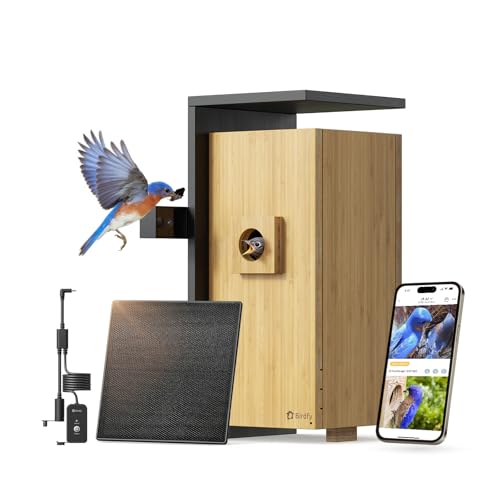 Netvue Birdfy Nest (dual-cam) Two 1080p cameras - one in the nest chamber, one on the entrance - with a 60 degree adjustable angle and identification paid for up front. This is the whole nesting season. | Inside the box and outside it, at once | $279.99 - View on Amazon #ad Price checked October 17, 2026. How this is funded |
1. Color at night inside the box
4MP Color Night Vision Bird House
4MP with full-color night vision rather than infrared gray, plus a published IP66 rating - a real difference on a subject that is only ever in the dark.
#ad Price checked October 17, 2026. How this is funded
Full-color night vision inside a nest chamber is a bigger deal than the same feature outdoors. The interior of a box is dark essentially all the time, so an infrared camera renders the entire nesting season in gray. Color shows you egg markings and nestling plumage as they develop.
4MP is modest against a feeder camera, and it matters far less here: a nest box camera sits four inches from its subject, in a fixed frame, with lighting it provides itself. The more interesting number is the IP66 rating, which is published on this listing and on neither of the branded boxes above.
The trade is the brand. This is a generic listing rather than an established camera maker, and these are app-dependent devices where company continuity is part of what you are buying. It is on this page because a category with one serious supplier is worse for buyers than one with two. Single camera, so you get the chamber or the entrance, not both - the Birdfy dual-cam is the answer to that.
What it does well
- Full-color night vision, unusual on an interior nest camera
- Published IP66 rating - the only weather figure among the nest boxes here
- 4MP at four inches is more than adequate
- The cheapest way into a nest box camera on this site
What it does not
- One camera, so no entrance view
- A generic listing with no brand track record behind the app
- No published hole diameter, battery or Wi-Fi band
- AI recognition is claimed without any stated scope
Skip this: if you want the entrance activity as well as the chamber, or if you would rather buy from a maker whose record you can check. Half the nesting story happens at the hole, and the dual-camera Birdfy covers both.
2. Inside the box and outside it, at once
Netvue Birdfy Nest (dual-cam)
Two 1080p cameras - one in the nest chamber, one on the entrance - with a 60 degree adjustable angle and identification paid for up front. This is the whole nesting season.
#ad Price checked October 17, 2026. How this is funded
A nest box camera is a completely different proposition to a feeder camera and it is worth understanding before you buy. A feeder gives you a hundred short visits a day. A nest box gives you nothing for weeks, then one continuous story - building, laying, hatching, fledging - that runs for about six weeks and does not repeat until next year. See what you actually see in a nest box.
The second camera is the whole product. The interior lens gives you the nest itself; the entrance lens gives you the arrivals, the fledging morning and - the part nobody warns you about - any competitor trying to take the box. One camera gives you half the story.
What is not published is the entrance hole diameter, and that is the specification that decides everything. Hole size is what selects your tenant - and gets it wrong. Hole size by species has the numbers; measure the box when it arrives.
| Cameras | Two: one inside the chamber, one facing the entranceSource: Birdfy Nest dual-cam - manufacturer listing on Amazon, retrieved 1 September 2026 |
|---|---|
| Video resolution | Dual 1080PSource: Birdfy Nest dual-cam - manufacturer listing on Amazon, retrieved 1 September 2026 |
| AI identification | Lifetime free AI bird ID stated on the listingBirdfy moved this line onto lifetime identification; it was previously sold with an optional recurring plan.Source: Birdfy Nest dual-cam - manufacturer listing on Amazon, retrieved 1 September 2026 |
| Camera angle | 60 degrees adjustable on bothSource: Birdfy Nest dual-cam - manufacturer listing on Amazon, retrieved 1 September 2026 |
| Audio | Built-inSource: Birdfy Nest dual-cam - manufacturer listing on Amazon, retrieved 1 September 2026 |
| Night vision | Not publishedNot stated on the current listing. |
| Solar | Not publishedNot stated on the current listing. |
| Entrance hole diameter | Not publishedThis is the specification that decides which species can use the box. |
| Battery capacity | Not published |
What it does well
- Two cameras cover the chamber and the entrance simultaneously
- Lifetime AI identification stated on the listing - nothing recurring
- Built-in audio - nestlings are far louder than people expect
- 60 degree adjustable angle on both cameras
What it does not
- Entrance hole diameter is not published, and it decides which species can nest
- 1080p on both cameras, with no higher option
- Night vision and solar are not stated on the current listing
- A nest box is empty most of the year
Skip this: if you want something to watch year-round. A nest box is spectacular for six weeks and inert for the other forty-six; a feeder camera is the opposite trade.
3MP is enough, and here is why
3MP sounds thin against the 4K and 8MP figures elsewhere on this site, and in this one application it genuinely does not matter much.
The reason is distance. A feeder camera photographs a bird several inches to a foot away and then wants headroom to crop, and it does it through a lens that has to cope with a subject backlit against a bright sky. A nest box camera sits in the lid of a box perhaps four to six inches above its subject, in a fixed frame, with controlled lighting it provides itself. Pixels per bird are high even at 3MP, and there is no crop to plan for because the subject fills the frame by design.
Resolution in this hub is closer to a marketing number than it is anywhere else in this category. Color, reliability and the ability to leave it alone for six weeks matter more.
One camera, which is the real limitation
This is a single-camera product, and half the nesting story happens at the entrance hole rather than inside the chamber.
The interior view gives you nest building, the eggs, the hatch, the nestlings and the feeding visits from the inside. The entrance view gives you the parents arriving with food, the moment of fledging, and - the part nobody warns you about - the intruders. Competition for a box is fierce, and an entrance camera is how you find out that a house sparrow spent a week trying to take it.
If you want both, the Birdfy Nest is the dual-camera answer and it is the reason it ranks above this one in the roundup. If you want the chamber in color for less, this is the trade.
The specification that is missing and matters most
The listing does not publish the entrance hole diameter, and in this hub that is the most consequential omission a seller can make - more consequential than the battery, the band or the resolution.
The hole is a filter. Any bird that fits can use the box; any bird that does not, cannot. NestWatch is explicit that a properly sized entrance excludes unwanted occupants, noting that European Starlings need at least 9/16" and House Sparrows need 1 1/4" - so a hole below those thresholds keeps out the two aggressive non-native competitors most likely to evict a native bird from your box.
Buying a box without knowing its hole size means you cannot predict who will nest in it, and you may have installed a camera specifically to watch a starling take a chickadee's box. Measure it when it arrives, and read the hole size guide first so you know what you are measuring for.
What the box itself does not tell you
The listing describes motion-triggered auto capture and app control, which is the standard arrangement. It does not publish a Wi-Fi band or a battery capacity.
The band is worth checking before you site the box, because a nest box usually goes further from the house than a feeder does and nearly everything in this category is 2.4GHz-only - the Wi-Fi guide covers what to do when a router broadcasting both bands under one name refuses the pairing. The battery matters here in a specific way that it does not on a feeder: you cannot open a box to swap or charge anything once a bird has moved in without abandoning the brood. Whatever charge state the camera is in at the start of the season is what you have for the season.
The box around the camera matters as much as the camera
It is easy to treat a smart bird house as a camera that happens to be in a box. It is more useful to treat it as a nest box that happens to contain a camera, because the box is what decides whether anything nests in it at all - and NestWatch's specification for a good birdhouse is more demanding than most commercial products meet.
Two requirements in particular are worth checking on arrival. NestWatch calls for two 5/8" ventilation holes on each side wall near the top - four in total - and at least four drainage holes of 3/8" to 1/2" in the floor. Without ventilation a box in summer sun overheats; without drainage, driven rain pools around the nest. Neither is exotic, and neither is universal on products sold primarily as cameras.
The third is easier to fix: NestWatch states plainly that a perch is unnecessary for the birds and can actually help predators gain access to the box. If your birdhouse has a decorative dowel under the entrance, take it off. Cavity nesters do not need it and something that wants to reach inside does.
The rule you have to follow once it is occupied
Do not open the box. That is the whole rule, and a camera exists precisely so you do not have to.
Once a bird is prospecting or building, opening the lid risks abandonment, and later in the season it risks causing nestlings to leave the box before they can fly. The camera is what makes six weeks of observation possible without any of that - which is the honest argument for this whole category and worth remembering when the temptation to check on a quiet incubating bird gets strong. Everything you would want to fix, you fix in autumn: the installation timing guide sets out that off-season checklist.
Who should buy it
Someone who wants the inside of the box in color, is content with the chamber view alone, and understands that this is a device with a six-week season. It is the cheaper way into the one thing a nest box camera does that nothing else can.
Who should not
Anyone who wants the entrance as well as the chamber - buy the dual-camera model instead. Anyone who needs to know the hole diameter before purchase, because it is not published. And anyone expecting a year-round device: a nest box is occupied for roughly four to six weeks per brood in a season running approximately March to July across most of the United States, and it films an empty box for the rest of the year. The hub page is blunt about that, and it is the single most common reason people are disappointed by this category.
Questions people actually ask
Is color night vision worth it in a nest box?
More than anywhere else on this site. A nest chamber is dark essentially all the time, so an infrared camera renders the entire season in gray. Color is what lets you see egg markings and nestling plumage develop.
Is 3MP enough for a nest box camera?
Yes, in this application. The camera sits four to six inches from its subject in a fixed frame with its own lighting, so pixels per bird are high and there is no crop to plan for. Resolution matters far less here than on a feeder.
What size is the entrance hole?
The seller does not publish it, which is the most consequential gap in this listing. NestWatch notes European Starlings need at least 9/16" and House Sparrows 1 1/4" - so the hole size decides whether an aggressive non-native competitor can take the box. Measure it on arrival.
Does it show the entrance as well as the inside?
No - this is a single interior camera. For both views you need a dual-camera model such as the Birdfy Nest, which is why that one ranks higher in the roundup.
How long will birds actually use it?
Roughly four to six weeks per brood, in a breeding season running approximately March to July across most of the US. A newly installed box is also frequently ignored in its first season. This is a six-week device, not a year-round one.
Have you tested this?
No. Everything here comes from the maker's published listing, cited below, with the unpublished figures printed as gaps rather than filled in.