Smart Bird Feeder Cameras
The Best Bird Seed for a Camera Feeder
Seed is the cheapest lever you have over what your camera records, and the criteria that matter for a feeder with a lens four inches away are not the ones general birding advice uses.
How this page is funded. Buying through a link here earns us a commission at no extra cost to you. It does not change what we recommend or the order we recommend it in, and we have not handled any of these products ourselves - see how we pick and the full disclosure.
Our own accessories guide says seed is a bigger lever than any accessory, and until now this site has not sold a single bag of it. This page fixes that, and it is worth being clear from the start why it is not just another best bird seed roundup.
General birding advice picks seed for the birds. That is the right frame if you own a wooden hopper on a pole. It is an incomplete frame if you own a camera feeder, because a camera feeder adds three constraints nobody writing about seed is thinking about: a hopper that holds roughly a liter, a lens a few inches from the tray, and a motion sensor that fires on anything that moves.
How we judged these
- Hulls, first and above everything. A shell is volume you bought, stored and carried that the bird discards at the feeder. In a small camera hopper that is a much worse deal than in a garden hopper, and the discarded shells land on the tray your lens is pointed at.
- Filler content. Cheap mixes are bulked with seed most birds will not eat. Project FeederWatch is direct that milo often goes to waste and that eastern feeders should avoid mixes containing much of it. Filler in a camera feeder is worse than filler in a big one: it is a larger share of a smaller hopper.
- Which birds it actually brings, cited to Project FeederWatch rather than to the bag. The species list is the product on a camera feeder - it is literally what you are paying to watch.
- What it does to squirrel traffic. Squirrels are not just a seed cost on a camera feeder, they are footage. A seed that reduces squirrel visits earns its price twice.
- Spoilage, because the seed that is best for a camera feeder is also the seed that goes off fastest, and that trade has to be stated rather than buried.
What is not on that list: our own taste tests, because we do not run any, and any claim about how birds behaved at our feeder, because we do not have one. Every species claim on this page is cited to Project FeederWatch or Audubon. How we pick sets out the method and its limits.
The hull problem, which is the whole page
Most seed sold for wild birds is in the shell. A bird takes a seed, cracks it, eats the kernel and drops the husk. On a conventional feeder those husks fall on the lawn and you rake them up in spring.
On a camera feeder they land on the tray. The tray is the part of the feeder inside the frame, a few inches from the lens, and it is where every bird you are trying to photograph stands. Within a week of in-shell seed a camera tray is carpeted in husks, and you are watching birds pick through debris in every clip.
There is a second-order effect that people discover later. Discarded hulls and rejected filler pile up under the feeder, and that pile attracts rodents. Rodents at night are motion events, and motion events are notifications, battery and storage. The seed you chose in March is why your phone buzzes at two in the morning in June.
Quick picks
Ranked on published specifications and what each one costs to own. Every pick names the buyer it is wrong for.
| # | Product | Best for | Price |
|---|---|---|---|
| 1 |  Kaytee Ultimate No Mess Wild Bird Seed A shell-free blend from an established brand - the one seed decision that keeps a small hopper working and the lens clean. | The default seed for any camera feeder | $21.99 - View on Amazon #ad Price checked October 17, 2026. How this is funded |
| 2 |  Audubon Park Sunflower Hearts & Chips Sunflower with the shell already off and nothing else in the bag - zero waste, zero filler, and the shortest shelf life here. | The purest version of the no-waste argument | $14.94 - View on Amazon #ad Price checked October 17, 2026. How this is funded |
| 3 |  Wagner's Safflower Seed Wild Bird Food The one seed Audubon says squirrels generally avoid - and the one cardinals will still come to, which is the combination a camera owner actually wants. | Cardinals on camera, without the squirrels | $11.98 - View on Amazon #ad Price checked October 17, 2026. How this is funded |
| 4 |  Wagner's Black Oil Sunflower Seed The baseline seed the whole hobby runs on - thin-shelled, universally taken, and the one that leaves hulls all over your camera tray. | The cheapest way to get the widest species list | $10.98 - View on Amazon #ad Price checked October 17, 2026. How this is funded |
| 5 |  Kaytee Nyjer Thistle Seed The finch specialist - and the one seed on this page that needs a different feeder from the one your camera is attached to. | Goldfinches, in a feeder your camera probably is not | $13.99 - View on Amazon #ad Price checked October 17, 2026. How this is funded |
| 6 | 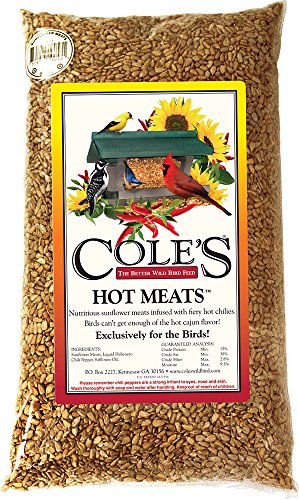 Cole's Hot Meats Bird Seed Hulled sunflower treated with capsaicin. We include it because it is what people search for, and the published research does not support the claim it is sold on. | Hulled sunflower with a chili coating - if you want to try it | $21.99 - View on Amazon #ad Price checked October 17, 2026. How this is funded |
1. The default seed for any camera feeder
Kaytee Ultimate No Mess Wild Bird Seed
A shell-free blend from an established brand - the one seed decision that keeps a small hopper working and the lens clean.
#ad Price checked October 17, 2026. How this is funded
Hull-free is the whole argument for a camera feeder, and it is a different argument from the one general birding sites make. They care about mess on the lawn. You care about a hopper that holds maybe a liter, a lens a few inches from the tray, and a motion sensor that fires on anything that moves.
Every hull in a bag is volume you paid to store and volume the bird discards at the feeder. In a small camera hopper that is a materially worse deal than it is in a big garden hopper, because you are refilling far more often to begin with.
The cost is shelf life. Project FeederWatch is explicit that hulled seed spoils faster than in-shell, so buy a bag you will get through rather than the biggest one on the page.
| Type | Hull-free blended seedSource: Kaytee Ultimate No Mess - manufacturer listing on Amazon, retrieved 1 September 2026 |
|---|---|
| Bag size | 9.75 lbSource: Kaytee Ultimate No Mess - manufacturer listing on Amazon, retrieved 1 September 2026 |
| Mess under the feeder | ReducedProject FeederWatch states hulled sunflower reduces mess underneath feeders.Source: Project FeederWatch: Feeding Birds - seed types and what they attract |
| Shelf life once out | Shorter than in-shellProject FeederWatch: hulled seed spoils more quickly than sunflower in the shell.Source: Project FeederWatch: Feeding Birds - seed types and what they attract |
| Exact blend ratio | Not publishedThe listing names the blend but not the proportion of each ingredient. |
| Milo content | Not published |
What it does well
- No hulls, so nothing accumulates on the tray in front of the lens
- Every ounce is edible - nothing in the hopper is packaging the bird will throw away
- Established brand with consistent blending, which the cheap mixes are not
What it does not
- Spoils faster than in-shell seed, per Project FeederWatch - buy smaller bags
- Costs more per pound than plain black oil sunflower
- Blend proportions are not published, so you cannot check the filler content
- Wet weather turns hull-free seed to paste faster than in-shell
Skip this: if your feeder sits somewhere exposed and gets rained into. Hull-free seed handles water badly, and in-shell sunflower is the more forgiving choice in an open position.
2. The purest version of the no-waste argument
Audubon Park Sunflower Hearts & Chips
Sunflower with the shell already off and nothing else in the bag - zero waste, zero filler, and the shortest shelf life here.
#ad Price checked October 17, 2026. How this is funded
This is the no-mess idea taken to its conclusion: one ingredient, no shell, nothing a bird will reject. For a camera feeder it is the cleanest thing you can put in the hopper, and the tray stays clear for longer than with any blend.
It is also the most expensive way to fill a feeder per pound, and the fastest to go off. Those two facts together mean it suits a small hopper you empty quickly - which is exactly what a camera feeder is.
The species range is the widest of anything here. Project FeederWatch notes that any bird that eats sunflower will take it hulled, and many prefer it, so you are not trading variety for tidiness.
| Type | Hulled sunflower hearts and chips, single ingredientSource: Audubon Park Sunflower Hearts & Chips - manufacturer listing on Amazon, retrieved 1 September 2026 |
|---|---|
| Bag size | 5 lbSource: Audubon Park Sunflower Hearts & Chips - manufacturer listing on Amazon, retrieved 1 September 2026 |
| Birds it attracts | Anything that eats sunflower, and many prefer it hulledProject FeederWatch: hulled sunflower is eaten by any bird that takes regular sunflower, and many actually prefer it.Source: Project FeederWatch: Feeding Birds - seed types and what they attract |
| Spoilage | Faster than in-shellSource: Project FeederWatch: Feeding Birds - seed types and what they attract |
| Filler content | None - single ingredientSource: Audubon Park Sunflower Hearts & Chips - manufacturer listing on Amazon, retrieved 1 September 2026 |
What it does well
- Single ingredient - no milo, no filler, nothing to sort through
- Widest species appeal of any seed on this page, per Project FeederWatch
- Nothing left on the tray, which is the whole point on a camera feeder
What it does not
- Dearest per pound of anything here
- Spoils fastest - a 5 lb bag is the right size, not a starting point
- Turns to paste in rain, so it needs a hopper with a real roof
- Squirrels like it as much as the birds do
Skip this: if you are filling a large hopper or feeding all winter on a budget. This is a premium consumable and it is at its best in a small feeder you refill often.
3. Cardinals on camera, without the squirrels
Wagner's Safflower Seed Wild Bird Food
The one seed Audubon says squirrels generally avoid - and the one cardinals will still come to, which is the combination a camera owner actually wants.
#ad Price checked October 17, 2026. How this is funded
This is the most interesting seed on the page for a camera owner, because it changes who appears in your footage rather than just how tidy the feeder is.
Audubon states plainly that squirrels dislike safflower and will generally avoid it. That is a sourced claim about a real behavior, and on a camera feeder it means fewer clips of a squirrel filling the frame and more of the birds you set the thing up for.
The honest counterweight comes from Project FeederWatch: most birds prefer sunflower over safflower. So you are trading total traffic for better traffic, and whether that is a good trade depends on whether your squirrel problem is bad enough to be worth it.
| Type | Safflower, single ingredientSource: Wagner's Safflower Seed - manufacturer listing on Amazon, retrieved 1 September 2026 |
|---|---|
| Bag size | 5 lbSource: Wagner's Safflower Seed - manufacturer listing on Amazon, retrieved 1 September 2026 |
| Birds it attracts | Cardinals and other big-billed birdsSource: Project FeederWatch: Feeding Birds - seed types and what they attract |
| Squirrels | Generally avoid itAudubon: squirrels "dislike the taste and will generally avoid it", while many birds will happily eat it.Source: Audubon: Yes, You Can Stop Squirrels From Raiding Bird Feeders |
| Overall bird preference | Lower than sunflowerProject FeederWatch: most birds prefer sunflower seeds over safflower.Source: Project FeederWatch: Feeding Birds - seed types and what they attract |
What it does well
- Squirrels generally avoid it, per Audubon - the cheapest squirrel intervention there is
- Cardinals and other big-billed birds take it readily
- Single ingredient, so no filler to sort through
What it does not
- Most birds prefer sunflower, per Project FeederWatch - expect fewer visits overall
- In some areas squirrels reportedly acquire a taste for it, so it is not a guarantee
- In-shell, so hulls will accumulate on the tray
- Narrower species range than sunflower, which matters if variety is the point
Skip this: if your feeder is quiet already. Safflower reduces squirrel traffic by reducing appeal generally, and on a feeder that is struggling for visitors that is the wrong lever to pull - a baffle on the pole costs more and does not cost you birds.
4. The cheapest way to get the widest species list
Wagner's Black Oil Sunflower Seed
The baseline seed the whole hobby runs on - thin-shelled, universally taken, and the one that leaves hulls all over your camera tray.
#ad Price checked October 17, 2026. How this is funded
If you put one thing in a feeder for the rest of your life, this is it. Project FeederWatch lists cardinals, chickadees, finches and sparrows, with woodpeckers taking it on occasion, and the thin shell is why small birds manage it so easily.
The camera-specific catch is the hulls. Every bird that takes a seed drops a shell, and on a feeder with a lens a few inches away those shells collect on the tray, in the corners and eventually on the glass.
That is not a reason to avoid it. It is a reason to know that you are choosing the widest species list and accepting a tray you will wipe more often - which for plenty of owners is exactly the right trade.
| Type | Black oil sunflower, in shell, single ingredientSource: Wagner's Black Oil Sunflower - manufacturer listing on Amazon, retrieved 1 September 2026 |
|---|---|
| Bag size | 5 lbSource: Wagner's Black Oil Sunflower - manufacturer listing on Amazon, retrieved 1 September 2026 |
| Birds it attracts | Cardinals, chickadees, finches and sparrows; woodpeckers occasionallySource: Project FeederWatch: Feeding Birds - seed types and what they attract |
| Shell | ThinProject FeederWatch notes the thin shell is part of why it is so widely preferred.Source: Project FeederWatch: Feeding Birds - seed types and what they attract |
| Waste | Hulls discarded at the feederSource: Project FeederWatch: Feeding Birds - seed types and what they attract |
What it does well
- The widest species appeal of any single seed, per Project FeederWatch
- Cheapest per pound on this page
- Keeps far better than any hulled seed, so a big bag is not a mistake
What it does not
- Hulls accumulate on the tray directly in front of the camera
- Discarded shells below the feeder attract rodents, which trigger overnight motion alerts
- You are paying to ship and store shell weight the birds throw away
- Squirrels love it as much as the birds do
Skip this: if your feeder is wall-mounted or on a balcony where the discarded hulls land somewhere you cannot sweep. In-shell seed makes a mess by design, and on a small camera tray it is a weekly chore.
5. Goldfinches, in a feeder your camera probably is not
Kaytee Nyjer Thistle Seed
The finch specialist - and the one seed on this page that needs a different feeder from the one your camera is attached to.
#ad Price checked October 17, 2026. How this is funded
Nyjer brings in a set of birds nothing else on this page will: American Goldfinch, Pine Siskin and Common Redpoll, per Project FeederWatch. If those are the birds you want on camera, no blend is a substitute.
The problem is mechanical. Nyjer needs a feeder with ports small enough to hold it, and almost no camera feeder is built that way - camera feeders are open trays and hoppers designed for sunflower.
Project FeederWatch also advises against putting it in a mix, because the seed the other birds ignore ends up on the ground. So this is genuinely a second feeder, which is worth saying before you buy a bag expecting it to work in the one you own.
| Type | Nyjer (thistle), single ingredientSource: Kaytee Nyjer Thistle Seed - manufacturer listing on Amazon, retrieved 1 September 2026 |
|---|---|
| Bag size | 3 lbSource: Kaytee Nyjer Thistle Seed - manufacturer listing on Amazon, retrieved 1 September 2026 |
| Birds it attracts | Finches - American Goldfinch, Pine Siskin, Common RedpollSource: Project FeederWatch: Feeding Birds - seed types and what they attract |
| Feeder required | Specialized feeder with small portsProject FeederWatch: nyjer requires feeders with small ports, and is best fed on its own rather than in a mix.Source: Project FeederWatch: Feeding Birds - seed types and what they attract |
| Use in a mix | Not recommendedProject FeederWatch advises feeding nyjer by itself to prevent waste.Source: Project FeederWatch: Feeding Birds - seed types and what they attract |
What it does well
- The only seed here that brings in goldfinches, siskins and redpolls
- Single ingredient, no filler
- Small bag size, which suits a seed fed on its own
What it does not
- Needs a small-port feeder that your camera feeder almost certainly is not
- Should not be mixed into a blend, per Project FeederWatch, so it cannot be added to what you already use
- Narrowest species range on this page
- Goes stale and birds reject old nyjer readily
Skip this: Skip this unless you are prepared to hang a second, non-camera feeder for it. Putting nyjer in a camera feeder built for sunflower wastes the seed and films nothing new.
6. Hulled sunflower with a chili coating - if you want to try it
Cole's Hot Meats Bird Seed
Hulled sunflower treated with capsaicin. We include it because it is what people search for, and the published research does not support the claim it is sold on.
#ad Price checked October 17, 2026. How this is funded
The conventional wisdom on hot pepper seed is that squirrels hate it and birds cannot taste it. Audubon reports research that undercuts both halves, which is why this pick carries a warning rather than a recommendation.
On squirrels: they preferred unspiced seed when they had the choice, and still ate the spiciest seed when they were hungry. A deterrent that fails precisely when the animal is motivated is not much of a deterrent.
On birds: they can detect capsaicin above roughly 500,000 Scoville units and refused seed entirely at ghost-pepper heat. Since no product publishes a Scoville rating, you cannot check where any given bag falls - and on a camera feeder, seed the birds quietly decline is the worst possible outcome.
| Type | Hulled sunflower kernels with hot pepper treatmentSource: Cole's Hot Meats - manufacturer listing on Amazon, retrieved 1 September 2026 |
|---|---|
| Bag size | 5 lbSource: Cole's Hot Meats - manufacturer listing on Amazon, retrieved 1 September 2026 |
| Effect on squirrels | Does not reliably deter themAudubon, reporting research by Colbeck et al. at Maryville University: squirrels ate unspiced seed first but "would still go back to eat even the spiciest ones", and "if they are hungry, they will tough it out".Source: Audubon: Hot Take - Seems Like Birds Can Taste Spice After All (Colbeck et al., Maryville University) |
| Effect on birds | Birds can detect capsaicin at high concentrationsThe same research found bird visits fell above roughly 500,000 Scoville units and stopped at ghost-pepper levels. The vanilloid receptor exists in birds, just far less sensitively than in mammals.Source: Audubon: Hot Take - Seems Like Birds Can Taste Spice After All (Colbeck et al., Maryville University) |
| Scoville rating | Not publishedNo heat level is published, so you cannot tell where this sits against the threshold in that research. |
What it does well
- Hulled sunflower underneath the treatment, so the no-waste argument still applies
- Established brand in the wild bird food aisle
- May reduce squirrel visits when easier food is available nearby
What it does not
- The squirrel claim is not supported by the research Audubon reports - hungry squirrels eat it anyway
- Birds can taste capsaicin above a threshold, and no maker publishes a Scoville rating
- Costs meaningfully more than plain hulled sunflower for an effect that may not materialize
- Handling treated seed means washing your hands before touching your eyes
Skip this: if you have a serious squirrel problem, which is the exact situation it is marketed for. A baffled pole solves it physically and permanently, and safflower is the better seed-based answer because the evidence for it is stronger.
Why the Kaytee no-mess blend wins
Because it solves the hull problem without narrowing the species list, and it does it from a brand that blends consistently. That last part matters more than it sounds - the cheapest no-mess bags vary bag to bag, and a bag that is mostly one ingredient this month and mostly another next month makes your footage inconsistent for no reason you can see.
It is a blend rather than a single seed, which is the right shape for a camera feeder. A blend covers more species than sunflower alone, and species variety is the entire proposition of a camera that identifies what visits. The blend proportions are not published, which is the honest gap here, so you cannot audit the filler content the way you can with a single-ingredient bag.
If you want to audit it, buy the sunflower hearts instead. One ingredient, nothing to hide, and the widest species appeal of anything on this page - at the highest price per pound and the shortest shelf life.
Safflower: the squirrel lever with real evidence behind it
Audubon states that squirrels dislike safflower and will generally avoid it, while many birds will happily eat it. That is a sourced statement about behavior, and for a camera owner it is more interesting than any tidiness argument on this page.
A squirrel on a camera feeder is not just seed theft. It is clips - often a lot of them, because a squirrel settles in and stays where a bird lands and leaves. Switching to safflower reduces that, and it does so for the price of a bag rather than the price of a baffled pole.
The counterweight, from Project FeederWatch, is that most birds prefer sunflower over safflower. So you get a cleaner species mix and fewer visits overall, and cardinals are the birds most likely to keep coming. On a busy feeder that is a good trade. On a quiet one it is the wrong lever, and a baffled pole solves the same problem without costing you birds.
There is also a reported caveat worth passing on: in some areas squirrels appear to acquire a taste for safflower. Treat it as a strong tendency rather than a guarantee, and if you need certainty, the squirrel-proof roundup covers the physical answers.
Hot pepper seed does not do what the bag says
This is the finding on this page that we expect to be least popular, and it is the best sourced. Hot pepper birdseed is sold on two claims: squirrels hate capsaicin, and birds cannot taste it. Audubon reports research from Gabriel Colbeck's team at Maryville University that complicates both.
- On squirrels. Given a choice, they went for unspiced seed first. But they still went back and ate even the spiciest seed, and the summary is blunt: if they are hungry, they will tough it out. A deterrent that stops working when the animal is motivated is not solving the problem you bought it for.
- On birds. The team filled feeders at heat levels from none up to a million Scoville units and counted visits by Northern Cardinals, Carolina Chickadees and House Finches. Visits fell off above roughly 500,000 Scoville, and at ghost-pepper heat the birds refused the seed. Birds do have the vanilloid receptor - it is far less sensitive than a mammal's, but it is there.
No hot pepper seed we found publishes a Scoville rating, so you cannot check where a given bag sits relative to that threshold. On a camera feeder that is the wrong kind of uncertainty: the failure mode is birds quietly declining to visit, which looks exactly like a camera that is not working.
We have kept it in the list at the bottom, because it is what people search for and because burying a product you disagree with is not the same as explaining it. If squirrels are the problem, safflower has better evidence and a baffle has better physics.
What the filler is doing
Cheap mixes are bulked out with seeds most birds will not eat. Project FeederWatch names milo specifically: it is not a favorite of most birds, it often goes to waste, and feeders in the east should avoid mixes containing large amounts of it. Western birds take it more readily.
In a big hopper, filler is money wasted. In a camera hopper, filler is money wasted and capacity wasted, because a liter of mixed seed that is a third milo is a feeder holding two thirds of a liter of food. You will refill more often to deliver the same number of meals, and the rejected third ends up on the ground recruiting the rodents mentioned above.
This is why the single-ingredient bags on this page are worth their premium more than the per-pound comparison suggests. You are not just buying better seed. You are buying hopper volume that does something.
Storage, and the trade nobody mentions
Everything good about hulled seed for a camera feeder comes with the same cost: Project FeederWatch is explicit that hulled sunflower spoils more quickly than sunflower in the shell. The shell is packaging, and removing the packaging shortens the life of what was inside it.
- Buy the bag size you will actually use, not the best value per pound. A camera feeder holds around a liter, so a 5 lb bag is a sensible unit and a 40 lb sack is a way of throwing seed away slowly.
- Keep it dry and sealed. Hulled seed turns to paste in damp far faster than in-shell, and paste in a hopper is a blockage rather than a meal.
- Check a feeder in an exposed position after rain. If your feeder has no real roof, in-shell sunflower is the more forgiving choice regardless of what this page recommends.
- Do not top up on top of old seed. Empty and refill. Seed at the bottom of a hopper that never gets eaten is where spoilage starts, and it is out of sight because the camera is looking at the tray.
What we would not buy
Anything sold as a general wild bird mix at the lowest price per pound, for all the filler reasons above. Anything with a large milo fraction if you are east of the Rockies. And nyjer, unless you are willing to hang a second feeder for it.
Nyjer is in this list because it brings in goldfinches, siskins and redpolls and nothing else here does. But Project FeederWatch is clear that it needs a feeder with small ports, and that it is best fed on its own rather than in a mix. Camera feeders are open trays and hoppers built for sunflower. Putting nyjer in one wastes the seed and films nothing new, which is a disappointing way to learn a lesson.
Does seed change what the AI identifies?
Indirectly, and more than most people expect. The identification model can only name what turns up, and what turns up is decided largely by what is in the hopper. Swapping black oil sunflower for safflower shifts the visitor mix toward cardinals and other big-billed birds; adding nyjer on a separate feeder adds finches that a sunflower feeder will never show you.
That is the practical answer to a complaint we see often, which is that the species count in the app stays stubbornly low. It is usually not the camera. What the AI species claims actually mean covers why the advertised 10,000-species figures are not the constraint, and what birds actually visit feeders uses real FeederWatch counts to show how few species a typical yard sees in a year.
If you want a longer list in the app, the cheapest intervention is a different bag of seed, then a second feeder with something else in it. Both cost less than a better camera and both do more.
The short version
Buy hulled seed, in a bag small enough to finish, and keep it dry. If squirrels are ruining your footage, try safflower before you try anything spicy. If your feeder is exposed to weather, accept the hulls and buy black oil sunflower instead. And if you want finches, accept that you need a second feeder.
None of this is expensive, and all of it changes your footage more reliably than moving up a resolution tier. The main roundup covers the cameras themselves, and what to buy with a bird feeder camera covers the pole, which is the only accessory that matters more than this one. For the other half of the yard - the insect-eaters that will never touch your sunflower - the suet roundup is the companion to this page.
The seed question nobody asks about squirrels
Everything above assumes squirrels are a cost. For some people they are the reason the camera is up, and the seed answer flips entirely - corn cobs and peanuts in the shell rather than safflower, on a separate station twenty feet from the bird feeder. Can a bird feeder camera watch squirrels covers why a dedicated squirrel feeder camera beats sharing one, and why the identification fails when you do share.
Questions people actually ask
What is the best bird seed for a smart bird feeder?
A hulled, shell-free blend. Camera feeders have small hoppers and a lens inches from the tray, so discarded shells cost you capacity and clutter every clip. Project FeederWatch confirms hulled sunflower reduces mess and that any bird taking regular sunflower will take it hulled.
Does hot pepper bird seed keep squirrels away?
Not reliably. Audubon reports research in which squirrels preferred unspiced seed but still ate the spiciest seed when hungry. The same research found birds can detect capsaicin above roughly 500,000 Scoville units and refused seed at ghost-pepper heat.
Can birds taste capsaicin?
Yes, above a threshold. Birds have the vanilloid receptor, far less sensitively than mammals, but visits fell off above roughly 500,000 Scoville units in the research Audubon reports - so the common claim that birds cannot taste it at all is wrong.
Will safflower stop squirrels raiding my feeder?
It helps. Audubon states squirrels dislike safflower and will generally avoid it, while many birds still eat it. In some areas squirrels reportedly develop a taste for it, so treat it as a strong tendency rather than a guarantee.
Why does my camera feeder attract rats at night?
Usually discarded hulls and rejected filler accumulating underneath it. Switching to a hull-free seed removes most of the pile, which removes most of the overnight motion alerts.
Should I use a seed mix or a single seed?
A quality blend covers more species, which is what a camera feeder is for. Avoid the cheapest mixes - Project FeederWatch notes milo often goes to waste and that eastern feeders should avoid mixes containing much of it.
Can I put nyjer in my camera feeder?
It will not work well. Project FeederWatch says nyjer needs a feeder with small ports and is best fed on its own rather than in a mix, and camera feeders are built as open trays and hoppers for sunflower.
How long does bird seed keep?
Hulled seed spoils faster than in-shell, per Project FeederWatch, because the shell is packaging. Buy a bag size you will finish, keep it sealed and dry, and empty the hopper before refilling rather than topping up on top of old seed.
Sources
- Project FeederWatch: Feeding Birds - seed types and what they attract
- Project FeederWatch: Common Feeder Birds, filterable by region, food and feeder type
- Audubon: Yes, You Can Stop Squirrels From Raiding Bird Feeders
- Audubon: Hot Take - Seems Like Birds Can Taste Spice After All (Colbeck et al., Maryville University)
- Kaytee Ultimate No Mess - manufacturer listing on Amazon, retrieved 1 September 2026
- Audubon Park Sunflower Hearts & Chips - manufacturer listing on Amazon, retrieved 1 September 2026
- Wagner's Safflower Seed - manufacturer listing on Amazon, retrieved 1 September 2026
- Wagner's Black Oil Sunflower - manufacturer listing on Amazon, retrieved 1 September 2026
- Kaytee Nyjer Thistle Seed - manufacturer listing on Amazon, retrieved 1 September 2026
- Cole's Hot Meats - manufacturer listing on Amazon, retrieved 1 September 2026