Smart Bird Bath Cameras
Bird Bath Camera vs Feeder Camera
They are not two versions of the same product. One narrows your garden to the birds that eat seed; the other opens it to every bird that drinks - at the cost of a great deal more cleaning.
How this page is funded. Buying through a link here earns us a commission at no extra cost to you. It does not change what we recommend or the order we recommend it in, and we have not handled any of these products ourselves - see how we pick and the full disclosure.
Almost everybody buys the feeder camera first. That is the right call more often than not, but it is the right call for the wrong reason - people buy it because it is the obvious product, not because they have thought about what each one films. The two devices point at genuinely different subjects, and the difference is bigger than any specification separating one camera from another.
The difference in one sentence
A seed feeder films the birds that eat seed. A bird bath films every bird.
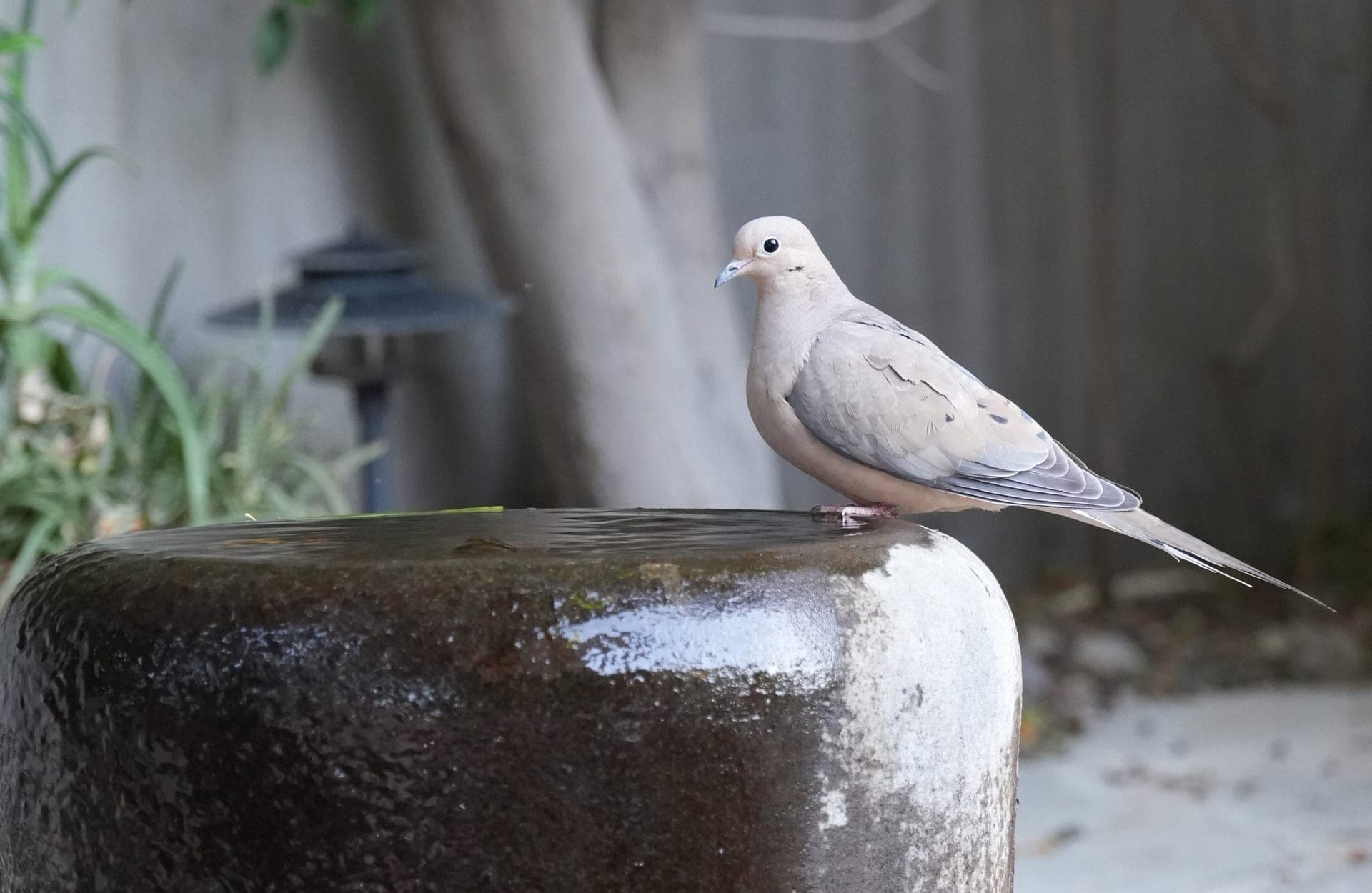
That is not a slogan, it is a fact about diet. Seed feeders are visited by granivores - finches, sparrows, cardinals, chickadees, titmice, jays, nuthatches - and essentially nothing else, because everything else has no reason to come. Warblers, thrushes, vireos, orioles, catbirds, flycatchers and wrens eat insects and fruit, will never touch your sunflower, and will absolutely use your water. Every bird drinks and most of them bathe - provided the water is shallow enough and the bath is somewhere they feel safe, which placement and water depth covers.
So the two devices produce different species lists from the same garden, and the water list is longer and less predictable. If what you want is variety, the bath is the more interesting camera. If what you want is traffic - lots of visits, reliably, all winter - the feeder wins easily.
Quick picks
Ranked on published specifications and what each one costs to own. Every pick names the buyer it is wrong for.
| # | Product | Best for | Price |
|---|---|---|---|
| 1 |  Birdfy Smart Bird Bath (dual-lens, solar, fountain) Dual-lens 2K with auto-tracking, a solar fountain and lifetime AI recognition. Bathing birds behave completely differently to feeding ones. | The best bird bath camera there is, mostly by default | |
| 2 |  Birdbuddy Pro Solar The largest published sensor in the category and the only maker that declines to advertise a species count - both of which point the same way. | The best pictures, if you can live with the app | |
| 3 |  LongPlus Solar Bird Bath Fountain 2K with color night vision and a solar pump. The category has almost no competition, and this is it. | The only real alternative to Birdfy on water |
1. The best bird bath camera there is, mostly by default
Birdfy Smart Bird Bath (dual-lens, solar, fountain)
Dual-lens 2K with auto-tracking, a solar fountain and lifetime AI recognition. Bathing birds behave completely differently to feeding ones.
Water pulls in birds that will never touch a seed feeder. Warblers, thrushes, waxwings - insect and fruit eaters that have no reason to visit a hopper of sunflower seed - all need to drink and bathe. If your feeder camera has shown you the same six species since March, a bath is the single fastest way to change that. It is the argument bath versus feeder camera makes at length.
The moving water is doing as much work as the camera. Birds find water by sound as much as by sight, and a still dish is close to invisible from the air. The three nozzles let you tune how loud it is.
What is not published: water capacity, battery capacity, Wi-Fi band. Water depth is the specification that actually governs which species will use a bath, and nobody publishes it - so measure it yourself, and keep it under about an inch at the shallow edge.
| Camera system | Dual lens, wide plus auto-tracking, 2KSource: Birdfy Bath - manufacturer listing on Amazon, retrieved 1 September 2026 |
|---|---|
| Fountain | Solar-powered, three interchangeable nozzlesSource: Birdfy Bath - manufacturer listing on Amazon, retrieved 1 September 2026 |
| Power | Built-in rechargeable battery with integrated solar panelSource: Birdfy Bath - manufacturer listing on Amazon, retrieved 1 September 2026 |
| AI | Lifetime AI bird recognition stated on the listingSource: Birdfy Bath - manufacturer listing on Amazon, retrieved 1 September 2026 |
| Water capacity | Not published |
| Battery capacity | Not published |
| Wi-Fi band | Not published |
What it does well
- Dual-lens 2K with auto-tracking on a genuinely difficult subject
- Solar fountain with three nozzles - moving water is what brings birds in
- Lifetime AI recognition stated on the listing, no subscription
- Reaches species a seed feeder never will
What it does not
- Water capacity and depth are not published, and depth is what decides which birds use it
- No published battery capacity or Wi-Fi band
- A bath needs emptying and scrubbing far more often than a feeder needs filling
Skip this: if you are not going to clean it. A bird bath is a shared water source, and a dirty one spreads disease through the exact population you are trying to attract. If a weekly scrub is not happening, buy a feeder.
2. The best pictures, if you can live with the app
Birdbuddy Pro Solar
The largest published sensor in the category and the only maker that declines to advertise a species count - both of which point the same way.
A 1/2.7" sensor is a real, checkable number, and it is bigger than anything else in this category will admit to. Sensor area is what governs how a photo looks when a bird lands at dusk, which is when most feeder traffic actually happens. Nobody else publishes the figure, so nobody else can be compared to it.
The thing worth noticing is what is missing. Every rival leads with an AI number - 6,000 species, 10,000 species. Birdbuddy prints none. A maker that does not put a number on its recognition claim is a maker with nothing to walk back, and after you read the species-claim audit that reads as confidence rather than as a gap.
The Wi-Fi position is the one to check before you buy. Birdbuddy's own support documentation says the original camera module requires 2.4GHz and does not work on 5GHz. If your router broadcasts one merged network name, that is the setup that fails - and the fix takes ten minutes once you know about it. It is covered in the Wi-Fi requirements guide.
| Video resolution | 2KSource: Birdbuddy Pro Solar - manufacturer listing on Amazon, retrieved 1 September 2026 |
|---|---|
| Photo resolution | 5MPSource: Birdbuddy Pro Solar - manufacturer listing on Amazon, retrieved 1 September 2026 |
| Sensor size | 1/2.7"The only sensor dimension published by any maker in this roundup.Source: Birdbuddy Pro Solar - manufacturer listing on Amazon, retrieved 1 September 2026 |
| Dynamic range | HDRSource: Birdbuddy Pro Solar - manufacturer listing on Amazon, retrieved 1 September 2026 |
| Wi-Fi band | 2.4GHz for the original camera module; the Birdbuddy 2 module adds 5GHzBirdbuddy's own support pages state the original module does not work on 5GHz.Source: Birdbuddy support: Connectivity and Wi-Fi requirements |
| Solar | Detachable solar roof, rotates 180 degreesSource: Birdbuddy Pro Solar - manufacturer listing on Amazon, retrieved 1 September 2026 |
| Battery capacity | Not publishedNo mAh figure appears on the listing or the support site. |
| Species identified | Not publishedBirdbuddy publishes no species count anywhere we could find. See the AI claims audit. |
| Subscription price | Not publishedNot stated on the listing, and the plan page did not serve us a price. |
What it does well
- Published 1/2.7" sensor with HDR - the only sensor dimension anyone in the category states
- Solar roof detaches and rotates, so the panel can face the sun even when the feeder cannot
- Makes no species-count claim, which is the honest position given the arithmetic
- The largest accessory ecosystem in the category, including perch extenders and nutrition sets
What it does not
- Battery capacity is not published, so runtime cannot be estimated from first principles
- The original camera module is 2.4GHz-only per Birdbuddy's own support pages
- Subscription pricing is not stated on the listing and was not retrievable from the plan page
Skip this: if you want every feature unlocked with no ongoing decision to make. Birdbuddy's premium tier exists, its price is not published where a buyer can find it, and buying into an unpriced subscription is exactly the trap the three-year cost guide was written about.
3. The only real alternative to Birdfy on water
LongPlus Solar Bird Bath Fountain
2K with color night vision and a solar pump. The category has almost no competition, and this is it.
Color night vision is the interesting claim. Most cameras in this category fall back to infrared after dusk, which turns everything gray. Color at night on a water source is genuinely useful, because a bird bath gets visitors that a feeder does not - and some of them are not birds.
This exists on the page because the smart bird bath category has essentially one incumbent, and a market with one product in it is a market where the buyer has no leverage. LongPlus at least gives you a second quote.
Very little is published, which is the pattern with newer entrants. Treat the specification list as shorter than the marketing copy suggests.
| Video resolution | 2K with color night visionSource: LongPlus bath - manufacturer listing on Amazon, retrieved 1 September 2026 |
|---|---|
| Pump | Solar-powered outdoor pumpSource: LongPlus bath - manufacturer listing on Amazon, retrieved 1 September 2026 |
| AI | Smart AI species recognitionSource: LongPlus bath - manufacturer listing on Amazon, retrieved 1 September 2026 |
| Water capacity | Not published |
| Battery capacity | Not published |
| Wi-Fi band | Not published |
| Species identified | Not published |
What it does well
- Color night vision rather than infrared
- Solar pump, so the water moves without a cable
- A genuine second option in a category with one incumbent
What it does not
- Almost nothing published beyond the headline features
- No stated species scope for the AI
- A newer brand with a shorter track record
Skip this: if you want the dual-lens close-up. Birdfy's bath puts a tracking lens on the bird; this frames the whole dish.
The four questions that actually decide it
1. What season are you buying for?
This is the biggest practical difference and it barely gets mentioned. A seed feeder peaks in cold weather, when natural food is scarce and birds need calories - a feeder camera in January is the busiest device on this site. A bird bath peaks in heat and in drought, when open water is hard to find, and it can be very quiet in a wet spring.
They are therefore complementary rather than competing, and if you are buying in autumn the feeder will reward you sooner. If you live somewhere with hot dry summers, the bath will out-perform the feeder for months.
2. How much maintenance will you actually do?
Be honest about this one, because it is where regret comes from. A feeder needs refilling and an occasional clean. A bath needs emptying, scrubbing and refilling on a schedule measured in days in warm weather, because standing water grows algae and biofilm and a dirty bath spreads disease among the birds using it.
That is not a reason to avoid a bath - it is a reason to know what you are signing up for. The cleaning and water guide sets out the actual routine. If reading it makes you tired, buy the feeder.
3. What does the camera have to cope with?
A feeder camera watches a perch a few inches away, at a known spot, with a bird that holds still while it eats. A bath camera watches a wider basin where the bird may land anywhere on the rim, moves constantly, and throws water at the lens.
That makes framing harder and it makes the case for the dual-lens baths, which put a tracking lens on the bird as well as a wide view on the dish. It also means splash and evaporation deposits on the housing are a real maintenance item that no feeder has.
4. Where can you actually put it?
Both need Wi-Fi, and a bath is typically sited further from the house than a feeder - out in the open, away from cover that would let a cat approach unseen. Nearly everything in this category is 2.4GHz-only, which travels further than 5GHz but still has limits. Work out the signal at the spot before you buy, not after: the Wi-Fi requirements guide covers what to check.
Side by side
| Feeder camera | Bath camera | |
|---|---|---|
| Species range | Granivores only - finches, cardinals, chickadees, jays | Every bird that drinks, including insectivores that ignore seed |
| Traffic volume | Higher, especially in cold weather | Lower but more varied; peaks in heat and drought |
| Peak season | Autumn through winter | Summer, and any dry spell |
| Maintenance | Refill seed, occasional clean | Empty, scrub and refill every few days in warm weather |
| Camera difficulty | Easy - fixed perch, still subject, close range | Harder - wider area, constant movement, water on the lens |
| Choice of models | Wide - the whole of the flagship roundup | Narrow - one incumbent and one real alternative |
| Winter behavior | Busiest time of year | Freezes without a heater; many people take it in |
The size of the field, which is not a small point
One practical asymmetry worth knowing before you commit: there is a great deal of choice in feeder cameras and almost none in bath cameras.
Feeder cameras come from a dozen makers at every price point, in plastic and metal, solar and not, with and without subscriptions - which means you can shop for the specific compromise you want. Bath cameras are essentially one incumbent selling the same product in two billing configurations, plus one alternative. If the incumbent's arrangement does not suit you, there is no third option to fall back on.
That matters for a reason beyond price. These are app-dependent devices, and a category with one serious supplier is a category where you have no answer if that supplier changes its terms. It is not a reason to avoid a bath camera; it is a reason to weigh the subscription position harder here than you would on a feeder, where walking away is easy.
The freeze problem, which decides it in cold regions
A bird bath in a hard-winter climate freezes, and a frozen bath is a decoration. Heated baths exist; a heated bath with a camera in it is not really a category yet. So in the northern half of the country a bath camera is a three-season device at best, and it is out of action for exactly the months when the feeder camera is at its most productive.
If you are in a mild or dry region, that reverses. A bath in a Californian or Arizonan summer is the busiest thing in the yard while the feeder goes quiet.
One thing a bath does that a feeder cannot
Worth stating separately because it is the strongest argument for a bath and it is almost never made: migration.
Birds moving through your area in spring and autumn are not residents and have no interest in establishing a feeding routine at your hopper. Warblers passing overnight and dropping into a garden at dawn are looking for insects and for water, not for sunflower seed. A bath is how you meet them; a feeder is not, and no amount of camera specification changes that.
That is also why a bath's quiet weeks and its remarkable weeks are further apart than a feeder's. A feeder gives you a steady cast of a couple of dozen regulars. A bath gives you fewer visits and a longer list, with occasional days in migration season that a feeder camera will never produce.
So which do you buy first?
Buy the feeder camera first if you are in a cold-winter region, if you want reliable traffic, if this is a gift, or if you are not certain how much maintenance you will really do. It is the easier product to succeed with and there is far more choice - the flagship roundup ranks the field.
Buy the bath camera first if you already have a feeder and the visitor list has stopped surprising you, if you live somewhere hot or dry, or if what you want is the widest possible range of species rather than the most footage. The bath roundup covers a deliberately short field, and the honest reason it is short is that almost nobody makes these.
And if you are going to end up with both - which many people do - the order that works best is feeder in autumn, bath in spring. That way each device arrives just before its own season instead of sitting through the other one.
Questions people actually ask
Which attracts more birds, a bird bath or a feeder?
A feeder attracts more visits; a bath attracts more species. Seed only interests granivores, while every bird drinks - so warblers, thrushes, orioles and catbirds will use water and never touch your sunflower.
Should I buy a bird bath camera or a feeder camera first?
The feeder, in most cases - it is easier to succeed with, works best in winter, and there is far more choice. Buy the bath first if you live somewhere hot or dry, or if you already have a feeder and want a wider range of species.
Is a bird bath camera more work?
Considerably. Standing water needs emptying, scrubbing and refilling every few days in warm weather, because a dirty bath spreads disease. A feeder needs topping up and an occasional clean.
Do bird bath cameras work in winter?
Not in a hard freeze. The water ices over, and a heated bath with a built-in camera is not really a product category yet. In cold regions treat it as a three-season device.
Can I use one camera for both?
No - these are integrated products, with the camera built into the feeder or the basin. They are separate purchases, which is part of why the order you buy them in is worth thinking about.
Which gives better footage?
The feeder, usually - a fixed perch inches from the lens with a bird that holds still is a far easier subject than a wide basin with a bird splashing in it. The dual-lens baths exist to close some of that gap.