Smart Bird Bath Cameras
Bird Bath Placement and Water Depth
Two decisions made in the first ten minutes determine whether your bath gets used at all - and one of them has a published number attached that most baths sold today ignore.
How this page is funded. Buying through a link here earns us a commission at no extra cost to you. It does not change what we recommend or the order we recommend it in, and we have not handled any of these products ourselves - see how we pick and the full disclosure.
A bird bath camera films whatever the bath earns. You can buy the better sensor, pay for the identification plan and mount it perfectly, and if the basin is too deep and standing in the wrong part of the yard you will spend the season watching an empty dish in high resolution. The hardware is the part with the specifications. The two decisions that actually fill the frame are free, reversible, and almost never discussed on a product listing.
This guide covers those two: how deep the water should be, and where the bath should stand. Both have the same failure mode - they look fine to a person and are unusable to a bird - which is why a bath that gets no visitors is so often diagnosed as a bad location when it is really a bad depth.
Depth: the number most baths get wrong
Audubon publishes a figure, and it is much shallower than the concrete pedestal baths sold in garden centers. Water should be only about an inch (2.5 cm) to an inch-and-a-half (3.8 cm) deep, and the basin itself should be not more than two inches (5 cm) deep. That is it. If your bath holds more water than a dinner plate, you are filling it wrong.
The reason is that birds do not swim in a bath. They stand in it. Bathing is a standing action - the bird plants its feet on the bottom, crouches, and beats water through its feathers with its wings. It needs to feel the floor. Water deeper than its legs is not a better bath, it is a hazard, and a bird assessing an unfamiliar basin from the rim will decline rather than find out.
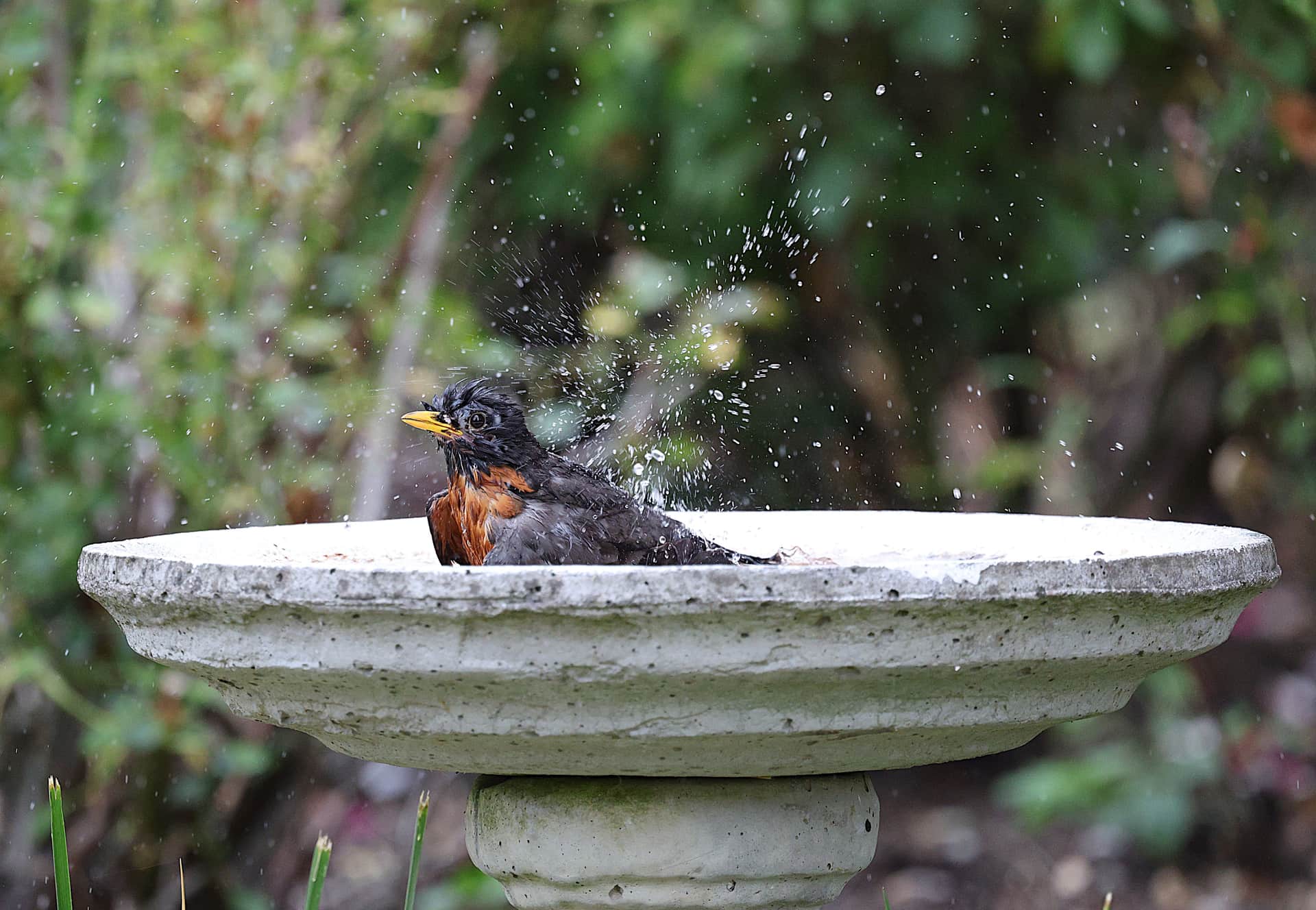
This is also why small birds are the ones you lose first. An inch and a half is ankle-deep to a robin and chest-deep to a chickadee, and the birds most people are hoping to film - the small, fast, interesting ones - are precisely the birds a deep basin excludes. A bath filled to the brim does not select for fewer birds evenly. It selects against the small ones.
What to do if the bath you own is already too deep
You do not need a new bath, and this is the single most useful sentence in this guide for anyone who already bought one. Audubon's fix is to toss in a few large pebbles or a flat stone, which gives the birds confidence to enter the water because it helps them judge how deep it is.
That is doing two things at once. It physically raises the floor, so a deep basin now has a shallow part. And it gives the bird a visual reading of the depth from the rim, which solves the assessment problem rather than just the physical one - a bird that can see the bottom will approach water it would otherwise refuse.
On a camera bath there is a third benefit that nobody set out to design. A flat stone is a perch, and a perch is a predictable position. Birds at a bath ordinarily move around the whole basin, which is the framing problem that makes bath footage harder than feeder footage. A stone placed in the camera's best focal zone concentrates the action where the lens is already looking.
Where it goes: three constraints that disagree
Siting a bath is not a matter of finding the good spot. It is a matter of trading off constraints that genuinely pull in different directions, and knowing which one you are sacrificing.
Cover nearby, but not overhanging
Audubon is direct about this: there should be some evergreens or other shrubs nearby. A wet bird is a slow bird. Bathing soaks the flight feathers, and for the minute or two it takes to shake out and preen, a bird is at its least able to escape. It will not take that risk in the open with nowhere to retreat to.
The tension is that the same shrub which gives a bird somewhere to dive into also gives a cat somewhere to wait. Dense cover pressed right up against the basin is worse than no cover at all. What you want is cover within a short flight - a few yards, close enough to reach in one movement - with open ground immediately around the bath itself so nothing can get close unseen. Branches slightly above the bath are useful for the same reason: a bird that has just bathed wants somewhere to preen dry, and it would rather do it a few feet up than on the ground.
Shade, which fights the solar panel
Shade does three things. It slows evaporation, so the bath does not empty itself in July. It slows algae, because warm water in direct sun is where algae wins. And for a camera specifically it removes the glare problem: water in direct sunlight reflects hard, and a small sensor handles that badly, blowing out exactly the part of the frame the bird is standing in.
The catch is that most bath cameras and most fountain pumps are solar. The placement that is best for the water is the worst for the panel, and this is a genuine conflict with no clean answer. Dappled shade - morning sun, afternoon shade - is the usual compromise. If your bath must sit in deep shade, that is an argument for a mains-powered dripper over a solar fountain, and an argument for checking how the camera you are considering charges before you buy it. The roundup sets out which models depend on solar and which do not.
Level ground, and close enough to a tap
Audubon notes that the ground should be level, which sounds like the least important line in this guide and is not. A basin holding an inch of water on a slight slope holds half an inch at one end and nothing at the other, and the shallow end is where the algae ring forms. On a camera bath a tilt also means the water line sits diagonally across the frame, which looks wrong in every clip you record.
The practical constraint nobody mentions is distance from a water source. You are going to change this water every few days through the whole warm half of the year. A bath sited at the bottom of the garden is a bath you will stop maintaining by August, and the maintenance is not optional - see the cleaning and water guide for what the schedule actually involves.
Height off the ground
Here we have to be honest about the limits of what we can source. Pedestal baths are conventionally sold at around waist height and ground-level baths are also widely recommended, and we could not find a published figure from Audubon or the Cornell Lab that settles the question. We are not going to invent one.
What can be said without a citation is the trade-off itself. A ground-level bath is closer to how birds encounter water in nature and is used by species that are reluctant to come up to a pedestal. A raised bath is safer from cats and easier for you to reach when you are changing the water twice a week. If you have outdoor cats in the neighborhood, that is the deciding factor and it decides in favor of height. If you do not, ground level is the more natural arrangement. For a camera, a raised bath also puts the basin nearer eye level, which is a better angle than looking down into a dish.
Setting up a bath from scratch
- 1
Pick the spot before you buy the bath
Cover within a short flight, open ground immediately around the basin, dappled shade rather than full sun, level footing, and near enough to a tap that you will still be refilling it in August.
- 2
Check the basin depth, not the bath height
Two inches (5 cm) maximum on the basin itself. Most decorative concrete baths are deeper than this and need stones from day one.
- 3
Fill to about an inch
An inch to an inch and a half. It will look under-filled. That is correct - the birds are standing, not swimming.
- 4
Add a flat stone or a few large pebbles
Mandatory if the basin is deeper than two inches, worth doing anyway. It raises the floor, shows the bird the depth from the rim, and on a camera bath it gives you a predictable perch in frame.
- 5
Add moving water if you can
Birds locate water by ear before they see it, and a dripper or small fountain markedly increases traffic over the same basin left still. This is the cheapest upgrade available.
- 6
Leave it alone for two weeks
Baths are found slowly. A new bath with no visitors after three days is not a failed bath, and moving it repeatedly is the commonest way to guarantee it never gets discovered.
- 7
Only then mount the camera
Site the bath for the birds first and the camera second. A bath positioned to suit a lens is a bath that films nothing.
Quick picks
Ranked on published specifications and what each one costs to own. Every pick names the buyer it is wrong for.
| # | Product | Best for | Price |
|---|---|---|---|
| 1 |  Birdfy Smart Bird Bath (dual-lens, solar, fountain) Dual-lens 2K with auto-tracking, a solar fountain and lifetime AI recognition. Bathing birds behave completely differently to feeding ones. | The best bird bath camera there is, mostly by default | |
| 2 |  LongPlus Solar Bird Bath Fountain 2K with color night vision and a solar pump. The category has almost no competition, and this is it. | The only real alternative to Birdfy on water | |
| 3 |  K&H Bird Bath Heater (Super Ice Eliminator, 80W) An 80W rock-styled deicer that drops into an existing basin - the accessory that decides whether your bath camera films anything between December and March. | Keeping a bath usable through a freezing winter | $28.91 - View on Amazon #ad Price checked October 17, 2026. How this is funded |
| 4 |  AISITIN 3-Tier Solar Bird Bath Fountain (3.5W pump) A 3.5W solar pump with a tiered head that turns a plain basin into moving water - no wiring, no battery to replace, and no operation on a dull day. | Adding moving water to a still basin for the price of a takeaway | $19.99 - View on Amazon #ad Price checked October 17, 2026. How this is funded |
1. The best bird bath camera there is, mostly by default
Birdfy Smart Bird Bath (dual-lens, solar, fountain)
Dual-lens 2K with auto-tracking, a solar fountain and lifetime AI recognition. Bathing birds behave completely differently to feeding ones.
Water pulls in birds that will never touch a seed feeder. Warblers, thrushes, waxwings - insect and fruit eaters that have no reason to visit a hopper of sunflower seed - all need to drink and bathe. If your feeder camera has shown you the same six species since March, a bath is the single fastest way to change that. It is the argument bath versus feeder camera makes at length.
The moving water is doing as much work as the camera. Birds find water by sound as much as by sight, and a still dish is close to invisible from the air. The three nozzles let you tune how loud it is.
What is not published: water capacity, battery capacity, Wi-Fi band. Water depth is the specification that actually governs which species will use a bath, and nobody publishes it - so measure it yourself, and keep it under about an inch at the shallow edge.
| Camera system | Dual lens, wide plus auto-tracking, 2KSource: Birdfy Bath - manufacturer listing on Amazon, retrieved 1 September 2026 |
|---|---|
| Fountain | Solar-powered, three interchangeable nozzlesSource: Birdfy Bath - manufacturer listing on Amazon, retrieved 1 September 2026 |
| Power | Built-in rechargeable battery with integrated solar panelSource: Birdfy Bath - manufacturer listing on Amazon, retrieved 1 September 2026 |
| AI | Lifetime AI bird recognition stated on the listingSource: Birdfy Bath - manufacturer listing on Amazon, retrieved 1 September 2026 |
| Water capacity | Not published |
| Battery capacity | Not published |
| Wi-Fi band | Not published |
What it does well
- Dual-lens 2K with auto-tracking on a genuinely difficult subject
- Solar fountain with three nozzles - moving water is what brings birds in
- Lifetime AI recognition stated on the listing, no subscription
- Reaches species a seed feeder never will
What it does not
- Water capacity and depth are not published, and depth is what decides which birds use it
- No published battery capacity or Wi-Fi band
- A bath needs emptying and scrubbing far more often than a feeder needs filling
Skip this: if you are not going to clean it. A bird bath is a shared water source, and a dirty one spreads disease through the exact population you are trying to attract. If a weekly scrub is not happening, buy a feeder.
2. The only real alternative to Birdfy on water
LongPlus Solar Bird Bath Fountain
2K with color night vision and a solar pump. The category has almost no competition, and this is it.
Color night vision is the interesting claim. Most cameras in this category fall back to infrared after dusk, which turns everything gray. Color at night on a water source is genuinely useful, because a bird bath gets visitors that a feeder does not - and some of them are not birds.
This exists on the page because the smart bird bath category has essentially one incumbent, and a market with one product in it is a market where the buyer has no leverage. LongPlus at least gives you a second quote.
Very little is published, which is the pattern with newer entrants. Treat the specification list as shorter than the marketing copy suggests.
| Video resolution | 2K with color night visionSource: LongPlus bath - manufacturer listing on Amazon, retrieved 1 September 2026 |
|---|---|
| Pump | Solar-powered outdoor pumpSource: LongPlus bath - manufacturer listing on Amazon, retrieved 1 September 2026 |
| AI | Smart AI species recognitionSource: LongPlus bath - manufacturer listing on Amazon, retrieved 1 September 2026 |
| Water capacity | Not published |
| Battery capacity | Not published |
| Wi-Fi band | Not published |
| Species identified | Not published |
What it does well
- Color night vision rather than infrared
- Solar pump, so the water moves without a cable
- A genuine second option in a category with one incumbent
What it does not
- Almost nothing published beyond the headline features
- No stated species scope for the AI
- A newer brand with a shorter track record
Skip this: if you want the dual-lens close-up. Birdfy's bath puts a tracking lens on the bird; this frames the whole dish.
3. Keeping a bath usable through a freezing winter
K&H Bird Bath Heater (Super Ice Eliminator, 80W)
An 80W rock-styled deicer that drops into an existing basin - the accessory that decides whether your bath camera films anything between December and March.
#ad Price checked October 17, 2026. How this is funded
This is the least interesting product on this page and the one most likely to change what your camera records. A bath that freezes is a bath that gets no visitors for three months, and winter is the season when open water is scarcest and therefore most valuable to birds.
80W is real electricity. It is not ruinous, but it is not nothing either, and because no thermostat threshold is published you cannot work out how many hours a season it will actually draw. Assume it runs whenever the air is near freezing.
The rock styling is cosmetic, but it matters more than it sounds on a camera bath - a bare metal disc in the middle of the frame is in every clip you record all winter.
| Power draw | 80WRuns from a household outlet, so an outdoor-rated extension run is part of the install.Source: K&H Bird Bath Heater - manufacturer listing on Amazon, retrieved 1 September 2026 |
|---|---|
| Form | Free-standing rock-styled unit that sits in the basinIt is not built into a bath - it is dropped into one you already own.Source: K&H Bird Bath Heater - manufacturer listing on Amazon, retrieved 1 September 2026 |
| Safety certification | Listed by an independent safety agencyThe listing describes it as "Safety Listed". The agency and file number are not named.Source: K&H Bird Bath Heater - manufacturer listing on Amazon, retrieved 1 September 2026 |
| Thermostat threshold | Not publishedNo switch-on temperature is published, so you cannot calculate what it costs to run in your winter. |
| Cord length | Not published |
| Basin sizes it suits | Not published |
What it does well
- Solves the one failure that takes a bath camera offline for an entire season
- Drops into a bath you already own rather than replacing it
- Described as safety listed, which not every deicer in this bracket claims
What it does not
- 80W from a mains outlet - you need an outdoor-rated cord run to the bath
- No published thermostat threshold, so running cost cannot be estimated
- No published cord length or basin compatibility
- Sits visibly in frame on a camera bath
Skip this: if your winters do not reach freezing, or if there is no safe way to run power to where the bath stands. A deicer with an improvised indoor extension lead across a wet garden is not worth the footage.
4. Adding moving water to a still basin for the price of a takeaway
AISITIN 3-Tier Solar Bird Bath Fountain (3.5W pump)
A 3.5W solar pump with a tiered head that turns a plain basin into moving water - no wiring, no battery to replace, and no operation on a dull day.
#ad Price checked October 17, 2026. How this is funded
Moving water is the single cheapest upgrade to a bath's traffic, because birds locate water by ear before they see it. A pump at this price is a smaller intervention than repositioning the bath and usually a bigger one in effect.
The thing nobody tells you about direct-drive solar pumps: with no published battery storage, the fountain stops when a cloud crosses and starts again after. Birds appear not to mind. Owners often do.
No published spray height is a genuine gap for a camera bath. A head that throws water too high empties a shallow basin faster than you will top it up, and puts droplets on the lens.
| Pump rating | 3.5WSource: AISITIN Solar Bird Bath Fountain - manufacturer listing on Amazon, retrieved 1 September 2026 |
|---|---|
| Power source | Solar panel, direct driveSunlight on the panel is what runs the pump.Source: AISITIN Solar Bird Bath Fountain - manufacturer listing on Amazon, retrieved 1 September 2026 |
| Head design | 3-tier fountain headSource: AISITIN Solar Bird Bath Fountain - manufacturer listing on Amazon, retrieved 1 September 2026 |
| Battery storage | Not publishedThe listing does not state whether it stores charge, which decides whether it keeps running when a cloud passes. |
| Flow rate | Not published |
| Spray height | Not publishedMatters more than it sounds: too high and it empties the basin over the rim. |
| Minimum water depth to run | Not published |
What it does well
- Moving water with no wiring and nothing to plug in
- Cheap enough to try against a basin you already own
- No battery to replace and nothing to subscribe to
What it does not
- No published battery storage - likely stops whenever the sun goes in
- No published flow rate, spray height or minimum operating depth
- A shaded bath, which is the bath siting we recommend, is the worst place for a solar panel
- Adds spray to a lens that is already dealing with a wet subject
Skip this: if your bath sits in full shade - the placement that is best for the water is the worst for a solar panel, and a mains dripper is the honest answer there.
What changes when there is a camera on it
Three things, and they all pull toward the same choices this guide already recommends.
Glare is the first. Water is a mirror, and a bath in direct sun produces reflections a small sensor cannot hold alongside a dark bird. The shade argument, which was already an argument about algae and evaporation, becomes an image-quality argument too.
Motion is the second. Bathing is vigorous and fast - much faster than perching at a feeder port - so bath footage is where motion blur shows up. Nothing in placement fixes that, but the stone does help, because a bird that pauses on a perch gives you the still frame that a bird thrashing in open water never will.
Framing is the third, and it is the structural difference between bath cameras and feeder cameras. A feeder has a port, and the bird comes to it. A bath has an area, and the bird uses all of it. That is why the dual-lens baths exist and why the Birdfy bath review spends so much time on coverage, and it is why the flat stone earns its place three separate times in this guide.
The two seasons that break a bath
Summer is evaporation. An inch of water in a shallow basin in full sun is gone in a day, and a dry bath teaches birds to stop checking. Shade buys you time and a deeper reservoir does not, because the fix for evaporation is not more depth - depth is capped at two inches for reasons that have nothing to do with summer.
Winter is ice, and it is the one that takes a camera offline for an entire quarter. Open water in freezing weather is scarcer than food and worth more to birds than anything you can put in a feeder, so a bath that stays liquid through a hard winter is not a marginal upgrade - it is the difference between three months of footage and three months of a frozen dish. That is what the deicer in the picks above is for, and it is the reason a fairly boring 80W accessory sits alongside two cameras on this page. One caveat that matters: the solar camera baths are three-season products, and a deicer belongs in a separate basin with no electronics in it rather than in the camera bath - the cleaning and water guide explains why.
One winter note that follows from the depth rule rather than contradicting it: the stones are useful in freezing weather for a second reason, because a bird can stand on a stone and drink without getting into the water at all. Getting wet at 20 degrees is dangerous for a small bird in a way that getting wet in June is not.
If you are still deciding whether to buy one
This guide assumes you are committed to a bath. If you are choosing between a bath and a seed feeder for a first camera, the honest answer is not the one that sells the more interesting product - bird bath camera versus feeder camera works through the four questions that decide it, and the bath hub sets out why water attracts a wider set of species than seed ever will, including everything insectivorous that will never touch a feeder.
What is worth saying here is that placement and depth are the cheapest part of this entire category and the part with the largest effect. The gap between a good bath camera and a mediocre one is real but modest. The gap between a correctly sited, correctly filled bath and one standing in full sun holding four inches of water is the difference between footage and no footage, and it costs nothing to close.
Questions people actually ask
How deep should the water in a bird bath be?
About an inch to an inch and a half (2.5 to 3.8 cm), in a basin no more than two inches (5 cm) deep, per Audubon. Birds stand in a bath rather than swimming, so deeper water is not a better bath - it excludes the smallest birds first.
My bird bath is too deep. Do I need a new one?
No. Add a flat stone or a few large pebbles. That raises the floor and, just as importantly, lets a bird judge the depth from the rim before committing - which is the part that decides whether it comes in at all.
Should a bird bath be in sun or shade?
Shade, on balance - it slows evaporation and algae, and it removes the glare that makes water hard for a small camera sensor. The complication is that most bath cameras and fountain pumps are solar, so dappled shade is usually the working compromise.
How close to bushes should a bird bath be?
Near enough to reach in one short flight, but not overhung. Audubon recommends evergreens or shrubs nearby because a wet bird is slow and needs an escape route. Cover pressed against the basin is worse than none, because it is also where a cat waits.
Should a bird bath be on the ground or raised?
Neither is universally right and we could not find a published figure that settles it. Ground level is more natural and reaches species that avoid pedestals; raised is safer where there are outdoor cats and easier for you to refill. For a camera, raised gives the better angle.
How long before birds find a new bird bath?
Longer than most people expect - give it two weeks before you judge it. Moving a bath repeatedly in the first week is the commonest reason one never gets discovered.
Does a bird bath need moving water?
It does not have to have it, but birds locate water by sound as well as sight and a dripper or fountain markedly increases traffic. Moving water also does not breed mosquitoes, which standing water in warm weather will.