Smart Bird Feeder Cameras
Kiwibit Smart Bird Feeder (4K)
The most specification per dollar in the category, a species claim that needs unpacking, and a brand name that changed underneath the product - which is worth knowing before you search for reviews of it.
How this page is funded. Buying through a link here earns us a commission at no extra cost to you. It does not change what we recommend or the order we recommend it in, and we have not handled any of these products ourselves - see how we pick and the full disclosure.
If you searched for Beako and landed here, that is deliberate. Beako is now Kiwibit - same product line, new name - and searches against the retired brand still run into pages that describe a product you can no longer buy under that name. Everything below is about the current listing.
The value case, which is real
Kiwibit publishes 4K and a solid list of supporting specifications at a price meaningfully below the two established brands. On specification-per-dollar it is the strongest thing on this site, and if you are shopping on a spreadsheet it wins.
The qualification is the one that applies across this whole category: 4K on a small lens, cropped to a perch a few inches away, compressed for upload over a 2.4GHz link, is not four times the useful detail of 2K. And because Kiwibit does not publish a sensor dimension - almost nobody does - there is no way to compare the thing that would actually settle it. See the buying guide for why resolution is the most-printed and least-useful number in this category.
The 10,000-species claim
Kiwibit advertises identification of more than 10,000 species. The IOC World Bird List recognizes 11,227 species of which 164 are extinct - about 11,063 living. So this is a claim to recognize roughly nine in ten birds alive on Earth, made about a camera bolted to a seed hopper in somebody's backyard.
It is not necessarily false. Image classifiers are trained on large public datasets and a model can carry an enormous label set. But the claim is doing marketing work rather than engineering work: the ABA checklist for the whole of North America is 1,161 species, a feeder in a US yard will see perhaps twenty to sixty in a year, and every app in this category handles that set. The full audit is here, including why a bigger label set can make a classifier worse rather than better at the birds you actually have.
Quick picks
Ranked on published specifications and what each one costs to own. Every pick names the buyer it is wrong for.
| # | Product | Best for | Price |
|---|---|---|---|
| 1 |  Kiwibit Smart Bird Feeder (4K) 4K, 8MP, a stated 5,200mAh cell and a stated 3W panel, with an IP65 rating and a real temperature range. Then it claims 10,000+ species. | The most published specification per dollar | |
| 2 | 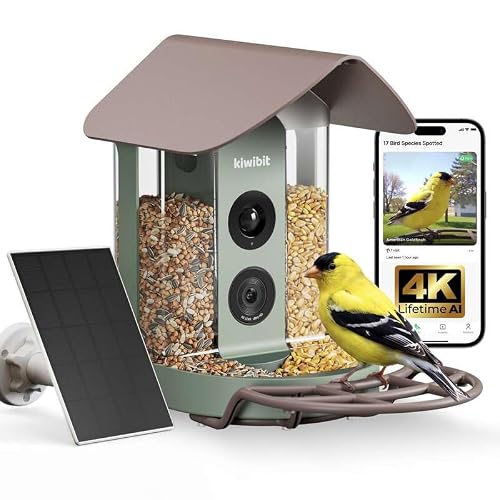 Kiwibit 4K, No-Subscription Edition The same hardware with lifetime AI identification stated on the listing. For a gift, that single line is worth more than any spec on it. | A gift that will never send anyone a bill |
1. The most published specification per dollar
Kiwibit Smart Bird Feeder (4K)
4K, 8MP, a stated 5,200mAh cell and a stated 3W panel, with an IP65 rating and a real temperature range. Then it claims 10,000+ species.
Kiwibit publishes more of its own numbers than anyone else here, and the ones it publishes are good: a 5,200mAh cell, a 3W adjustable panel, IP65, and an operating range of -4F to 122F. That last figure is 18 degrees colder at the bottom than Birdfy's, which is the difference between a camera that works through a Minnesota February and one that does not.
This is also the brand formerly sold as Beako. If you have read a review of a Beako feeder, you have read a review of this. The rename is why searches for the old name land here.
And then there is the 10,000+ figure. There are 11,227 bird species in the world by the current IOC list and 1,161 in the entire ABA Area. A claim of 10,000+ on a device pointed at a six-inch perch in North America is a claim about a training set, not about your backyard. It is not a lie, but it is not information either - here is what the number can honestly mean.
What it does well
- Publishes battery, panel wattage, ingress rating and temperature range - unusually complete
- -4F to 122F is the widest published operating range on this page
- 4K and 8MP stills give genuine cropping room
- Free live view, playback and motion alerts per the maker's listing
What it does not
- The 10,000+ species claim is 8.6x the entire ABA Area list
- Sensor size is not published, so the 8MP figure has no context
- The Beako rename means older reviews are filed under a brand name that no longer exists
Skip this: if the species number is what sold you on it. Buy it for the battery, the panel and the temperature range, which are real published figures you can hold the maker to.
2. A gift that will never send anyone a bill
Kiwibit 4K, No-Subscription Edition
The same hardware with lifetime AI identification stated on the listing. For a gift, that single line is worth more than any spec on it.
A gift that arrives with a monthly fee attached is a gift that keeps asking the recipient for money. That is the whole argument for this variant, and it is why it leads the no-subscription roundup.
Read the wording carefully before you buy, though, because it is the wording that matters. The listing says lifetime AI identification, not lifetime cloud storage, and those are different promises. Storage terms in this category change quietly, and a lifetime claim on one feature says nothing about the other.
Everything else is the Kiwibit 4K platform: the same 5,200mAh cell, the same 4K stream, the same 8MP stills.
| Subscription | No subscription; lifetime AI identification stated on the listingSource: Kiwibit no-subscription - manufacturer listing on Amazon, retrieved 1 September 2026 |
|---|---|
| Video resolution | 4K live streamSource: Kiwibit no-subscription - manufacturer listing on Amazon, retrieved 1 September 2026 |
| Photo resolution | 8MPSource: Kiwibit no-subscription - manufacturer listing on Amazon, retrieved 1 September 2026 |
| Solar | Solar poweredSource: Kiwibit no-subscription - manufacturer listing on Amazon, retrieved 1 September 2026 |
| Battery capacity | 5,200mAhPublished for the Kiwibit 4K platform.Source: Kiwibit 4K - manufacturer listing on Amazon, retrieved 1 September 2026 |
| Sensor size | Not published |
| Species identified | Not publishedThis listing states lifetime identification without naming a count. |
What it does well
- Lifetime AI identification stated in writing on the maker's own listing
- Nothing to explain to the person you gave it to
- Same published 4K and 8MP capture as the subscription variant
What it does not
- Lifetime AI is not the same promise as lifetime cloud storage
- No published sensor size
- The species count is not stated on this variant, so it cannot be compared like for like
Skip this: if you want the deepest cloud archive you can get. A no-subscription model is a model with a smaller storage story, and if you plan to keep three years of clips you should read the three-year cost comparison before deciding.
The no-subscription edition, which is the interesting one
Kiwibit sells a second 4K model whose listing states plainly that no subscription is required. In a category where the identification feature is routinely held behind a plan and the plan price is routinely unpublished, that is a commitment worth having in writing - and it is the single best reason to look at this brand.
It is also, for the same reason, the strongest gift in the category: nobody wants to unwrap a present that asks for a card number to work. That argument is made properly in the gift roundup, and the cost side of it in the subscription guide.
The brand-age question
This is a newer name than Birdbuddy or Netvue, and it has already changed once. That carries a real risk that has nothing to do with the hardware: these are app-dependent devices, and a feeder whose maker stops publishing the app is a plastic box. We have no evidence that is happening here, and we are not going to imply we do - but a brand with a shorter track record is a consideration you are entitled to weigh, particularly against a purchase you expect to keep for three years.
Who should not buy this
Anyone who wants the best image on published specifications - that is the Birdbuddy, on the sensor dimension. And anyone buying primarily on the strength of the 10,000-species number, because that number is not what it appears to be for a US backyard. For the wider view, is Kiwibit worth it is the brand-level verdict across all four models, and VicoHome versus Kiwibit sets it against the closest challenger.
Questions people actually ask
Is Kiwibit the same as Beako?
Yes - Beako was renamed Kiwibit. The product line continued under the new name, which is why searches for Beako reviews turn up material about a product you can no longer buy under that name.
Does the Kiwibit feeder need a subscription?
The standard 4K model offers a plan. A separate no-subscription edition states plainly that none is required - that is the one to buy if recurring charges are the objection.
Can it really identify 10,000 species?
That is the published claim, and it is not obviously impossible - large label sets are ordinary in image classification. It is also irrelevant to a US backyard, where the ABA checklist covers 1,161 species for the entire continent and a feeder sees a few dozen a year.
Is Kiwibit as good as Birdbuddy?
Better on paper per dollar, and it publishes 4K where Birdbuddy publishes 2K. Birdbuddy publishes a sensor dimension, which is the specification that actually decides a backlit shot, and has the longer track record. The head-to-head sets them against each other.
Sources
- Kiwibit Smart Bird Feeder 4K - manufacturer listing on Amazon, retrieved 1 September 2026
- Kiwibit 4K No-Subscription Edition - manufacturer listing on Amazon, retrieved 1 September 2026
- IOC World Bird List v15.2 (13 April 2026), International Ornithologists' Union
- ABA Checklist v8.19 (January 2026), American Birding Association
- Merlin Bird ID, Cornell Lab of Ornithology