Smart Bird Feeder Cameras
Birdbuddy vs Kiwibit
The genuine value argument in this category: more specification per dollar against a longer track record and the one number that actually decides a photograph.
How this page is funded. Buying through a link here earns us a commission at no extra cost to you. It does not change what we recommend or the order we recommend it in, and we have not handled any of these products ourselves - see how we pick and the full disclosure.
This is the comparison where the specification sheet and the sensible purchase disagree most sharply, which makes it the most interesting one on the site.
Kiwibit publishes 4K and claims identification of over 10,000 species, at a price below the Birdbuddy. Birdbuddy publishes 2K, no species count, and costs more. On paper that is not close. In practice it is very close indeed, and the reasons are worth understanding because they apply to the whole category.
Quick picks
Ranked on published specifications and what each one costs to own. Every pick names the buyer it is wrong for.
| # | Product | Best for | Price |
|---|---|---|---|
| 1 |  Birdbuddy Pro Solar The largest published sensor in the category and the only maker that declines to advertise a species count - both of which point the same way. | The best pictures, if you can live with the app | |
| 2 |  Kiwibit Smart Bird Feeder (4K) 4K, 8MP, a stated 5,200mAh cell and a stated 3W panel, with an IP65 rating and a real temperature range. Then it claims 10,000+ species. | The most published specification per dollar | |
| 3 | 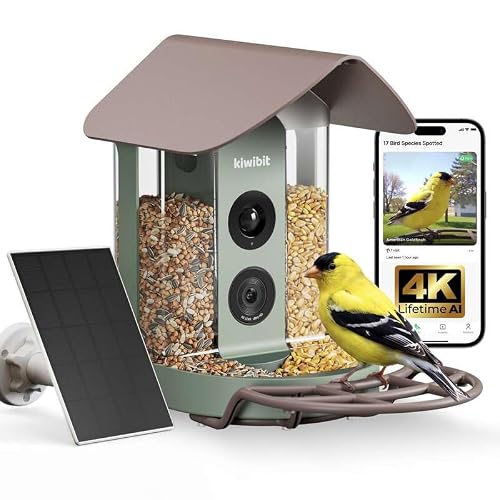 Kiwibit 4K, No-Subscription Edition The same hardware with lifetime AI identification stated on the listing. For a gift, that single line is worth more than any spec on it. | A gift that will never send anyone a bill |
1. The best pictures, if you can live with the app
Birdbuddy Pro Solar
The largest published sensor in the category and the only maker that declines to advertise a species count - both of which point the same way.
A 1/2.7" sensor is a real, checkable number, and it is bigger than anything else in this category will admit to. Sensor area is what governs how a photo looks when a bird lands at dusk, which is when most feeder traffic actually happens. Nobody else publishes the figure, so nobody else can be compared to it.
The thing worth noticing is what is missing. Every rival leads with an AI number - 6,000 species, 10,000 species. Birdbuddy prints none. A maker that does not put a number on its recognition claim is a maker with nothing to walk back, and after you read the species-claim audit that reads as confidence rather than as a gap.
The Wi-Fi position is the one to check before you buy. Birdbuddy's own support documentation says the original camera module requires 2.4GHz and does not work on 5GHz. If your router broadcasts one merged network name, that is the setup that fails - and the fix takes ten minutes once you know about it. It is covered in the Wi-Fi requirements guide.
| Video resolution | 2KSource: Birdbuddy Pro Solar - manufacturer listing on Amazon, retrieved 1 September 2026 |
|---|---|
| Photo resolution | 5MPSource: Birdbuddy Pro Solar - manufacturer listing on Amazon, retrieved 1 September 2026 |
| Sensor size | 1/2.7"The only sensor dimension published by any maker in this roundup.Source: Birdbuddy Pro Solar - manufacturer listing on Amazon, retrieved 1 September 2026 |
| Dynamic range | HDRSource: Birdbuddy Pro Solar - manufacturer listing on Amazon, retrieved 1 September 2026 |
| Wi-Fi band | 2.4GHz for the original camera module; the Birdbuddy 2 module adds 5GHzBirdbuddy's own support pages state the original module does not work on 5GHz.Source: Birdbuddy support: Connectivity and Wi-Fi requirements |
| Solar | Detachable solar roof, rotates 180 degreesSource: Birdbuddy Pro Solar - manufacturer listing on Amazon, retrieved 1 September 2026 |
| Battery capacity | Not publishedNo mAh figure appears on the listing or the support site. |
| Species identified | Not publishedBirdbuddy publishes no species count anywhere we could find. See the AI claims audit. |
| Subscription price | Not publishedNot stated on the listing, and the plan page did not serve us a price. |
What it does well
- Published 1/2.7" sensor with HDR - the only sensor dimension anyone in the category states
- Solar roof detaches and rotates, so the panel can face the sun even when the feeder cannot
- Makes no species-count claim, which is the honest position given the arithmetic
- The largest accessory ecosystem in the category, including perch extenders and nutrition sets
What it does not
- Battery capacity is not published, so runtime cannot be estimated from first principles
- The original camera module is 2.4GHz-only per Birdbuddy's own support pages
- Subscription pricing is not stated on the listing and was not retrievable from the plan page
Skip this: if you want every feature unlocked with no ongoing decision to make. Birdbuddy's premium tier exists, its price is not published where a buyer can find it, and buying into an unpriced subscription is exactly the trap the three-year cost guide was written about.
2. The most published specification per dollar
Kiwibit Smart Bird Feeder (4K)
4K, 8MP, a stated 5,200mAh cell and a stated 3W panel, with an IP65 rating and a real temperature range. Then it claims 10,000+ species.
Kiwibit publishes more of its own numbers than anyone else here, and the ones it publishes are good: a 5,200mAh cell, a 3W adjustable panel, IP65, and an operating range of -4F to 122F. That last figure is 18 degrees colder at the bottom than Birdfy's, which is the difference between a camera that works through a Minnesota February and one that does not.
This is also the brand formerly sold as Beako. If you have read a review of a Beako feeder, you have read a review of this. The rename is why searches for the old name land here.
And then there is the 10,000+ figure. There are 11,227 bird species in the world by the current IOC list and 1,161 in the entire ABA Area. A claim of 10,000+ on a device pointed at a six-inch perch in North America is a claim about a training set, not about your backyard. It is not a lie, but it is not information either - here is what the number can honestly mean.
What it does well
- Publishes battery, panel wattage, ingress rating and temperature range - unusually complete
- -4F to 122F is the widest published operating range on this page
- 4K and 8MP stills give genuine cropping room
- Free live view, playback and motion alerts per the maker's listing
What it does not
- The 10,000+ species claim is 8.6x the entire ABA Area list
- Sensor size is not published, so the 8MP figure has no context
- The Beako rename means older reviews are filed under a brand name that no longer exists
Skip this: if the species number is what sold you on it. Buy it for the battery, the panel and the temperature range, which are real published figures you can hold the maker to.
3. A gift that will never send anyone a bill
Kiwibit 4K, No-Subscription Edition
The same hardware with lifetime AI identification stated on the listing. For a gift, that single line is worth more than any spec on it.
A gift that arrives with a monthly fee attached is a gift that keeps asking the recipient for money. That is the whole argument for this variant, and it is why it leads the no-subscription roundup.
Read the wording carefully before you buy, though, because it is the wording that matters. The listing says lifetime AI identification, not lifetime cloud storage, and those are different promises. Storage terms in this category change quietly, and a lifetime claim on one feature says nothing about the other.
Everything else is the Kiwibit 4K platform: the same 5,200mAh cell, the same 4K stream, the same 8MP stills.
| Subscription | No subscription; lifetime AI identification stated on the listingSource: Kiwibit no-subscription - manufacturer listing on Amazon, retrieved 1 September 2026 |
|---|---|
| Video resolution | 4K live streamSource: Kiwibit no-subscription - manufacturer listing on Amazon, retrieved 1 September 2026 |
| Photo resolution | 8MPSource: Kiwibit no-subscription - manufacturer listing on Amazon, retrieved 1 September 2026 |
| Solar | Solar poweredSource: Kiwibit no-subscription - manufacturer listing on Amazon, retrieved 1 September 2026 |
| Battery capacity | 5,200mAhPublished for the Kiwibit 4K platform.Source: Kiwibit 4K - manufacturer listing on Amazon, retrieved 1 September 2026 |
| Sensor size | Not published |
| Species identified | Not publishedThis listing states lifetime identification without naming a count. |
What it does well
- Lifetime AI identification stated in writing on the maker's own listing
- Nothing to explain to the person you gave it to
- Same published 4K and 8MP capture as the subscription variant
What it does not
- Lifetime AI is not the same promise as lifetime cloud storage
- No published sensor size
- The species count is not stated on this variant, so it cannot be compared like for like
Skip this: if you want the deepest cloud archive you can get. A no-subscription model is a model with a smaller storage story, and if you plan to keep three years of clips you should read the three-year cost comparison before deciding.
Why 4K does not settle it
Resolution is the most-printed and least-decisive specification here. The subject is a small bird, a few inches from a small lens, usually backlit against the sky, and the footage is compressed for upload over a 2.4GHz link. Under those constraints the limiting factors are light-gathering and dynamic range - and Birdbuddy publishes a 1/2.7" sensor with HDR while Kiwibit publishes no sensor dimension at all.
So the honest position: Kiwibit may well produce the better image, and nothing published lets anyone determine that. What can be said is that the 4K figure does not establish it, and that a maker publishing the harder number is making a comparison it expects to survive.
Why 10,000 species does not settle it either
The IOC World Bird List recognizes 11,227 species, 164 extinct. Kiwibit's claim is therefore near-total global coverage. The ABA checklist for all of North America is 1,161 species, and a US backyard feeder sees a few dozen a year - all of which Birdbuddy's app handles despite publishing no number.
A larger label set can also make a classifier worse at your birds, not better: more classes means more opportunities to confuse a house finch with something it could not possibly be. The audit goes through this properly. Either way, this number should not carry your decision.
What actually separates them
| Birdbuddy | Kiwibit | |
|---|---|---|
| Published optics | Sensor dimension (1/2.7"), HDR, 2K video, 5MP stills | 4K, no sensor dimension published |
| Species claim | None published | 10,000+ |
| Subscription | Optional plan, price not published | Optional on the standard model; a separate edition claims none required |
| Track record | Defined the category, longest history | Newer, and previously traded as Beako |
| Wi-Fi | 2.4GHz | 2.4GHz |
The brand-continuity question
These are app-dependent devices. A feeder whose maker stops publishing the app is a plastic box with a dead camera in it, and that risk scales inversely with how long the company has been around. Birdbuddy has the longest history in the category. Kiwibit is newer and has already changed name once, from Beako.
We have no evidence of any problem with Kiwibit and will not imply one. But if you are buying something you expect to run for five years, the age of the company behind the app is a legitimate input - and it is the strongest argument for paying more here.
The tiebreaker most people should use
Kiwibit's no-subscription edition. It removes the ongoing cost entirely, which over three years is worth more than the difference between these two cameras - and it makes the value argument decisively rather than marginally. That is covered in the no-subscription roundup and it is why the same model tops the gift roundup. If it is the brand rather than the model you are weighing, is Kiwibit worth it takes the whole range at once.
Questions people actually ask
Is Kiwibit as good as Birdbuddy?
On the specification sheet per dollar, better. On the one specification that decides a backlit photograph - sensor size - Birdbuddy is the only one publishing a number, so the comparison cannot be completed. Birdbuddy also has the longer track record.
Is Kiwibit the same as Beako?
Yes, Beako was renamed Kiwibit. Reviews written under the old brand name describe the same product line.
Which is better value?
Kiwibit, and it is not particularly close - especially the no-subscription edition, which removes a three-year recurring cost that is worth more than the hardware difference between these two.
Should I worry about buying from a newer brand?
It is worth weighing rather than worrying about. These are app-dependent devices, so company continuity is part of what you are buying. Birdbuddy has the longer history; we have no evidence of a problem with Kiwibit.
Sources
- Birdbuddy Pro Solar - manufacturer listing on Amazon, retrieved 1 September 2026
- Kiwibit Smart Bird Feeder 4K - manufacturer listing on Amazon, retrieved 1 September 2026
- Kiwibit 4K No-Subscription Edition - manufacturer listing on Amazon, retrieved 1 September 2026
- Birdbuddy support: Birdbuddy 2 Specifications
- IOC World Bird List v15.2 (13 April 2026), International Ornithologists' Union
- ABA Checklist v8.19 (January 2026), American Birding Association