Smart Bird Feeder Cameras
Kiwibit 4K, No-Subscription Edition
The configuration this whole site keeps arguing for - decent hardware with nothing recurring attached - and the one sentence on the listing you need to read twice before you buy it.
How this page is funded. Buying through a link here earns us a commission at no extra cost to you. It does not change what we recommend or the order we recommend it in, and we have not handled any of these products ourselves - see how we pick and the full disclosure.
The most expensive thing about a smart bird feeder is usually not the feeder. It is the plan attached to it, charged monthly, for as long as you keep using the thing. That is the finding this site keeps returning to, and it is why this particular variant is worth a page of its own rather than a line in a roundup.
Kiwibit sells the same 4K hardware in two billing shapes. One has an optional plan. This one states lifetime AI identification on the listing and asks for nothing recurring. Everything else - the 4K stream, the 8MP stills, the 5,200mAh cell - is the same platform.
Why the billing shape is the specification
Run the arithmetic that the three-year cost guide sets out and the ranking of this category changes. Hardware price plus monthly plan times thirty-six is the real number, and at ordinary rates in this category the plan over three years is frequently comparable to the feeder itself. A cheaper camera with a required plan is routinely the most expensive thing on the shelf by month eighteen.
Remove the plan and that whole calculation collapses into the sticker price. That is what you are buying here, and it is worth more than the difference between any two cameras in the flagship roundup.
Quick picks
Ranked on published specifications and what each one costs to own. Every pick names the buyer it is wrong for.
| # | Product | Best for | Price |
|---|---|---|---|
| 1 | 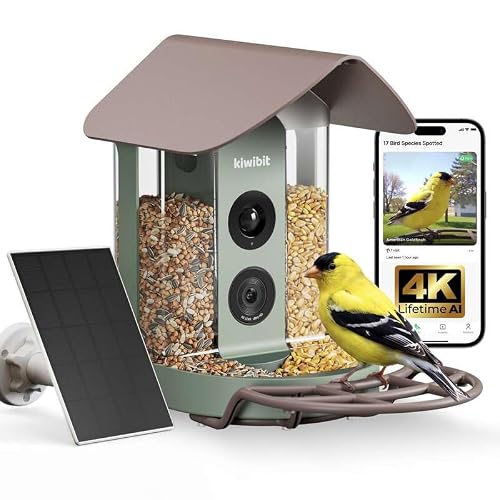 Kiwibit 4K, No-Subscription Edition The same hardware with lifetime AI identification stated on the listing. For a gift, that single line is worth more than any spec on it. | A gift that will never send anyone a bill | |
| 2 |  Kiwibit Smart Bird Feeder (4K) 4K, 8MP, a stated 5,200mAh cell and a stated 3W panel, with an IP65 rating and a real temperature range. Then it claims 10,000+ species. | The most published specification per dollar |
1. A gift that will never send anyone a bill
Kiwibit 4K, No-Subscription Edition
The same hardware with lifetime AI identification stated on the listing. For a gift, that single line is worth more than any spec on it.
A gift that arrives with a monthly fee attached is a gift that keeps asking the recipient for money. That is the whole argument for this variant, and it is why it leads the no-subscription roundup.
Read the wording carefully before you buy, though, because it is the wording that matters. The listing says lifetime AI identification, not lifetime cloud storage, and those are different promises. Storage terms in this category change quietly, and a lifetime claim on one feature says nothing about the other.
Everything else is the Kiwibit 4K platform: the same 5,200mAh cell, the same 4K stream, the same 8MP stills.
| Subscription | No subscription; lifetime AI identification stated on the listingSource: Kiwibit no-subscription - manufacturer listing on Amazon, retrieved 1 September 2026 |
|---|---|
| Video resolution | 4K live streamSource: Kiwibit no-subscription - manufacturer listing on Amazon, retrieved 1 September 2026 |
| Photo resolution | 8MPSource: Kiwibit no-subscription - manufacturer listing on Amazon, retrieved 1 September 2026 |
| Solar | Solar poweredSource: Kiwibit no-subscription - manufacturer listing on Amazon, retrieved 1 September 2026 |
| Battery capacity | 5,200mAhPublished for the Kiwibit 4K platform.Source: Kiwibit 4K - manufacturer listing on Amazon, retrieved 1 September 2026 |
| Sensor size | Not published |
| Species identified | Not publishedThis listing states lifetime identification without naming a count. |
What it does well
- Lifetime AI identification stated in writing on the maker's own listing
- Nothing to explain to the person you gave it to
- Same published 4K and 8MP capture as the subscription variant
What it does not
- Lifetime AI is not the same promise as lifetime cloud storage
- No published sensor size
- The species count is not stated on this variant, so it cannot be compared like for like
Skip this: if you want the deepest cloud archive you can get. A no-subscription model is a model with a smaller storage story, and if you plan to keep three years of clips you should read the three-year cost comparison before deciding.
2. The most published specification per dollar
Kiwibit Smart Bird Feeder (4K)
4K, 8MP, a stated 5,200mAh cell and a stated 3W panel, with an IP65 rating and a real temperature range. Then it claims 10,000+ species.
Kiwibit publishes more of its own numbers than anyone else here, and the ones it publishes are good: a 5,200mAh cell, a 3W adjustable panel, IP65, and an operating range of -4F to 122F. That last figure is 18 degrees colder at the bottom than Birdfy's, which is the difference between a camera that works through a Minnesota February and one that does not.
This is also the brand formerly sold as Beako. If you have read a review of a Beako feeder, you have read a review of this. The rename is why searches for the old name land here.
And then there is the 10,000+ figure. There are 11,227 bird species in the world by the current IOC list and 1,161 in the entire ABA Area. A claim of 10,000+ on a device pointed at a six-inch perch in North America is a claim about a training set, not about your backyard. It is not a lie, but it is not information either - here is what the number can honestly mean.
What it does well
- Publishes battery, panel wattage, ingress rating and temperature range - unusually complete
- -4F to 122F is the widest published operating range on this page
- 4K and 8MP stills give genuine cropping room
- Free live view, playback and motion alerts per the maker's listing
What it does not
- The 10,000+ species claim is 8.6x the entire ABA Area list
- Sensor size is not published, so the 8MP figure has no context
- The Beako rename means older reviews are filed under a brand name that no longer exists
Skip this: if the species number is what sold you on it. Buy it for the battery, the panel and the temperature range, which are real published figures you can hold the maker to.
Now read the wording
The listing says lifetime AI identification. It does not say lifetime cloud storage. Those are different promises and the difference is the single most important thing on this page.
AI identification is the feature that names the bird. Cloud storage is the feature that keeps the clips. A maker can honestly give away the first forever and still change the terms on the second, and storage terms in this category do change quietly. So the correct expectation to buy with is: the app will name your birds for as long as the product and the service exist, and how much video history you keep is a separate question you should check at the point of purchase rather than trusting a review - ours included.
The second caveat applies to every lifetime claim anywhere in this category and is worth stating plainly. Lifetime means the life of the product and the service, not the life of the buyer. These are app-dependent devices; if a maker discontinues its app, a lifetime license and a subscription both end, except the lifetime buyer has already paid. That is not a reason to avoid lifetime pricing - it is usually still the better deal - but it is a reason to weigh how long the company behind the app has been around.
The hardware, briefly
4K live stream, 8MP stills, solar, and a published 5,200mAh battery for the Kiwibit 4K platform. That battery figure deserves a mention on its own: almost nobody in this category publishes an mAh number at all, and a maker that does is a maker inviting a comparison it expects to survive.
On the 4K itself, the honest position is the one taken in the head-to-head with Birdbuddy: resolution is the most-printed and least-decisive specification in this category. A small lens a few inches from a backlit bird, compressed for upload over 2.4GHz, does not deliver four times the useful detail of a 2K sensor. What decides that photograph is sensor area and dynamic range, and Kiwibit publishes neither. It may well take the better picture. Nothing published lets anyone establish that.
What this variant does not tell you
The standard Kiwibit advertises identification of over 10,000 species. This variant states lifetime identification without naming a count, which means the two cannot be compared like for like on that point.
In practice this matters less than it looks. As the species-claim audit works through, the IOC World Bird List recognizes 11,227 species of which 164 are extinct, while the ABA checklist for the whole of North America runs to 1,161 - and a US backyard feeder sees somewhere between twenty and sixty across a year. Every app in this category covers that set. A missing headline number is a documentation gap, not a capability gap you are likely to notice.
The battery figure, and why it is worth more than the 4K
5,200mAh is published for the Kiwibit 4K platform, and it is close to unique in this category. Almost every rival treats battery capacity as something buyers do not need to know, which means runtime cannot be reasoned about at all - you are left with a marketing phrase about weeks of use and no way to check it.
A published number does not tell you the runtime either, because runtime depends on how many clips the camera records and how hard it is working to upload them. What it does give you is a basis for comparison and a sanity check: a cell of that size doing occasional short uploads is a different proposition from a small cell doing the same work, and you can at least reason about which one you are buying.
The other half of that equation is signal strength, and it is the part most people miss. A camera on a weak connection retries, and retrying is expensive - a feeder that seems to have poor battery life very often has a Wi-Fi problem instead. Moving it closer to the house fixes more of these than any charging habit does, which is one of the main practical findings in the Wi-Fi requirements guide.
The gift case
This is the model that tops the gift roundup, and the reason is not the 4K. A present that asks the recipient for a card number before it does the thing it was bought for is a poor present, and most of this category is exactly that. This one is not. Nothing to explain, nothing to cancel, nothing that arrives as a bill in February.
Who should skip it
Anyone who wants the deepest cloud archive they can get. A no-subscription model is a model with a smaller storage story by design, and if you intend to keep three years of clips you are the buyer for whom a paid plan genuinely earns its money.
Anyone buying primarily on optics should look at the Birdbuddy, which is the only camera in the category publishing a sensor dimension. And anyone weighing brand longevity should know Kiwibit is newer than the incumbents and traded as Beako before its rename - not evidence of a problem, but a legitimate input when the app is the product. Is Kiwibit worth it takes that question brand-wide, and the Humbirdy is the other feeder making a no-subscription claim in its title.
Questions people actually ask
Does the Kiwibit no-subscription feeder really have no subscription?
The listing states lifetime AI identification with no subscription. Read the wording precisely though: lifetime identification is not the same promise as lifetime cloud storage, and storage terms are the ones that tend to change. Check the current terms at the point of purchase.
What does lifetime actually mean here?
The life of the product and the service, not the life of the buyer. These are app-dependent devices - if the maker discontinues the app, a lifetime license ends in the same place a subscription does. It is usually still the better deal; it is not a guarantee.
Is this the same camera as the standard Kiwibit 4K?
Same platform - 4K live stream, 8MP stills, the published 5,200mAh cell. The difference is how identification is billed, not what the hardware does.
Is 4K worth it on a bird feeder?
Less than the number suggests. A small lens cropped to a perch inches away and compressed for upload over 2.4GHz does not give four times the useful detail. Sensor size and dynamic range decide a backlit bird, and Kiwibit publishes neither.
Is this a good gift?
It is the best gift in the category on this site's criteria, for one reason: the recipient is never asked for a card number to use the present. The gift roundup explains why that outranks the specifications.
How many species does it identify?
This variant does not publish a count - it states lifetime identification without a number. The standard model advertises 10,000+. For a US backyard, which sees roughly twenty to sixty species a year, both are far beyond what you need.
Sources
- Kiwibit 4K No-Subscription Edition - manufacturer listing on Amazon, retrieved 1 September 2026
- Kiwibit Smart Bird Feeder 4K - manufacturer listing on Amazon, retrieved 1 September 2026
- IOC World Bird List v15.2 (13 April 2026), International Ornithologists' Union
- ABA Checklist v8.19 (January 2026), American Birding Association