Smart Bird Feeder Cameras
Humbirdy 4K Smart Bird Feeder
The shortest listing of any feeder on this site, at close to the highest price. One of its three claims is genuinely valuable and the other two are not enough to judge it on.
How this page is funded. Buying through a link here earns us a commission at no extra cost to you. It does not change what we recommend or the order we recommend it in, and we have not handled any of these products ourselves - see how we pick and the full disclosure.
The Humbirdy listing makes three claims: 4K, no subscription, solar powered. That is not a summary of the specification. That is the specification, in full, and it belongs to one of the more expensive feeders we cover.
This review is therefore shorter on specifications than most and longer on what that silence should do to your decision, because the honest answer here is not about image quality - nobody has published enough to discuss image quality.
The claim that is worth something
No subscription, stated in the title. That is the single most valuable sentence a listing in this category can contain, and most makers go out of their way not to write it.
The reason is arithmetic. Species identification is routinely held behind a recurring plan whose price appears nowhere on the listing, and over three years a monthly plan can approach or exceed the cost of the hardware. The cheapest feeder attached to a required plan is frequently the most expensive configuration to own - which is the whole argument of what a smart bird feeder actually costs.
A maker that puts the no-subscription position in the product title has made that harder to walk back. It is not a legal guarantee, but it is a commitment made in the most visible place available, and this category gives you few of those.
The claim that is not
4K, unaccompanied. Resolution counts pixels; sensor size decides how much light lands on them; and no sensor size is published here. A 4K image off a small sensor under a garden canopy is a large noisy picture, not a better one.
Nor is there a frame rate, a dynamic range claim, a lens specification or a minimum focus distance. Minimum focus distance is the quietly important one at a feeder, because the subject is often four or five inches from the lens and a camera that cannot focus that close produces a soft bird in a sharp feeder.
Quick picks
Ranked on published specifications and what each one costs to own. Every pick names the buyer it is wrong for.
| # | Product | Best for | Price |
|---|---|---|---|
| 1 |  Humbirdy 4K Smart Bird Feeder 4K and an explicit no-subscription claim in the title - the two things buyers ask about first, both answered before you open the page. | 4K with the subscription question closed on the listing | |
| 2 | 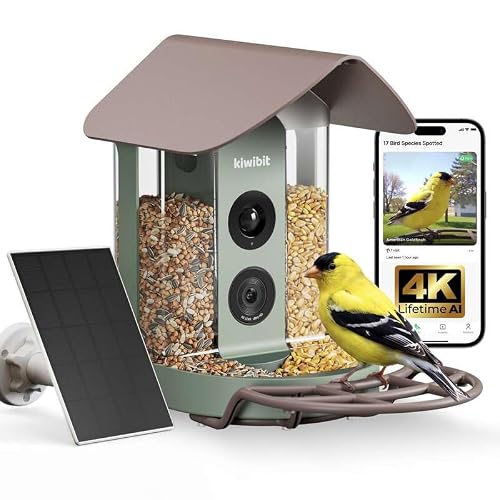 Kiwibit 4K, No-Subscription Edition The same hardware with lifetime AI identification stated on the listing. For a gift, that single line is worth more than any spec on it. | A gift that will never send anyone a bill | |
| 3 |  Birdfy 4K Full-Metal, Dual-Band The only established brand publishing dual-band 2.4/5GHz support, plus a metal body and a lifetime-free AI claim. That first fact is why it is on this list. | The only one that will join a 5GHz network |
1. 4K with the subscription question closed on the listing
Humbirdy 4K Smart Bird Feeder
4K and an explicit no-subscription claim in the title - the two things buyers ask about first, both answered before you open the page.
The listing title is three claims long and that is the entire published specification. It is the shortest listing of any feeder on this site, which is a finding in itself at this price.
The no-subscription claim is the valuable one, because it is the single largest cost variable in this category and most makers leave it ambiguous. Taking it as a headline is a commitment.
The gap that matters: a feeder with no subscription still has to put footage somewhere, and nothing published says whether that is an SD card, local app storage, or a free cloud tier that could be withdrawn later.
| Video resolution | 4KSource: Humbirdy 4K Smart Bird Feeder - manufacturer listing on Amazon, retrieved 1 September 2026 |
|---|---|
| Subscription | None claimedThe title carries "No Subscription" as a headline claim.Source: Humbirdy 4K Smart Bird Feeder - manufacturer listing on Amazon, retrieved 1 September 2026 |
| Power | SolarSource: Humbirdy 4K Smart Bird Feeder - manufacturer listing on Amazon, retrieved 1 September 2026 |
| Wi-Fi band | Not published |
| Sensor size | Not published |
| Battery capacity | Not published |
| Seed capacity | Not published |
| Storage | Not publishedA no-subscription feeder has to store footage somewhere, and the listing does not say where. |
| Species claim | Not published |
| Ingress rating | Not published |
What it does well
- 4K, which only a handful of feeders claim
- No-subscription claim stated in the title rather than buried
- Solar
What it does not
- The published specification is three claims long - no band, no sensor, no capacity, no ingress rating
- No published storage path, which undercuts the no-subscription claim it leads with
- Priciest 4K feeder on this site with the least published to justify it
- New brand with no track record
Skip this: if you compare on specifications, because there are barely any to compare. The Kiwibit and Birdfy 4K listings publish considerably more for similar money.
2. A gift that will never send anyone a bill
Kiwibit 4K, No-Subscription Edition
The same hardware with lifetime AI identification stated on the listing. For a gift, that single line is worth more than any spec on it.
A gift that arrives with a monthly fee attached is a gift that keeps asking the recipient for money. That is the whole argument for this variant, and it is why it leads the no-subscription roundup.
Read the wording carefully before you buy, though, because it is the wording that matters. The listing says lifetime AI identification, not lifetime cloud storage, and those are different promises. Storage terms in this category change quietly, and a lifetime claim on one feature says nothing about the other.
Everything else is the Kiwibit 4K platform: the same 5,200mAh cell, the same 4K stream, the same 8MP stills.
| Subscription | No subscription; lifetime AI identification stated on the listingSource: Kiwibit no-subscription - manufacturer listing on Amazon, retrieved 1 September 2026 |
|---|---|
| Video resolution | 4K live streamSource: Kiwibit no-subscription - manufacturer listing on Amazon, retrieved 1 September 2026 |
| Photo resolution | 8MPSource: Kiwibit no-subscription - manufacturer listing on Amazon, retrieved 1 September 2026 |
| Solar | Solar poweredSource: Kiwibit no-subscription - manufacturer listing on Amazon, retrieved 1 September 2026 |
| Battery capacity | 5,200mAhPublished for the Kiwibit 4K platform.Source: Kiwibit 4K - manufacturer listing on Amazon, retrieved 1 September 2026 |
| Sensor size | Not published |
| Species identified | Not publishedThis listing states lifetime identification without naming a count. |
What it does well
- Lifetime AI identification stated in writing on the maker's own listing
- Nothing to explain to the person you gave it to
- Same published 4K and 8MP capture as the subscription variant
What it does not
- Lifetime AI is not the same promise as lifetime cloud storage
- No published sensor size
- The species count is not stated on this variant, so it cannot be compared like for like
Skip this: if you want the deepest cloud archive you can get. A no-subscription model is a model with a smaller storage story, and if you plan to keep three years of clips you should read the three-year cost comparison before deciding.
3. The only one that will join a 5GHz network
Birdfy 4K Full-Metal, Dual-Band
The only established brand publishing dual-band 2.4/5GHz support, plus a metal body and a lifetime-free AI claim. That first fact is why it is on this list.
Dual-band support sounds like a minor line on a spec sheet and is in fact the most consequential difference on this page. The single most common way a smart feeder fails is that the buyer's router broadcasts one merged network name across both bands, the camera can only see 2.4GHz, and pairing simply never completes. A camera that speaks both bands cannot fail that way.
It is also the only feeder here that pairs a no-subscription AI claim with a metal body. Those two features usually sit on opposite ends of the price range, which is what makes this model awkward to categorise and easy to recommend.
4K on a feeder camera is more about cropping than about resolution. You are photographing a five-inch bird at eighteen inches; the extra pixels let you crop to the head without the picture falling apart. Whether the sensor behind them is any good is unknowable, because the sensor dimension is not published.
| Wi-Fi bands | Dual-band 2.4GHz and 5GHzThe only feeder in this roundup whose listing states 5GHz support.Source: Birdfy 4K dual-band - manufacturer listing on Amazon, retrieved 1 September 2026 |
|---|---|
| Video resolution | 4K UHD with HDRSource: Birdfy 4K dual-band - manufacturer listing on Amazon, retrieved 1 September 2026 |
| AI subscription | Lifetime free AI bird ID, no subscriptionSource: Birdfy 4K dual-band - manufacturer listing on Amazon, retrieved 1 September 2026 |
| Body | Full metal, chew-resistantSource: Birdfy 4K dual-band - manufacturer listing on Amazon, retrieved 1 September 2026 |
| Solar | Solar poweredSource: Birdfy 4K dual-band - manufacturer listing on Amazon, retrieved 1 September 2026 |
| Sharing | 20+ family membersSource: Birdfy 4K dual-band - manufacturer listing on Amazon, retrieved 1 September 2026 |
| Battery capacity | Not published |
| Sensor size | Not published |
What it does well
- Publishes dual-band 2.4/5GHz support - the merged-SSID problem simply does not apply
- Lifetime free AI bird ID stated on the listing, with no subscription
- Full-metal, chew-resistant body
- 4K gives real cropping headroom on a small subject
What it does not
- No published sensor size, so 4K is a pixel count with no context
- No published battery capacity
- A metal body is heavier, which matters for what you hang it from
Skip this: if you already know your network splits its bands and you have a 2.4GHz SSID you can point a camera at. In that case dual-band is a feature you have paid for and will never use, and one of the cheaper picks does the same job.
The gap that undercuts the headline
That is not an accusation, it is a gap. Competing no-subscription feeders close it explicitly: the iRonrain and Lanshanchu listings both name a 32GB card in the box, which is a mechanism you can hold in your hand. Here you are trusting a title.
If a closed billing question is the reason you are shopping, the no-subscription roundup ranks the options by how firmly each one has actually committed, which is a different ranking from how loudly each one advertises.
The price problem
This is the awkward part. Humbirdy sits near the top of the feeder price range while publishing less than feeders at a third of the money. The iRonrain and Lanshanchu 4K listings both publish their storage; the Birdfy 4K Full-Metal publishes a Wi-Fi band and a dual-band capability nobody else in the range matches; Kiwibit's no-subscription edition makes the same billing claim in the same place.
So the question is not whether the Humbirdy is bad - we have no basis to say that, and would not - but what the premium is buying. On published information alone, the answer is that we cannot tell, and that is itself the finding.
Solar, and the usual caveat
Solar is claimed and no panel wattage, battery capacity or runtime accompanies it, which is normal for this category and still worth flagging. Solar on a feeder is a top-up mechanism rather than a power source: a feeder hung where birds feel safe is a feeder in or near cover, and cover is the enemy of a panel.
Without a published capacity there is no way to estimate how long it runs on a dull week, which is the arithmetic the battery life guide does for the handful of feeders that publish enough to attempt it. This is not one of them.
Who should buy it
Somebody who wants 4K and a no-subscription commitment in one product and has looked at the alternatives. That combination genuinely narrows the field, and this listing does make both claims plainly.
Buy it knowing you are buying two sentences and a brand with no track record, at a price that usually buys documentation. If that trade is acceptable - and for some buyers it reasonably is, because the billing claim is the expensive variable - it is a defensible purchase.
Who should not
Anybody who compares on specifications, because there are barely any here to compare. Anybody who needs to know the Wi-Fi band before ordering. And anybody for whom the storage question is the point rather than the billing question, since those are not the same and only one of them is answered.
The verdict
One genuinely valuable claim, made in the right place, wrapped in the thinnest specification sheet on this site and priced as though it were the thickest. If the no-subscription promise is what you are buying, the Kiwibit no-subscription edition makes the same commitment for less, and the cheaper 4K listings with cards in the box make it in a form you can verify.
Questions people actually ask
Does the Humbirdy really have no subscription?
The listing says so in its title, which is the most visible commitment a maker can make. No storage mechanism is published to support it, so what happens to your footage is undescribed.
Is the Humbirdy 4K better than a 2K feeder?
There is no way to tell. No sensor size, frame rate or dynamic range figure is published, and resolution alone does not determine image quality.
What Wi-Fi band does it use?
Not published. In this category that has consistently meant 2.4GHz only.
How long does the battery last?
Not published - there is no battery capacity, panel rating or runtime figure on the listing, so it cannot be estimated.
Is it worth the price?
On published information we cannot say what the premium buys. Cheaper 4K feeders publish their storage, and Birdfy's 4K publishes a Wi-Fi band that this one does not.