Smart Bird Feeder Cameras
Bird Feeder Camera Battery Life
The most asked question in this category has no published answer anywhere in it. Here is exactly how much of the sum the makers give you, and how to buy around the missing half.

How this page is funded. Buying through a link here earns us a commission at no extra cost to you. It does not change what we recommend or the order we recommend it in, and we have not handled any of these products ourselves - see how we pick and the full disclosure.
Search "how long does a bird feeder camera battery last" and you will find a great many confident answers and no sources. We are going to do this the other way round: here is every published figure in the category, and here is why none of them adds up to the number you asked for.
The short version. Of the thirty feeder cameras we cover, four publish a battery capacity. Two publish a solar panel rating. Not one publishes a runtime, a daily draw, or a figure for how many recordings a charge is good for. The arithmetic you want cannot be done, by us or by anyone, from what is currently public.
Everything that is published
| Feeder | Battery capacity | Solar panel | Runtime |
|---|---|---|---|
| Birdfy 2 Pro Solar | 9,000mAh | 3W | Not published |
| Kiwibit 4K | 5,200mAh | 3W, adjustable | Not published |
| Kiwibit 4K, no-subscription edition | 5,200mAh | Not published | Not published |
| Frzgat 4K | 5,200mAh | Solar, no rating | Not published |
| Every other feeder on this site | Not published | Mostly not published | Not published |
That is the whole evidence base. Four rows of real numbers and one row that covers the other twenty-six products, which is a finding rather than an oversight on our part.
Why a capacity is only half a sum
A milliamp-hour figure describes the size of the tank. Runtime is tank size divided by consumption, and consumption is the half nobody publishes.
Worse, consumption on these devices is not a constant. A feeder camera is asleep most of the day and wakes on motion, so its daily draw is set by how many times something moves in front of it - which depends on your garden, your season, your seed, and whether a squirrel has found it. Two identical feeders in two gardens will not return the same number.
This is the honest reason no maker publishes a runtime, and it is a better reason than cynicism would suggest. A single figure would be wrong for most buyers. What they could publish is a draw per wake event, or a standby current, and none of them does.
What solar actually contributes
Less than the marketing implies, and the reason is siting. A feeder is placed where birds will use it, which means near cover - a hedge, a tree, the edge of a shrub border. Cover is shade. The best place for the feeder is rarely a good place for a panel.
Treat solar as a top-up that extends the interval between charges rather than as a power source that removes charging altogether. In midsummer in an open yard it may genuinely keep up. In a shaded garden in November it will contribute close to nothing, which is also the season when short days and hungry birds push the draw up.
Quick picks
Ranked on published specifications and what each one costs to own. Every pick names the buyer it is wrong for.
| # | Product | Best for | Price |
|---|---|---|---|
| 1 |  Birdfy 2 Pro Solar Two lenses, a stated 9,000mAh battery and a stated 3W panel. Birdfy publishes numbers other makers hide, and the numbers are good. | The most published specification of anything here | |
| 2 |  Kiwibit Smart Bird Feeder (4K) 4K, 8MP, a stated 5,200mAh cell and a stated 3W panel, with an IP65 rating and a real temperature range. Then it claims 10,000+ species. | The most published specification per dollar | |
| 3 |  Frzgat 4K Bird Feeder Camera (5200mAh) Publishes a 5200mAh battery, a 2L hopper, IP65 and a 32GB card - four specifics most of this category withholds, at the bottom of the 4K price range. | A published battery capacity, which most of this category withholds | $42.99 - View on Amazon #ad Price checked October 17, 2026. How this is funded |
| 4 | 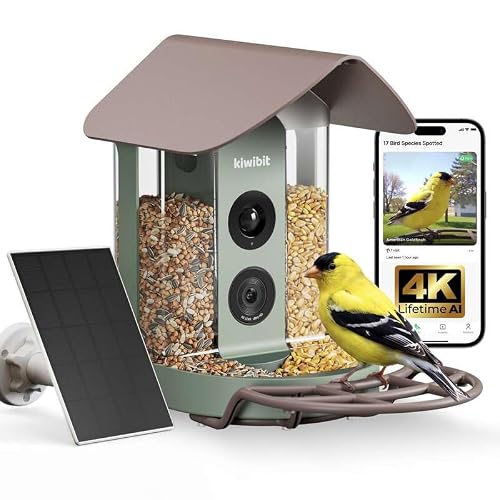 Kiwibit 4K, No-Subscription Edition The same hardware with lifetime AI identification stated on the listing. For a gift, that single line is worth more than any spec on it. | A gift that will never send anyone a bill |
1. The most published specification of anything here
Birdfy 2 Pro Solar
Two lenses, a stated 9,000mAh battery and a stated 3W panel. Birdfy publishes numbers other makers hide, and the numbers are good.
A 9,000mAh cell paired with a 3W panel is the most generous published power budget in the category, and it is the reason this model turns up in so many yards that get only morning sun. It is also, notably, a number: Birdfy states it, most rivals do not, and a stated number is one you can hold them to.
The dual-lens arrangement is a genuine design decision rather than a spec-sheet flourish. One lens frames the whole feeder, the other pushes in on the perch. What that buys you is a photo where the bird fills the frame without the wide shot becoming useless - which is precisely the complaint people have about single-lens feeders.
The species claim is where to be careful. 6,000+ is a claim by the maker. There are 11,227 bird species on Earth by the current IOC list, and 1,161 in the whole ABA Area. What a 6,000-species model can honestly do in a North American backyard is worked through in the AI claims audit.
Operating range is stated at 14F to 113F. If you live somewhere that spends February below 14F, that is a published limit, not a rumor, and it should decide your purchase.
| Camera system | Dual lens: 1080P wide + 2K auto-tracking close-up, with split viewSource: Birdfy 2 Pro Solar - manufacturer listing on Amazon, retrieved 1 September 2026 |
|---|---|
| Battery capacity | 9,000mAhThe largest published capacity of any feeder on this site, and one of only four published at all.Source: Birdfy 2 Pro Solar - manufacturer listing on Amazon, retrieved 1 September 2026 |
| Solar panel | 3WSource: Birdfy 2 Pro Solar - manufacturer listing on Amazon, retrieved 1 September 2026 |
| Species identified | 6,000+ claimedA claim by the maker, not a verified figure. See the audit.Source: Birdfy 2 - manufacturer listing on Amazon, retrieved 1 September 2026 |
| Operating range | 14F to 113FSource: Birdfy 2 - manufacturer listing on Amazon, retrieved 1 September 2026 |
| Sharing | 20+ accountsSource: Birdfy 2 - manufacturer listing on Amazon, retrieved 1 September 2026 |
| Sensor size | Not publishedResolution is published; the sensor dimension behind it is not. |
| Subscription price | Not published |
What it does well
- 9,000mAh battery and 3W panel, both published - the best documented power budget here
- Dual lens gives a wide frame and a close-up without choosing between them
- Publishes an operating temperature range, which almost nobody else does
- Shares to 20+ accounts, which matters if this is a gift for a household
What it does not
- The 6,000+ species claim is far larger than any North American backyard can exercise
- Sensor dimensions are not published, so image quality cannot be compared to Birdbuddy's
- Subscription pricing is not stated on the listing
Skip this: if you live where winter regularly drops below 14F. Birdfy publishes that as the bottom of the operating range, and a camera that stops in January is a camera you bought for eight months of the year.
2. The most published specification per dollar
Kiwibit Smart Bird Feeder (4K)
4K, 8MP, a stated 5,200mAh cell and a stated 3W panel, with an IP65 rating and a real temperature range. Then it claims 10,000+ species.
Kiwibit publishes more of its own numbers than anyone else here, and the ones it publishes are good: a 5,200mAh cell, a 3W adjustable panel, IP65, and an operating range of -4F to 122F. That last figure is 18 degrees colder at the bottom than Birdfy's, which is the difference between a camera that works through a Minnesota February and one that does not.
This is also the brand formerly sold as Beako. If you have read a review of a Beako feeder, you have read a review of this. The rename is why searches for the old name land here.
And then there is the 10,000+ figure. There are 11,227 bird species in the world by the current IOC list and 1,161 in the entire ABA Area. A claim of 10,000+ on a device pointed at a six-inch perch in North America is a claim about a training set, not about your backyard. It is not a lie, but it is not information either - here is what the number can honestly mean.
What it does well
- Publishes battery, panel wattage, ingress rating and temperature range - unusually complete
- -4F to 122F is the widest published operating range on this page
- 4K and 8MP stills give genuine cropping room
- Free live view, playback and motion alerts per the maker's listing
What it does not
- The 10,000+ species claim is 8.6x the entire ABA Area list
- Sensor size is not published, so the 8MP figure has no context
- The Beako rename means older reviews are filed under a brand name that no longer exists
Skip this: if the species number is what sold you on it. Buy it for the battery, the panel and the temperature range, which are real published figures you can hold the maker to.
3. A published battery capacity, which most of this category withholds
Frzgat 4K Bird Feeder Camera (5200mAh)
Publishes a 5200mAh battery, a 2L hopper, IP65 and a 32GB card - four specifics most of this category withholds, at the bottom of the 4K price range.
#ad Price checked October 17, 2026. How this is funded
This replaced a Cokque listing that published the same 5200mAh figure and has been discontinued. The replacement publishes more, not less: the same battery capacity plus a 2L hopper, IP65 and a 32GB card. What it drops is the word "native" on the 4K claim - upscaled 4K from a 2K sensor is common and rarely admitted.
The catch on the battery figure is that capacity without draw is half a calculation. 5200mAh tells you the size of the tank and nothing about the mileage, and no runtime is published to close the gap.
Subscription is not addressed anywhere on the listing, which is the single most expensive thing to leave unstated in this category.
| Battery capacity | 5200mAhOne of only four seed feeders on this site that publishes a capacity at all. The same figure as the listing this replaced.Source: Frzgat 4K Bird Feeder - manufacturer listing on Amazon, retrieved 1 September 2026 |
|---|---|
| Video resolution | 4K HDThe listing this replaced claimed 4K "native" - a claim that the sensor captures 4K rather than upscaling to it. This one does not use the word, so we no longer make that claim for it.Source: Frzgat 4K Bird Feeder - manufacturer listing on Amazon, retrieved 1 September 2026 |
| Seed capacity | 2LPublished, which the listing this replaced did not do.Source: Frzgat 4K Bird Feeder - manufacturer listing on Amazon, retrieved 1 September 2026 |
| Ingress rating | IP65Source: Frzgat 4K Bird Feeder - manufacturer listing on Amazon, retrieved 1 September 2026 |
| Storage | 32GB card includedSource: Frzgat 4K Bird Feeder - manufacturer listing on Amazon, retrieved 1 September 2026 |
| Power | Battery with solar panelSource: Frzgat 4K Bird Feeder - manufacturer listing on Amazon, retrieved 1 September 2026 |
| Capture | Auto capture with instant arrival alerts and an alarmSource: Frzgat 4K Bird Feeder - manufacturer listing on Amazon, retrieved 1 September 2026 |
| Wi-Fi band | Not published |
| Sensor size | Not published |
| Runtime from a full charge | Not publishedA capacity is not a runtime - what it draws per day is the missing half of the sum. |
| Species claim | Not published |
| Subscription | Not published |
What it does well
- Publishes an actual battery capacity - only four seed feeders here do
- Also publishes a 2L hopper, IP65 and a 32GB card, which the listing it replaced did not
- Battery plus solar rather than solar alone
- Cheapest 4K feeder on this site
What it does not
- No published runtime, so the mAh figure cannot be converted into days
- Subscription not addressed at all on the listing
- No published Wi-Fi band or sensor size
- Drops the "native" 4K claim the listing it replaced made
- Unestablished brand
Skip this: if you need to know what the AI costs. A listing that never mentions a subscription is not the same as a listing that rules one out.
4. A gift that will never send anyone a bill
Kiwibit 4K, No-Subscription Edition
The same hardware with lifetime AI identification stated on the listing. For a gift, that single line is worth more than any spec on it.
A gift that arrives with a monthly fee attached is a gift that keeps asking the recipient for money. That is the whole argument for this variant, and it is why it leads the no-subscription roundup.
Read the wording carefully before you buy, though, because it is the wording that matters. The listing says lifetime AI identification, not lifetime cloud storage, and those are different promises. Storage terms in this category change quietly, and a lifetime claim on one feature says nothing about the other.
Everything else is the Kiwibit 4K platform: the same 5,200mAh cell, the same 4K stream, the same 8MP stills.
| Subscription | No subscription; lifetime AI identification stated on the listingSource: Kiwibit no-subscription - manufacturer listing on Amazon, retrieved 1 September 2026 |
|---|---|
| Video resolution | 4K live streamSource: Kiwibit no-subscription - manufacturer listing on Amazon, retrieved 1 September 2026 |
| Photo resolution | 8MPSource: Kiwibit no-subscription - manufacturer listing on Amazon, retrieved 1 September 2026 |
| Solar | Solar poweredSource: Kiwibit no-subscription - manufacturer listing on Amazon, retrieved 1 September 2026 |
| Battery capacity | 5,200mAhPublished for the Kiwibit 4K platform.Source: Kiwibit 4K - manufacturer listing on Amazon, retrieved 1 September 2026 |
| Sensor size | Not published |
| Species identified | Not publishedThis listing states lifetime identification without naming a count. |
What it does well
- Lifetime AI identification stated in writing on the maker's own listing
- Nothing to explain to the person you gave it to
- Same published 4K and 8MP capture as the subscription variant
What it does not
- Lifetime AI is not the same promise as lifetime cloud storage
- No published sensor size
- The species count is not stated on this variant, so it cannot be compared like for like
Skip this: if you want the deepest cloud archive you can get. A no-subscription model is a model with a smaller storage story, and if you plan to keep three years of clips you should read the three-year cost comparison before deciding.
How to buy around the gap
- Prefer a published capacity over an unpublished one. Not because the number gives you a runtime, but because a maker willing to publish it is a maker willing to be compared. Four feeders qualify.
- Prefer a removable battery. The single most useful property is being able to swap a charged pack in rather than bringing the whole feeder indoors, and it is worth checking the listing photographs for.
- Prefer a panel you can angle. One of the four publishes an adjustable panel. On a fixed panel the feeder's orientation is set by the birds, and the sun gets whatever is left.
- Assume you will charge it. Plan for a cable and a route indoors. Every owner report pattern we have looked at points the same way, and the not-charging guide exists because this is where these products fail most often.
- Discount resolution accordingly. Higher resolution means more data per event and a shorter interval between charges. A 4K feeder is a heavier consumer than a 1080p one, and the 4K roundup makes the case for treating the badge carefully.
The seasonal trap
Battery performance and solar yield both fall in cold weather, and they fall in the same months that feeder traffic peaks. Winter is when a seed feeder is busiest, when the days are shortest, and when lithium cells deliver least - three curves pointing the wrong way at once.
So a feeder that ran for three weeks between charges in July may need charging weekly in January, and nothing on any listing warns you about that. If you live somewhere with real winters, the cold weather roundup is the more specific page.
What about the models that publish nothing?
Most of the category. The absence is not evidence of a bad battery - it is evidence of a listing written to sell rather than to inform, which describes nearly every listing here.
What it does mean is that you cannot compare them on this axis at all, so compare them on axes where they have committed to something: a published Wi-Fi band, a published storage path, a stated subscription position. The buying guide orders the specifications by how much each one actually decides.
The answer, such as it is
We will not give you a number of days, because doing so would mean inventing one. What we can tell you is that 9,000mAh is meaningfully more capacity than 5,200mAh, that an adjustable panel is better than a fixed one, that solar is a supplement rather than a supply, and that anyone quoting you a confident runtime for these products did not get it from the manufacturer - because the manufacturer has not published one.
If charging frequency is genuinely your deciding factor, the largest published capacity in the category belongs to the Birdfy 2 Pro, and it is the only feeder that pairs a published capacity with a published panel rating. That is the best-evidenced answer available, and it is still not a runtime.
Questions people actually ask
How long does a bird feeder camera battery last?
No manufacturer publishes a runtime, so there is no sourced answer. Daily draw depends on how often motion wakes the camera, which varies by garden and season, and consumption is the half of the calculation nobody discloses.
Which bird feeder camera has the biggest battery?
Of the four that publish a capacity, the Birdfy 2 Pro Solar publishes the largest at 9,000mAh. It is also the only one that pairs a published capacity with a published solar panel rating.
Does the solar panel mean I never have to charge it?
No. A feeder is sited where birds feel safe, which usually means near cover, which means shade. Treat solar as a top-up that lengthens the interval between charges.
Why do most feeders not publish a battery capacity?
Twenty-six of the thirty we cover do not. The absence is not evidence of a poor battery - it reflects listings written to sell rather than to be compared.
Does 4K drain the battery faster than 1080p?
More data per event means more work per event, so a higher-resolution feeder is a heavier consumer. No maker publishes figures that would let you quantify the difference.
Will it last through winter?
Expect it to need charging more often. Cold reduces cell performance, short days reduce solar yield, and winter is when feeder traffic is highest - all three push the same way.
Sources
- Birdfy 2 Pro Solar - manufacturer listing on Amazon, retrieved 1 September 2026
- Kiwibit 4K - manufacturer listing on Amazon, retrieved 1 September 2026
- Kiwibit no-subscription edition - manufacturer listing on Amazon, retrieved 1 September 2026
- Frzgat 4K Bird Feeder - manufacturer listing on Amazon, retrieved 1 September 2026