Smart Bird Feeder Cameras
Nafnti Smart Bird Feeder (5GHz)
It solves the problem that causes more returns than anything else in this category, for well under a hundred dollars, and tells you nothing else at all.

How this page is funded. Buying through a link here earns us a commission at no extra cost to you. It does not change what we recommend or the order we recommend it in, and we have not handled any of these products ourselves - see how we pick and the full disclosure.
This is the shortest review on the site, because the listing gives us very little to work with. Nafnti publishes a Wi-Fi band, a power source and the existence of bird identification. That is the specification.
Ordinarily that would put a product near the bottom of any ranking here, and on most of our pages it does. This one is worth a review anyway, because the one thing it publishes happens to be the thing that decides whether these products work at all.
Why the band is worth buying on its own
The single commonest way a bird feeder camera purchase fails is not image quality, battery life or app bugs. It is never pairing in the first place.
Nearly every feeder in this category is 2.4GHz only. Modern routers commonly broadcast 2.4GHz and 5GHz under one network name, and a 2.4GHz-only device joining one of those frequently fails in a way that looks exactly like a defective product. People return the feeder, buy a different one, and hit the same wall - because it was never the feeder.
A dual-band device cannot have that problem. That is the entire proposition here, and at this price it is a cheaper solution than almost anything else on the shelf. The Wi-Fi requirements guide covers the failure mode properly, and the dual-band roundup collects the handful of feeders that qualify.
Quick picks
Ranked on published specifications and what each one costs to own. Every pick names the buyer it is wrong for.
| # | Product | Best for | Price |
|---|---|---|---|
| 1 |  Nafnti 5GHz Dual-band support at well under a hundred dollars, which until recently did not exist at any price outside one premium model. | The cheapest route to a 5GHz camera | $84.99 - View on Amazon #ad Price checked October 17, 2026. How this is funded |
| 2 | 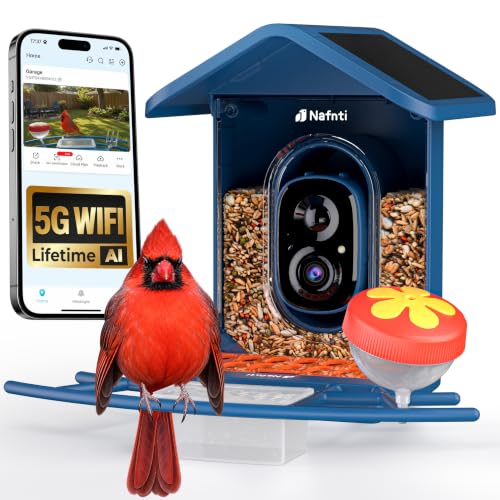 Nafnti 5GHz, No-Subscription Edition The only feeder on this site that publishes 5GHz support and states no subscription in the same listing - the two things that cost buyers most. | Dual-band and nothing recurring | $135.99 - View on Amazon #ad Price checked October 17, 2026. How this is funded |
| 3 | 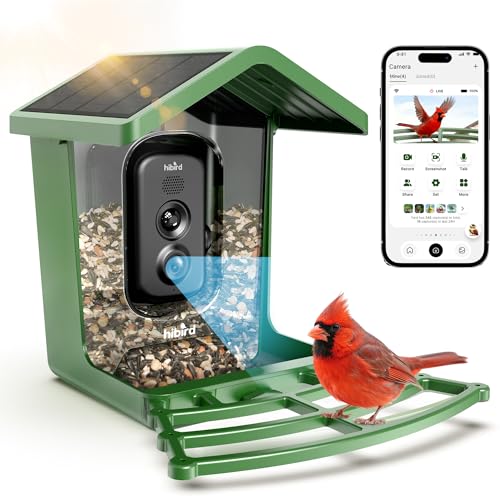 Hibird 4K Dual-Band The only listing here that publishes 4K and explicit 2.4GHz/5GHz dual WiFi in the same breath, at roughly half what the metal alternative costs. | 4K and dual-band together | $169.99 - View on Amazon #ad Price checked October 17, 2026. How this is funded |
1. The cheapest route to a 5GHz camera
Nafnti 5GHz
Dual-band support at well under a hundred dollars, which until recently did not exist at any price outside one premium model.
#ad Price checked October 17, 2026. How this is funded
The entire argument for this one is price. If your router merges its bands and you are not willing to go into its settings, dual-band support is the specification that decides whether the feeder works at all - and until recently the only way to get it cost nearly three hundred dollars.
Everything else about this listing is undocumented. No resolution, no capacity, no battery, and no statement about how identification is billed. You are buying one specification and taking the rest on trust.
For a first camera on a difficult network that is a defensible trade. For a main feeder you expect to use for years, the better-documented options in the flagship roundup are worth the difference.
| Wi-Fi band | 5GHz stated on the listingSource: Nafnti 5GHz - manufacturer listing on Amazon, retrieved 1 September 2026 |
|---|---|
| Solar | Solar poweredSource: Nafnti 5GHz - manufacturer listing on Amazon, retrieved 1 September 2026 |
| AI | AI bird identification stated on the listingSource: Nafnti 5GHz - manufacturer listing on Amazon, retrieved 1 September 2026 |
| Video resolution | Not published |
| Seed capacity | Not published |
| Battery capacity | Not published |
| Subscription | Not publishedNot addressed on the listing. |
| Species identified | Not published |
What it does well
- Publishes 5GHz support at the lowest price of anything here that does
- Solar as standard
- Removes the single most common pairing failure in the category
What it does not
- Publishes almost nothing beyond the band and the solar panel
- Subscription position not addressed at all
- A newer brand with no track record behind the app
Skip this: if your network is straightforward. Dual-band is worth paying for when a merged-SSID router has already defeated a smart-home device in your house; if it has not, you are paying for a fix to a problem you do not have.
2. Dual-band and nothing recurring
Nafnti 5GHz, No-Subscription Edition
The only feeder on this site that publishes 5GHz support and states no subscription in the same listing - the two things that cost buyers most.
#ad Price checked October 17, 2026. How this is funded
This listing does two unusual things at once, and they happen to be the two that decide most of the regret in this category. It publishes 5GHz support, which removes the band-steering failure that sends more of these back to the retailer than any defect does. And it states no subscription, which removes the recurring cost that makes a cheap feeder expensive by month eighteen.
What you give up is documentation. Beyond the band, the billing and solar, this listing publishes essentially nothing - no capture resolution, no capacity, no battery figure. On a site that ranks makers by what they are willing to state, that is a real mark against it, and it is why this does not lead the roundup despite winning on the two criteria the page is about.
Nafnti is also a newer brand with no track record behind its app. These are app-dependent devices, so that is a genuine input rather than snobbery - the three-year cost guide explains why a lifetime or no-subscription promise is only as durable as the company making it.
| Wi-Fi band | 5GHz stated on the listingDual-band support removes the merged-network pairing failure that is the commonest return reason in this category.Source: Nafnti 5GHz No Subscription - manufacturer listing on Amazon, retrieved 1 September 2026 |
|---|---|
| Subscription | No subscription stated on the listingSource: Nafnti 5GHz No Subscription - manufacturer listing on Amazon, retrieved 1 September 2026 |
| Solar | Solar poweredSource: Nafnti 5GHz No Subscription - manufacturer listing on Amazon, retrieved 1 September 2026 |
| Video resolution | Not publishedThe listing does not state a capture resolution. |
| Seed capacity | Not published |
| Battery capacity | Not published |
| Sensor size | Not published |
| Species identified | Not published |
What it does well
- Publishes 5GHz support, which almost nothing in this category does
- States no subscription - the two biggest buyer costs solved in one listing
- Solar as standard
What it does not
- No published capture resolution, capacity, battery figure or sensor size
- A newer brand with no track record behind an app-dependent device
- No species count stated, so the identification scope is unknown
Skip this: if you want to know what you are buying before you spend. It wins on the two criteria this page cares about and publishes almost nothing else, and the flagship roundup is where the documented cameras are.
3. 4K and dual-band together
Hibird 4K Dual-Band
The only listing here that publishes 4K and explicit 2.4GHz/5GHz dual WiFi in the same breath, at roughly half what the metal alternative costs.
#ad Price checked October 17, 2026. How this is funded
The band claim here is the most explicit of any listing on this site - it names both 2.4GHz and 5GHz rather than implying dual-band - which matters because ambiguity on this specification is exactly what catches buyers out.
4K alongside it is the headline, and the usual caveat applies: resolution is the most-printed and least-decisive specification in this category. A small lens cropped to a perch inches away and compressed for upload does not deliver four times the useful detail, and no sensor dimension is published here to settle it. The flagship roundup sets out why sensor area beats resolution on a backlit bird.
The 10,000+ species claim should carry no weight in your decision. The ABA checklist for the whole of North America is 1,161 species and a typical yard sees a couple of dozen - the audit works through the arithmetic.
| Wi-Fi band | 2.4GHz/5GHz dual WiFi stated on the listingSource: Hibird 4K Dual-Band - manufacturer listing on Amazon, retrieved 1 September 2026 |
|---|---|
| Video resolution | 4K HDSource: Hibird 4K Dual-Band - manufacturer listing on Amazon, retrieved 1 September 2026 |
| Species identified | 10,000+ claimedA claim by the maker. See the AI claims audit for what that number can honestly mean.Source: Hibird 4K Dual-Band - manufacturer listing on Amazon, retrieved 1 September 2026 |
| Capture | Auto capture with real-time notifications and live streamingSource: Hibird 4K Dual-Band - manufacturer listing on Amazon, retrieved 1 September 2026 |
| Solar | Solar poweredSource: Hibird 4K Dual-Band - manufacturer listing on Amazon, retrieved 1 September 2026 |
| Seed capacity | Not published |
| Battery capacity | Not published |
| Sensor size | Not published |
| Subscription | Not publishedThe listing says nothing either way, and silence is not the same as free. |
What it does well
- The most explicit band statement on this site - names 2.4GHz and 5GHz directly
- 4K capture at roughly half the price of the metal dual-band alternative
- Auto capture with live streaming and real-time notifications
What it does not
- The subscription position is not stated anywhere on the listing
- No published sensor size, capacity or battery figure
- The 10,000+ species claim describes a problem no backyard has
Skip this: if the unanswered billing question bothers you. A listing that advertises AI identification without saying how it is charged for is a listing with an open cost on it, and the no-subscription roundup has the models that put their terms in writing.
What you are not told
Almost everything, and it is worth listing plainly rather than softening.
- No video resolution. Not 4K, not 2K, not 1080p - no figure at all. You are buying a camera whose output is entirely undescribed.
- No sensor size, which would have contextualized a resolution if there had been one.
- No seed capacity, so refill frequency is unknown until you own it.
- No battery capacity and no panel rating, so runtime cannot be estimated - normal in this category, where only four feeders publish a capacity at all.
- No species count, and no statement about what the identification is or is not.
- No subscription position. Not addressed either way, which is the most expensive thing to leave unstated.
We want to be fair about the species count. Declining to claim a number is arguably more honest than the 10,000-species figures elsewhere, which do not discriminate between products - the ABA checklist covers 1,161 species for all of North America and a typical backyard sees twenty to sixty in a year. But not claiming a number and describing nothing at all are different things, and this listing does the second.
The no-subscription sibling
Nafnti sells a second variant that adds a no-subscription claim to the same dual-band proposition, and if the billing question matters to you it is the one to buy.
That combination - published 5GHz support plus a stated no-subscription position - is close to unique in this category, and it is a genuinely strong pairing for a buyer who has been burned by either problem. It costs more, and everything else about the listing is as sparse as this one. The no-subscription roundup ranks it against the rest.
Is a single-specification purchase defensible?
Sometimes, and this is one of the cases where we think it is - with conditions.
If you have already tried a feeder camera and it would not pair, you have a specific diagnosed problem and this is a cheap device that cannot have it. Buying a solution to a known problem is different from buying blind, even when the rest of the spec sheet is empty.
If you have not tried one yet, the better move is ten minutes in your router's admin page. Splitting the bands into two network names costs nothing and opens the whole category to you, rather than the three or four models that publish 5GHz. Then buy on optics, where there is actually information to compare.
Who should buy it
Somebody with a single-network-name router who wants the problem gone for under a hundred dollars and is treating the camera as a bonus rather than the point. Somebody replacing a feeder that would not connect. And somebody who wants to find out whether they enjoy this at all before spending real money.
Who should not
Anybody who cares what the footage looks like, because nothing published lets you form a view. Anybody for whom the subscription question is open - buy the no-subscription variant instead, or read the cost guide first. And anybody buying a gift, because a device with no published resolution is not a thing to put your name on.
The verdict
A one-specification product that happens to publish the right specification. That is a narrow recommendation and we are not going to widen it.
If dual-band is the reason you are shopping, this is the cheapest way to get it and the Hibird is the better-documented step up - 4K, dual-band, and a listing with actual content. If dual-band is not your reason, this feeder has nothing to say to you, and the main roundup ranks the field on everything rather than on one number. Bird Buddy alternatives puts it in context for anyone leaving the big brand over exactly this issue.
Questions people actually ask
Does the Nafnti support 5GHz Wi-Fi?
Yes, the listing publishes 5GHz support. That is the main reason to buy it and close to the only specification it states.
What resolution is the Nafnti camera?
Not published. No video resolution figure appears on the listing at all, so the camera's output is undescribed.
Does it need a subscription?
The listing does not say either way. Nafnti sells a separate variant that adds an explicit no-subscription claim - buy that one if billing certainty matters.
Should I buy a dual-band feeder or change my router?
Change the router if you can. Splitting the bands into two network names takes about ten minutes, costs nothing, and opens the entire category rather than the three or four models publishing 5GHz.
Is it worth buying with so little published?
Only if dual-band is a diagnosed need - for example you already own a feeder that will not pair. As a first purchase made blind, there are better-documented options at similar money.