Hummingbird Feeder Cameras
Star&Mi Integrated-Roof Hummingbird Camera
Birdbuddy's hummingbird feeder - the only one that ever published a sensor dimension - is discontinued. This is what replaced it in our pick, and what the category lost.
How this page is funded. Buying through a link here earns us a commission at no extra cost to you. It does not change what we recommend or the order we recommend it in, and we have not handled any of these products ourselves - see how we pick and the full disclosure.
The discontinuation costs this category something specific and worth naming. Birdbuddy was the only maker that ever published a sensor dimension on a hummingbird camera - 1/2.7 inch, the same as its seed feeder - and sensor size is the figure that governs how much light reaches the chip. With it gone, no hummingbird camera on this site publishes one, which makes every resolution claim in this hub harder to judge than it was a month ago.
What replaced it
The Star&Mi, which publishes 2.5K video, color night vision, an all-in-one integrated solar roof with no wires, a leakproof design and AI identification. That is a fuller spec sheet than most nectar cameras offer, and it is the highest published resolution of any you can currently buy.
It is also a considerably cheaper product from a maker with no track record in bird cameras, and it publishes no sensor size. So this is a step down in disclosure and a step up in resolution, which is the trade this whole category keeps asking buyers to make.
The shade problem, which no trim now solves
Hummingbird feeders hang where you can see them - a porch, under an eave, beside a kitchen window - and those places are shaded by definition. A solar roof under an eave collects almost nothing.
Birdbuddy's answer used to be a non-solar trim with a larger cell, bought deliberately rather than as the budget option. Both trims are now gone. What remains is to accept the charging cycle, or to buy on stored capacity instead - the second pick above is the only nectar camera here that publishes a battery figure. An integrated solar roof like the Star&Mi's at least removes the wiring question; it does not conjure sunlight that is not there.
Quick picks
Ranked on published specifications and what each one costs to own. Every pick names the buyer it is wrong for.
| # | Product | Best for | Price |
|---|---|---|---|
| 1 |  Star&Mi Integrated-Roof Hummingbird Camera 2.5K with color night vision and an integrated solar roof, in the slot the discontinued Birdbuddy hummingbird feeder used to hold. | The highest published resolution on a nectar feeder you can actually buy | |
| 2 |  Birdfy Hummingbird Feeder (9000mAh) The one nectar camera here that states its battery capacity - 9000mAh - which is the specification that actually decides things on a feeder hanging in shade. | The only published battery figure in this hub | $139.99 - View on Amazon #ad Price checked October 17, 2026. How this is funded |
1. The highest published resolution on a nectar feeder you can actually buy
Star&Mi Integrated-Roof Hummingbird Camera
2.5K with color night vision and an integrated solar roof, in the slot the discontinued Birdbuddy hummingbird feeder used to hold.
This slot used to hold the Birdbuddy solar hummingbird feeder, which is discontinued. Birdbuddy published a sensor dimension, and with it gone no hummingbird camera on this site publishes one - which makes every resolution claim in this hub harder to judge than it was.
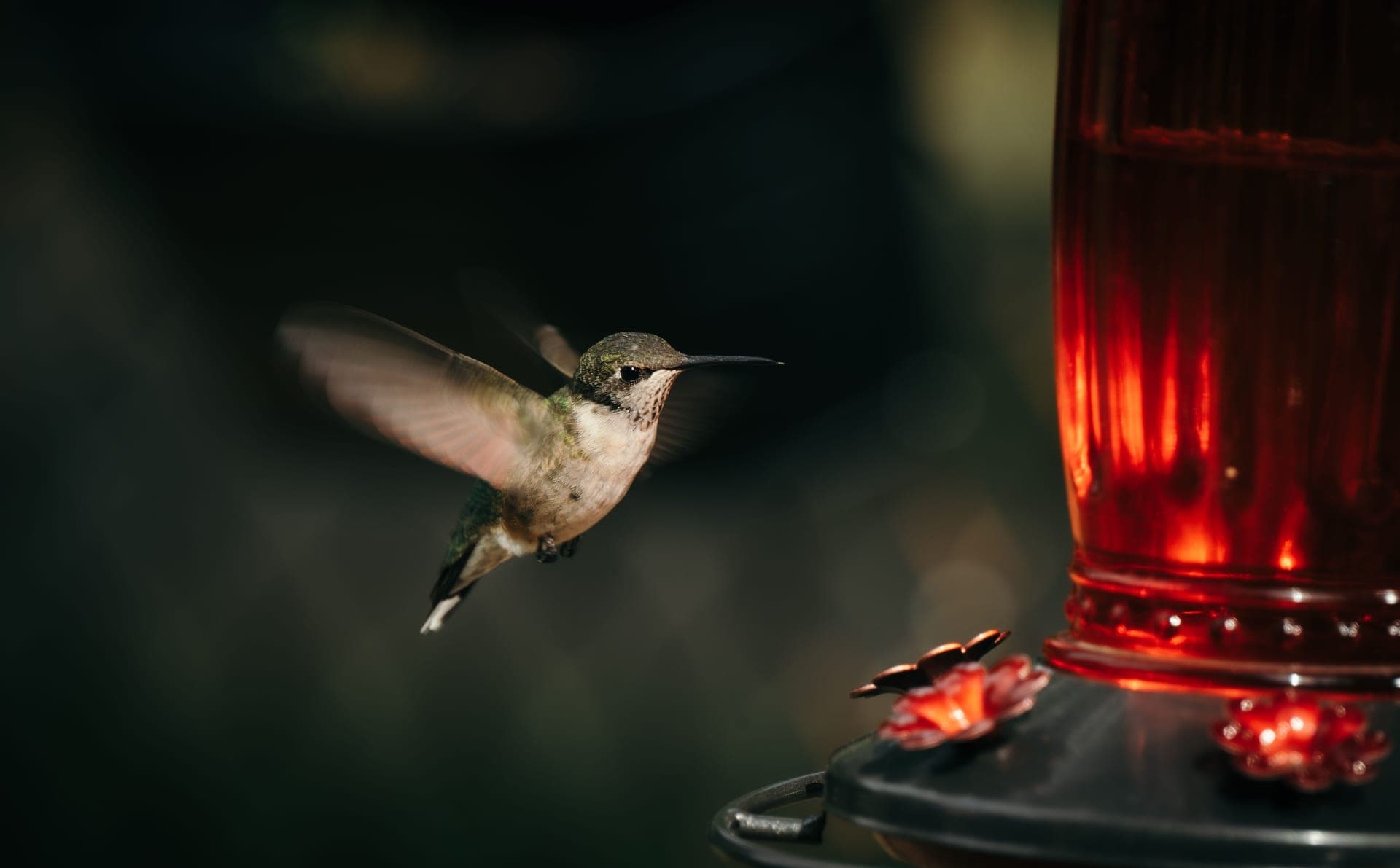
Hummingbirds are the hardest subject in this category. A ruby-throated hummingbird beats its wings roughly fifty times a second and rarely holds still for a full second, and the specification that decides whether you get a shaped wing is frame rate. Nobody publishes it, so 2.5K is the most you can buy on and it is not the figure that matters.
The integrated solar roof is the practical standout. Nectar feeders hang on shaded porches, so a panel does its least work exactly where the feeder belongs - but no wires on a porch-mounted device is a genuine convenience, and the leakproof claim matters because dripping sugar water brings ants.
| Video resolution | 2.5K HDSource: Star&Mi Hummingbird Camera - manufacturer listing on Amazon, retrieved 1 September 2026 |
|---|---|
| Night vision | Color night visionOf limited use on hummingbirds, which are strictly daytime feeders - but it covers dawn and dusk, when nectar traffic is heaviest.Source: Star&Mi Hummingbird Camera - manufacturer listing on Amazon, retrieved 1 September 2026 |
| Power | All-in-one integrated solar roof, no wiresSource: Star&Mi Hummingbird Camera - manufacturer listing on Amazon, retrieved 1 September 2026 |
| Leak protection | Leakproof design claimedWorth more on a nectar feeder than it sounds: sugar water that drips recruits ants and wasps.Source: Star&Mi Hummingbird Camera - manufacturer listing on Amazon, retrieved 1 September 2026 |
| Species identification | AI identification claimedClaimed without a species count.Source: Star&Mi Hummingbird Camera - manufacturer listing on Amazon, retrieved 1 September 2026 |
| Sensor size | Not publishedNo hummingbird camera on this site publishes one any more. The discontinued Birdbuddy was the only maker that ever did. |
| Frame rate | Not publishedThe figure that actually decides whether a beating wing is a shape or a smear. Nobody in this category publishes it. |
| Nectar capacity | Not published |
| Wi-Fi band | Not published |
| Subscription | Not published |
What it does well
- Highest published resolution of any nectar camera we can currently buy
- Integrated solar roof with no wiring to run to a porch
- Publishes a leakproof claim, which most nectar cameras do not address
What it does not
- No published sensor size, so the 2.5K figure has no context
- No published frame rate - the one specification that decides hummingbird footage
- No published nectar capacity, Wi-Fi band or subscription position
- Unestablished brand with no track record in bird cameras
Skip this: if you want more feeding positions in a single frame. The Birdfy Hummee uses a two-in-one feeder body to spread visiting birds across one view, which on a busy multi-port feeder records more of the visits.
2. The only published battery figure in this hub
Birdfy Hummingbird Feeder (9000mAh)
The one nectar camera here that states its battery capacity - 9000mAh - which is the specification that actually decides things on a feeder hanging in shade.
#ad Price checked October 17, 2026. How this is funded
This pick exists because of one number. Nectar feeders belong in shade - sun ferments sugar water fast, which is bad for the birds - so the correct place for a hummingbird feeder is exactly the place a solar panel does least. That makes stored capacity the specification that decides whether you are handling the camera every fortnight, and almost nobody in this category publishes it.
Birdfy does: 9000mAh, stated on the listing. Treat it as a basis for comparison rather than a runtime promise - how long any of these lasts depends on how many clips it records and how hard the radio works to upload them.
What it does not publish is the capture resolution, which on a camera is a strange omission and the reason it ranks where it does rather than higher. If the picture is your priority, the Birdbuddy publishes the better-documented optics.
| Battery capacity | 9000mAhThe only published mAh figure among the hummingbird cameras on this site.Source: Birdfy Hummingbird Feeder 9000mAh - manufacturer listing on Amazon, retrieved 1 September 2026 |
|---|---|
| Solar | Solar poweredSource: Birdfy Hummingbird Feeder 9000mAh - manufacturer listing on Amazon, retrieved 1 September 2026 |
| Video resolution | Not publishedThe listing does not state a capture resolution. |
| Nectar capacity | Not published |
| Wi-Fi band | Not published |
| Species identified | Not published |
What it does well
- 9000mAh published - the only stated battery capacity in this hub
- Solar as well as a large cell, which suits a part-shaded site
- From the maker with the deepest camera-app track record in the category
What it does not
- No published capture resolution at all
- No published nectar capacity or Wi-Fi band
- Identification sits behind Birdfy's usual optional plan, whose price is not on the listing
Skip this: if you want to know what the footage will look like before you buy. A nectar camera that will not state its resolution is one you are buying on the battery alone, and the roundup has the models that document their optics.
What the camera can and cannot do
It cannot freeze the wings. Nothing in this category can - 50 to over 70 beats per second is beyond the shutter speeds available here, and no listing claims otherwise. Expect a sharp body and blurred wings, which is also what the bird looks like in person.
What it can do is catch the bird at all, which is less trivial than it sounds. A hummingbird may be at the feeder for two seconds. The gap between the motion trigger firing and the sensor capturing decides whether you get a clip or an empty frame, and it is the specification nobody publishes.
Identification, with a caveat
The Star&Mi claims AI identification without attaching a species count, which is the more defensible way to make the claim. Telling similar female hummingbirds apart is genuinely hard, and the field marks that settle it are often not visible from a fixed camera at a feeder port - so a big number would be worth less here than almost anywhere.
In most of the eastern United States this is moot - there is one species and any app will get it right. West and southwest, treat a confident identification as a suggestion. The audit covers why more label classes does not mean better answers.
Cleaning, which you will do more than you expect
Nectar ferments. In hot weather this feeder needs cleaning every two to three days, which is not a fault of any particular model - it is a hummingbird feeder problem, and it applies to the plain glass one too. What matters is whether the reservoir separates from the electronics easily, because a feeder that is awkward to clean is a feeder that gets cleaned late. The Star&Mi publishes no cleaning detail, which is a gap on a product defined by sugar water. The nectar guide has the schedule.
Who should not buy this
Anyone who does not already keep a hummingbird feeder. This is an addition to an existing habit rather than a way to start one - if the birds are not already coming, a camera does not bring them, and the seed feeder in the main roundup is the more rewarding first purchase in almost every yard.
Questions people actually ask
What happened to the Birdbuddy hummingbird feeder?
Birdbuddy has discontinued its hummingbird line - we could find neither the solar nor the non-solar trim on sale. Our current pick in its place is the Star&Mi, which publishes a higher resolution and no sensor size.
Does any hummingbird camera still publish a sensor size?
No. Birdbuddy was the only maker that ever did on a nectar camera, and with that line discontinued no hummingbird camera on this site publishes one.
Does it capture hummingbird wings without blur?
No, and neither does anything else in this category. Wingbeats of 50 to 70 per second are beyond these shutter speeds, and no maker publishes a frame rate.
Does it identify hummingbird species?
It claims AI identification and publishes no species count. Be skeptical in the west and southwest where similar species overlap; in most of the eastern US there is only one species to get right.
How often does it need cleaning?
Every two to three days in hot weather, weekly when cool. That is the nature of sugar water rather than a fault of this feeder.