Hummingbird Feeder Cameras
Are Smart Hummingbird Feeders Worth It?
This is a harder yes than the seed-feeder version, and anyone telling you otherwise is selling. Four things no listing mentions, then the buyers for whom it is genuinely worth the money.
How this page is funded. Buying through a link here earns us a commission at no extra cost to you. It does not change what we recommend or the order we recommend it in, and we have not handled any of these products ourselves - see how we pick and the full disclosure.
A seed feeder camera is an easy recommendation. Point it at a perch, wait a fortnight, get hundreds of usable clips of birds sitting still. A hummingbird camera is the same money pointed at the hardest subject in the category, and the honest answer to whether it is worth it is considerably more qualified.
We would rather set the expectation correctly and lose the sale than have you spend two hundred dollars on a device that disappoints you in week three. So here are the four things the listings do not tell you, and then the buyers for whom this is genuinely one of the best purchases on this site.
1. The wings will be blurred. At every resolution.
Hummingbird wingbeat rates run from roughly fifty to over seventy beats per second depending on species. No consumer camera in this category has a shutter fast enough to freeze that, and none claims to.
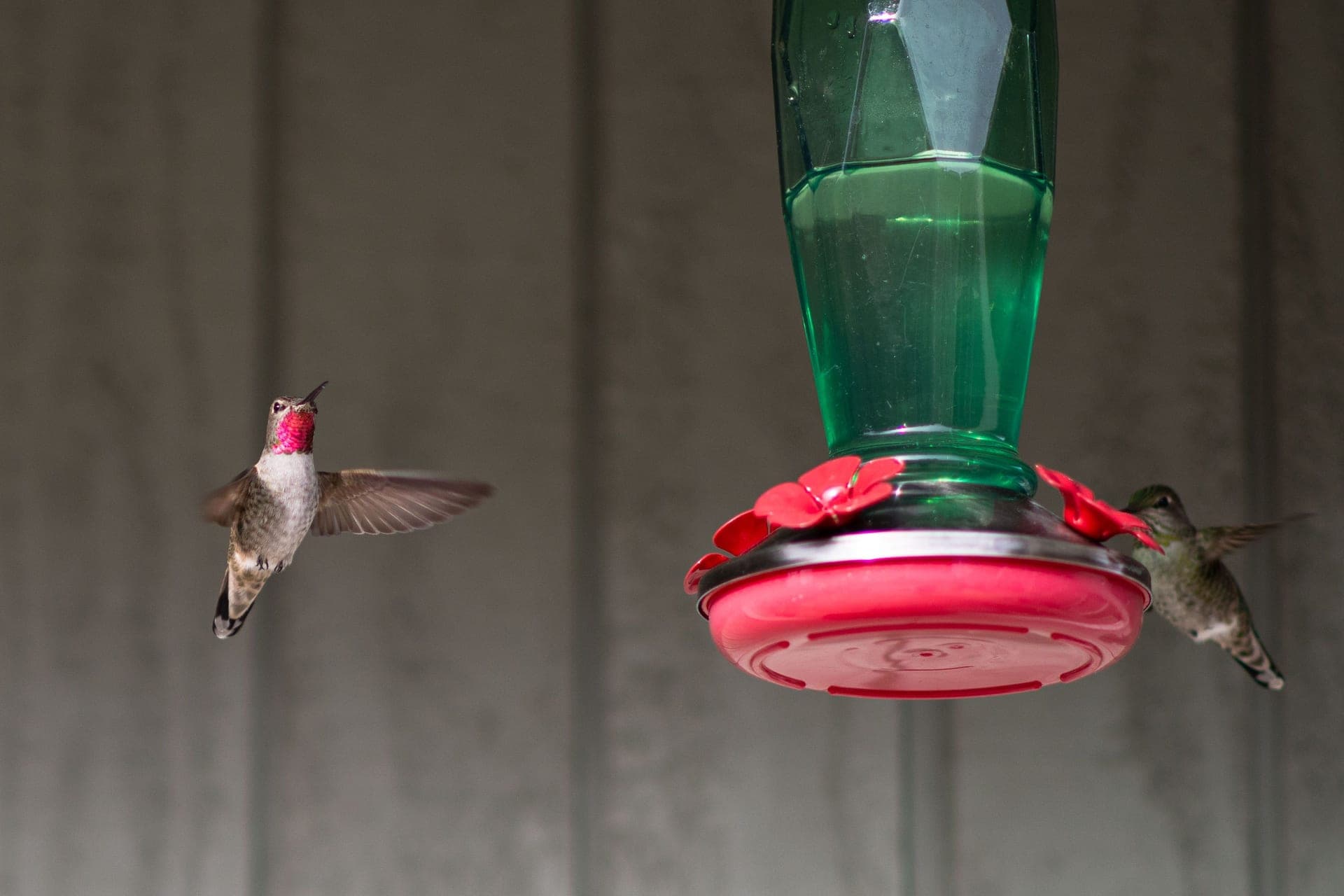
What you get is a sharp body and a blur where the wings are - which is, for what it is worth, what a hummingbird looks like to the naked eye too. The practical consequence is that resolution matters even less here than it does on a seed feeder. A 4K blur is a higher-resolution blur.
If you are picturing the frozen-wing photographs you have seen online, those were taken with fast flash setups and a photographer standing there. A feeder camera will not produce them, and any marketing implying otherwise is overselling.
2. It will miss visits, and nobody publishes how many
Every smart feeder works the same way: a sensor detects motion, the camera wakes, the camera records. On a chickadee that lands and sits for several seconds, the wake delay is invisible. On a hummingbird that hovers for two seconds and leaves, it is the difference between a clip of a bird and a clip of an empty feeder.
Not one maker in this category publishes that wake latency. It is the single most decisive specification for this product and it is absent from every listing, which means nobody - us included - can tell you what proportion of visits any of these will catch. That is a genuine gap in what can be known before buying, and it is the strongest argument for scepticism here.
3. The cleaning is not optional, and it is frequent
This is the obligation people underestimate, and it is the one place in this whole category where getting it wrong actively harms the birds rather than merely disappointing you.
Sugar water ferments and grows mold in warm weather in a matter of days. Audubon's guidance is direct: in hot weather the feeder should be emptied and cleaned every day or every other day. Not topped up - emptied, scrubbed into the ports, and refilled. A neglected nectar feeder is worse than no feeder at all.
So buying one of these is committing to a chore every two or three days through the hottest months. If that sounds like more than you want, that is a completely reasonable conclusion and it is better reached now. The nectar and cleaning guide sets out the actual routine, including the correct 1:4 ratio and why red dye should not be used.
Quick picks
Ranked on published specifications and what each one costs to own. Every pick names the buyer it is wrong for.
| # | Product | Best for | Price |
|---|---|---|---|
| 1 |  Star&Mi Integrated-Roof Hummingbird Camera 2.5K with color night vision and an integrated solar roof, in the slot the discontinued Birdbuddy hummingbird feeder used to hold. | The highest published resolution on a nectar feeder you can actually buy | |
| 2 |  Birdfy Hummee Birdfy's dedicated nectar camera, built as a two-in-one feeder to pull more birds into one frame. Very little about it is published beyond that. | Two feeding stations under one camera | |
| 3 |  Birdfy Hummingbird Feeder (9000mAh) The one nectar camera here that states its battery capacity - 9000mAh - which is the specification that actually decides things on a feeder hanging in shade. | The only published battery figure in this hub | $139.99 - View on Amazon #ad Price checked October 17, 2026. How this is funded |
1. The highest published resolution on a nectar feeder you can actually buy
Star&Mi Integrated-Roof Hummingbird Camera
2.5K with color night vision and an integrated solar roof, in the slot the discontinued Birdbuddy hummingbird feeder used to hold.
This slot used to hold the Birdbuddy solar hummingbird feeder, which is discontinued. Birdbuddy published a sensor dimension, and with it gone no hummingbird camera on this site publishes one - which makes every resolution claim in this hub harder to judge than it was.
Hummingbirds are the hardest subject in this category. A ruby-throated hummingbird beats its wings roughly fifty times a second and rarely holds still for a full second, and the specification that decides whether you get a shaped wing is frame rate. Nobody publishes it, so 2.5K is the most you can buy on and it is not the figure that matters.
The integrated solar roof is the practical standout. Nectar feeders hang on shaded porches, so a panel does its least work exactly where the feeder belongs - but no wires on a porch-mounted device is a genuine convenience, and the leakproof claim matters because dripping sugar water brings ants.
| Video resolution | 2.5K HDSource: Star&Mi Hummingbird Camera - manufacturer listing on Amazon, retrieved 1 September 2026 |
|---|---|
| Night vision | Color night visionOf limited use on hummingbirds, which are strictly daytime feeders - but it covers dawn and dusk, when nectar traffic is heaviest.Source: Star&Mi Hummingbird Camera - manufacturer listing on Amazon, retrieved 1 September 2026 |
| Power | All-in-one integrated solar roof, no wiresSource: Star&Mi Hummingbird Camera - manufacturer listing on Amazon, retrieved 1 September 2026 |
| Leak protection | Leakproof design claimedWorth more on a nectar feeder than it sounds: sugar water that drips recruits ants and wasps.Source: Star&Mi Hummingbird Camera - manufacturer listing on Amazon, retrieved 1 September 2026 |
| Species identification | AI identification claimedClaimed without a species count.Source: Star&Mi Hummingbird Camera - manufacturer listing on Amazon, retrieved 1 September 2026 |
| Sensor size | Not publishedNo hummingbird camera on this site publishes one any more. The discontinued Birdbuddy was the only maker that ever did. |
| Frame rate | Not publishedThe figure that actually decides whether a beating wing is a shape or a smear. Nobody in this category publishes it. |
| Nectar capacity | Not published |
| Wi-Fi band | Not published |
| Subscription | Not published |
What it does well
- Highest published resolution of any nectar camera we can currently buy
- Integrated solar roof with no wiring to run to a porch
- Publishes a leakproof claim, which most nectar cameras do not address
What it does not
- No published sensor size, so the 2.5K figure has no context
- No published frame rate - the one specification that decides hummingbird footage
- No published nectar capacity, Wi-Fi band or subscription position
- Unestablished brand with no track record in bird cameras
Skip this: if you want more feeding positions in a single frame. The Birdfy Hummee uses a two-in-one feeder body to spread visiting birds across one view, which on a busy multi-port feeder records more of the visits.
2. Two feeding stations under one camera
Birdfy Hummee
Birdfy's dedicated nectar camera, built as a two-in-one feeder to pull more birds into one frame. Very little about it is published beyond that.
The Hummee is the only product in this hub designed as a nectar camera from the start rather than a seed feeder adapted to nectar, and the two-in-one feeder body is the reason to consider it: more feeding positions in one frame means more of the visits land where the lens is pointed.
It is also, on published material, the least documented pick here. Birdfy states the feeder design and the auto-capture behavior and then stops - no resolution, no nectar capacity, no battery figure, no Wi-Fi band. On a site that ranks on what makers publish, that is itself the finding.
Whatever you buy, the maintenance is the same and it is not optional: nectar needs replacing every two to three days in hot weather regardless of how full the reservoir is. The nectar and cleaning guide has the routine.
| Feeder design | Two-in-one feeder, described as attracting more hummingbirdsSource: Birdfy Hummee - manufacturer listing on Amazon, retrieved 1 September 2026 |
|---|---|
| Capture | Auto capture of bird videos, framed for close-up viewingSource: Birdfy Hummee - manufacturer listing on Amazon, retrieved 1 September 2026 |
| Video resolution | Not publishedThe current listing does not state a capture resolution. |
| Nectar capacity | Not published |
| Battery capacity | Not published |
| Wi-Fi band | Not published |
| Species identified | Not published |
What it does well
- Purpose-built as a hummingbird camera rather than an adapted seed feeder
- Two-in-one feeder body puts more feeding positions in one frame
- From the maker with the longest camera-app track record in the category
What it does not
- No published capture resolution - unusual on a product sold for its footage
- No published nectar capacity, battery capacity or Wi-Fi band
- Identification sits behind Birdfy's optional plan, whose price is not on the listing
Skip this: if you want the specification sheet filled in before you spend. Birdbuddy publishes a sensor size and this publishes almost nothing, which is what the head-to-head comes down to.
3. The only published battery figure in this hub
Birdfy Hummingbird Feeder (9000mAh)
The one nectar camera here that states its battery capacity - 9000mAh - which is the specification that actually decides things on a feeder hanging in shade.
#ad Price checked October 17, 2026. How this is funded
This pick exists because of one number. Nectar feeders belong in shade - sun ferments sugar water fast, which is bad for the birds - so the correct place for a hummingbird feeder is exactly the place a solar panel does least. That makes stored capacity the specification that decides whether you are handling the camera every fortnight, and almost nobody in this category publishes it.
Birdfy does: 9000mAh, stated on the listing. Treat it as a basis for comparison rather than a runtime promise - how long any of these lasts depends on how many clips it records and how hard the radio works to upload them.
What it does not publish is the capture resolution, which on a camera is a strange omission and the reason it ranks where it does rather than higher. If the picture is your priority, the Birdbuddy publishes the better-documented optics.
| Battery capacity | 9000mAhThe only published mAh figure among the hummingbird cameras on this site.Source: Birdfy Hummingbird Feeder 9000mAh - manufacturer listing on Amazon, retrieved 1 September 2026 |
|---|---|
| Solar | Solar poweredSource: Birdfy Hummingbird Feeder 9000mAh - manufacturer listing on Amazon, retrieved 1 September 2026 |
| Video resolution | Not publishedThe listing does not state a capture resolution. |
| Nectar capacity | Not published |
| Wi-Fi band | Not published |
| Species identified | Not published |
What it does well
- 9000mAh published - the only stated battery capacity in this hub
- Solar as well as a large cell, which suits a part-shaded site
- From the maker with the deepest camera-app track record in the category
What it does not
- No published capture resolution at all
- No published nectar capacity or Wi-Fi band
- Identification sits behind Birdfy's usual optional plan, whose price is not on the listing
Skip this: if you want to know what the footage will look like before you buy. A nectar camera that will not state its resolution is one you are buying on the battery alone, and the roundup has the models that document their optics.
4. In most of the country, it is a seasonal device
How many months a hummingbird camera actually works is a regional question, and it varies enormously.
Per Audubon, nectar should go out by early March in the Southeast and by late April in the Northeast, with the Ruby-throated reaching the Gulf Coast in early March and northern states by late May. In the Southwest, on the West Coast, in coastal areas from Cape Hatteras southward and in Florida, hummingbirds are present year-round.
That means the same camera does useful work for roughly five months in the Northeast and twelve on the West Coast - and it is idle for the rest. No product listing mentions this, and it changes what the purchase is worth by more than any specification difference between models. The full regional calendar is here.
It also has a billing consequence worth spelling out. A monthly plan on a camera you use five months a year is a plan you pay for seven months of nothing, unless you remember to cancel and resubscribe every spring - and almost nobody does. On a seasonal device, a model that charges once or not at all is worth a premium it would not be worth on a seed feeder.
So when is it worth it?
Having stacked up the case against, here is the case for - and it is real.
If you already have hummingbirds. This is the single best predictor. A nectar camera does not attract birds; it films the ones already using your feeder. If you currently watch hummingbirds from a window and want to see what they actually do at the ports, the answer is close to an unqualified yes. If you have never had one, buy an ordinary feeder first and find out whether they come.
If you live somewhere they are year-round. In Southern California, Arizona, the Gulf Coast or Florida, this stops being a seasonal gadget and becomes a device that works every week of the year. That roughly doubles what the money buys.
If the behavior is what interests you, not the photograph. Hummingbirds are extraordinarily territorial. A camera at the ports shows you one bird driving off every other bird for weeks, chases, hovering standoffs, and the moment a second species arrives. None of that needs frozen wings, and none of it is visible from inside the house. This is the strongest argument for the purchase and it is the one the marketing never makes.
If you can put it somewhere shaded and close. Nectar feeders belong in shade - sun accelerates fermentation - and shade is where a solar roof does least. A feeder near the house solves both the signal problem and the charging problem, and nectar feeders naturally hang on porches anyway. The placement guide covers the trade.
What to weight when you choose
| Criterion | Why it matters on nectar specifically |
|---|---|
| Billing model | The device is seasonal in most of the country. A recurring plan across a seven-month off-season is the largest avoidable cost in the purchase. |
| Stored battery capacity | Nectar feeders hang in shade, where solar contributes least. Only one model here publishes an mAh figure at all. |
| Close focus and framing | The ports are inches from the lens - closer than a seed perch. A camera that cannot focus that close produces soft footage of everything. |
| Reservoir size and cleaning access | You are opening this every two to three days in heat. How easily it comes apart matters more than how much it holds. |
| Ant and bee defenses | Insects find sugar water fast and will drive hummingbirds off entirely. An ant moat and port guards are the standard answers and are usually a separate purchase. |
| Resolution | Last. The wings blur at every resolution available in this category. |
Note how far down resolution sits and how far up billing sits. That ordering is the opposite of how these products are marketed, and it is the practical answer to the question in the title: the purchase is worth it or not mostly because of the terms, not the camera.
The one accessory you should budget for
Insects, and they will decide whether this purchase works more often than any camera specification will.
Ants find sugar water quickly and arrive along whatever the feeder hangs from; the standard answer is an ant moat, a small water-filled cup above the feeder that ants will not cross. Bees and wasps come to the ports themselves, and the usual defenses are port guards and keeping the nectar level low enough that shorter mouthparts cannot reach it while hummingbird tongues still can.
This matters here more than on a seed feeder because a nectar feeder that has been colonized by insects stops being used by hummingbirds entirely - and a camera pointed at a feeder no bird will approach records nothing at all. Budget for a moat and guards at the same time as the feeder rather than discovering the problem in July.
The verdict
Worth it if you already have hummingbirds using a feeder, you want to watch what they do rather than photograph frozen wings, and you buy a configuration that will not bill you through the off-season. On those terms it shows you behavior that is genuinely invisible from a window, and people who buy it for that reason keep it for years.
Not worth it if you are hoping it will attract hummingbirds you do not currently get, if you are picturing magazine photographs, or if cleaning something every two days in August sounds like a chore you will skip. All three are knowable now and all three account for most of the disappointment with this product.
If you are in, the hummingbird roundup ranks the field on published specifications and the head-to-head sets the two leading options against each other. If you are not sure, a seed feeder camera is the easier first purchase and works year-round - the flagship roundup is where that starts.
Questions people actually ask
Are smart hummingbird feeders worth it?
Worth it if you already have hummingbirds using a feeder and you want to watch their behavior - the territorial chases and standoffs are invisible from a window. Not worth it if you expect it to attract birds you do not currently get, or if you are picturing frozen-wing photographs.
Will the camera freeze the hummingbird's wings?
No, and neither will any other camera in this category at any resolution. Wingbeats run from roughly fifty to over seventy per second, well beyond the shutter behavior these devices have. Expect a sharp body and blurred wings from every model.
Will it miss visits?
Some, and nobody publishes how many. Every one of these wakes from standby when motion is detected, and a bird that hovers for two seconds can be gone before recording starts. That latency is the most decisive specification for this product and no maker states it.
How much cleaning does a smart hummingbird feeder need?
In hot weather, emptying and cleaning every day or every other day per Audubon's guidance - not topping up. Sugar water ferments and grows mold quickly, and a neglected nectar feeder is worse for the birds than no feeder.
How many months of the year will it be useful?
Roughly five in the Northeast and twelve on the West Coast, in the Southwest, on the coastal Southeast and in Florida, where hummingbirds are present year-round. That difference changes what the purchase is worth more than any specification does.
Should I buy a seed feeder camera instead?
As a first camera, usually yes - it works year-round, the subject sits still, and it is far easier to succeed with. A hummingbird camera is an excellent second purchase once you know hummingbirds use your yard.
Sources
- Audubon: Hummingbird Feeding FAQs
- Audubon: When to Expect Hummingbirds at Your Feeders and Flowers This Spring
- Star&Mi Hummingbird Camera - manufacturer listing on Amazon, retrieved 1 September 2026
- Birdfy Hummee - manufacturer listing on Amazon, retrieved 1 September 2026
- Audubon: how to feed birds and keep feeders clean