Buying & Setup Guides
What People Actually Complain About
A lot of people search for the unvarnished owner verdict rather than another review. Here is an honest account of what those complaints cluster around - and why we are not going to quote strangers at you as though it were evidence.

How this page is funded. Buying through a link here earns us a commission at no extra cost to you. It does not change what we recommend or the order we recommend it in, and we have not handled any of these products ourselves - see how we pick and the full disclosure.
"Best smart bird feeder reddit" is a real and popular search, and the impulse behind it is completely sound: people want the unfiltered verdict from owners rather than another affiliate page.
We are the affiliate page, so let us be straight about that up front, and then be useful anyway.
What we are not going to do
Quote a set of anonymous comments and present them as a finding. Pages that do this are usually assembling whatever supports the product they wanted to recommend, and there is no way for you to tell the difference between a representative sample and a curated one. A screenshot of a stranger agreeing with us is not evidence.
What we can do honestly is describe what the recurring complaints in this category are actually about, because they are consistent, they are mechanical, and each has a cause you can check before buying.
The four complaints that recur, and what they mean
1. "It won't connect to my Wi-Fi"
The most common complaint in the category by a wide margin, and it is a router configuration problem rather than a product fault. Nearly every feeder camera is 2.4GHz-only; most modern routers publish both bands under one name and will not let such a device join.
This is why so many owner reports describe a feeder as "faulty" and why so many are returned unopened after a bad evening. It is fixable in about ten minutes - the Wi-Fi guide - and entirely avoidable by buying the one dual-band model.
2. "They want a subscription for the thing I bought it for"
The second most common, and the angriest. It is not usually a case of a hidden charge appearing later - it is that the plan was disclosed somewhere the buyer did not read, or the plan price was not published at all so the buyer had nothing to react to.
The anger is legitimate: identification is the feature the category is sold on, and discovering it is behind a paywall after unboxing feels like a bait and switch even when the terms were technically available. The cost guide exists because of this, and the no-subscription roundup is the answer.
3. "The battery doesn't last"
Usually two causes wearing one costume. A busy feeder consumes far more power than a quiet one because consumption is per wake-record-upload cycle. And a camera on a weak signal burns power retrying continuously.
So the same model genuinely does perform very differently in two gardens, which is why owner reports on battery life contradict each other so violently. Both reporters are telling the truth. How these work explains the mechanism.
4. "It says a bird is something it obviously isn't"
Real, and expected. Identification is a server-side image classifier working from a fixed camera angle, and the makers advertising the largest species counts are advertising the largest opportunity for confusion. The audit covers why a bigger label set is not the reassurance it looks like.
Quick picks
Ranked on published specifications and what each one costs to own. Every pick names the buyer it is wrong for.
| # | Product | Best for | Price |
|---|---|---|---|
| 1 |  Birdfy 4K Full-Metal, Dual-Band The only established brand publishing dual-band 2.4/5GHz support, plus a metal body and a lifetime-free AI claim. That first fact is why it is on this list. | The only one that will join a 5GHz network | |
| 2 | 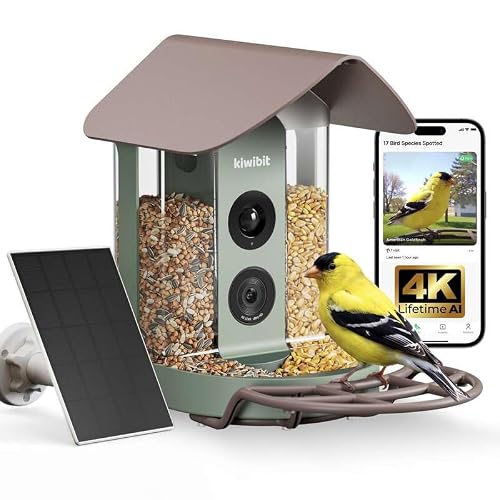 Kiwibit 4K, No-Subscription Edition The same hardware with lifetime AI identification stated on the listing. For a gift, that single line is worth more than any spec on it. | A gift that will never send anyone a bill | |
| 3 |  Birdbuddy Pro Solar The largest published sensor in the category and the only maker that declines to advertise a species count - both of which point the same way. | The best pictures, if you can live with the app |
1. The only one that will join a 5GHz network
Birdfy 4K Full-Metal, Dual-Band
The only established brand publishing dual-band 2.4/5GHz support, plus a metal body and a lifetime-free AI claim. That first fact is why it is on this list.
Dual-band support sounds like a minor line on a spec sheet and is in fact the most consequential difference on this page. The single most common way a smart feeder fails is that the buyer's router broadcasts one merged network name across both bands, the camera can only see 2.4GHz, and pairing simply never completes. A camera that speaks both bands cannot fail that way.
It is also the only feeder here that pairs a no-subscription AI claim with a metal body. Those two features usually sit on opposite ends of the price range, which is what makes this model awkward to categorise and easy to recommend.
4K on a feeder camera is more about cropping than about resolution. You are photographing a five-inch bird at eighteen inches; the extra pixels let you crop to the head without the picture falling apart. Whether the sensor behind them is any good is unknowable, because the sensor dimension is not published.
| Wi-Fi bands | Dual-band 2.4GHz and 5GHzThe only feeder in this roundup whose listing states 5GHz support.Source: Birdfy 4K dual-band - manufacturer listing on Amazon, retrieved 1 September 2026 |
|---|---|
| Video resolution | 4K UHD with HDRSource: Birdfy 4K dual-band - manufacturer listing on Amazon, retrieved 1 September 2026 |
| AI subscription | Lifetime free AI bird ID, no subscriptionSource: Birdfy 4K dual-band - manufacturer listing on Amazon, retrieved 1 September 2026 |
| Body | Full metal, chew-resistantSource: Birdfy 4K dual-band - manufacturer listing on Amazon, retrieved 1 September 2026 |
| Solar | Solar poweredSource: Birdfy 4K dual-band - manufacturer listing on Amazon, retrieved 1 September 2026 |
| Sharing | 20+ family membersSource: Birdfy 4K dual-band - manufacturer listing on Amazon, retrieved 1 September 2026 |
| Battery capacity | Not published |
| Sensor size | Not published |
What it does well
- Publishes dual-band 2.4/5GHz support - the merged-SSID problem simply does not apply
- Lifetime free AI bird ID stated on the listing, with no subscription
- Full-metal, chew-resistant body
- 4K gives real cropping headroom on a small subject
What it does not
- No published sensor size, so 4K is a pixel count with no context
- No published battery capacity
- A metal body is heavier, which matters for what you hang it from
Skip this: if you already know your network splits its bands and you have a 2.4GHz SSID you can point a camera at. In that case dual-band is a feature you have paid for and will never use, and one of the cheaper picks does the same job.
2. A gift that will never send anyone a bill
Kiwibit 4K, No-Subscription Edition
The same hardware with lifetime AI identification stated on the listing. For a gift, that single line is worth more than any spec on it.
A gift that arrives with a monthly fee attached is a gift that keeps asking the recipient for money. That is the whole argument for this variant, and it is why it leads the no-subscription roundup.
Read the wording carefully before you buy, though, because it is the wording that matters. The listing says lifetime AI identification, not lifetime cloud storage, and those are different promises. Storage terms in this category change quietly, and a lifetime claim on one feature says nothing about the other.
Everything else is the Kiwibit 4K platform: the same 5,200mAh cell, the same 4K stream, the same 8MP stills.
| Subscription | No subscription; lifetime AI identification stated on the listingSource: Kiwibit no-subscription - manufacturer listing on Amazon, retrieved 1 September 2026 |
|---|---|
| Video resolution | 4K live streamSource: Kiwibit no-subscription - manufacturer listing on Amazon, retrieved 1 September 2026 |
| Photo resolution | 8MPSource: Kiwibit no-subscription - manufacturer listing on Amazon, retrieved 1 September 2026 |
| Solar | Solar poweredSource: Kiwibit no-subscription - manufacturer listing on Amazon, retrieved 1 September 2026 |
| Battery capacity | 5,200mAhPublished for the Kiwibit 4K platform.Source: Kiwibit 4K - manufacturer listing on Amazon, retrieved 1 September 2026 |
| Sensor size | Not published |
| Species identified | Not publishedThis listing states lifetime identification without naming a count. |
What it does well
- Lifetime AI identification stated in writing on the maker's own listing
- Nothing to explain to the person you gave it to
- Same published 4K and 8MP capture as the subscription variant
What it does not
- Lifetime AI is not the same promise as lifetime cloud storage
- No published sensor size
- The species count is not stated on this variant, so it cannot be compared like for like
Skip this: if you want the deepest cloud archive you can get. A no-subscription model is a model with a smaller storage story, and if you plan to keep three years of clips you should read the three-year cost comparison before deciding.
3. The best pictures, if you can live with the app
Birdbuddy Pro Solar
The largest published sensor in the category and the only maker that declines to advertise a species count - both of which point the same way.
A 1/2.7" sensor is a real, checkable number, and it is bigger than anything else in this category will admit to. Sensor area is what governs how a photo looks when a bird lands at dusk, which is when most feeder traffic actually happens. Nobody else publishes the figure, so nobody else can be compared to it.
The thing worth noticing is what is missing. Every rival leads with an AI number - 6,000 species, 10,000 species. Birdbuddy prints none. A maker that does not put a number on its recognition claim is a maker with nothing to walk back, and after you read the species-claim audit that reads as confidence rather than as a gap.
The Wi-Fi position is the one to check before you buy. Birdbuddy's own support documentation says the original camera module requires 2.4GHz and does not work on 5GHz. If your router broadcasts one merged network name, that is the setup that fails - and the fix takes ten minutes once you know about it. It is covered in the Wi-Fi requirements guide.
| Video resolution | 2KSource: Birdbuddy Pro Solar - manufacturer listing on Amazon, retrieved 1 September 2026 |
|---|---|
| Photo resolution | 5MPSource: Birdbuddy Pro Solar - manufacturer listing on Amazon, retrieved 1 September 2026 |
| Sensor size | 1/2.7"The only sensor dimension published by any maker in this roundup.Source: Birdbuddy Pro Solar - manufacturer listing on Amazon, retrieved 1 September 2026 |
| Dynamic range | HDRSource: Birdbuddy Pro Solar - manufacturer listing on Amazon, retrieved 1 September 2026 |
| Wi-Fi band | 2.4GHz for the original camera module; the Birdbuddy 2 module adds 5GHzBirdbuddy's own support pages state the original module does not work on 5GHz.Source: Birdbuddy support: Connectivity and Wi-Fi requirements |
| Solar | Detachable solar roof, rotates 180 degreesSource: Birdbuddy Pro Solar - manufacturer listing on Amazon, retrieved 1 September 2026 |
| Battery capacity | Not publishedNo mAh figure appears on the listing or the support site. |
| Species identified | Not publishedBirdbuddy publishes no species count anywhere we could find. See the AI claims audit. |
| Subscription price | Not publishedNot stated on the listing, and the plan page did not serve us a price. |
What it does well
- Published 1/2.7" sensor with HDR - the only sensor dimension anyone in the category states
- Solar roof detaches and rotates, so the panel can face the sun even when the feeder cannot
- Makes no species-count claim, which is the honest position given the arithmetic
- The largest accessory ecosystem in the category, including perch extenders and nutrition sets
What it does not
- Battery capacity is not published, so runtime cannot be estimated from first principles
- The original camera module is 2.4GHz-only per Birdbuddy's own support pages
- Subscription pricing is not stated on the listing and was not retrievable from the plan page
Skip this: if you want every feature unlocked with no ongoing decision to make. Birdbuddy's premium tier exists, its price is not published where a buyer can find it, and buying into an unpriced subscription is exactly the trap the three-year cost guide was written about.
How to read owner reports well
- Separate setup complaints from product complaints. A great many one-star reviews are Wi-Fi pairing problems, which is a solvable router issue and tells you nothing about the camera.
- Check the date. Firmware and app changes are frequent in this category. A complaint from two years ago may describe software that no longer exists - in either direction.
- Distrust battery claims in both directions. Consumption depends on your feeder's traffic and your signal strength, so someone else's figure does not transfer to your garden.
- Weight complaints about the company over complaints about the hardware. A camera that arrived scratched is bad luck. A maker that has stopped updating its app is a structural problem with an app-dependent device.
- Ignore 'no birds came' reviews. That is the new-feeder delay, not the product.
The genuinely useful thing owner reports give you
Longevity. It is the one thing no specification sheet contains and no reviewer without a lab can establish: does this thing still work after two winters, and is the app still being updated? Recent reports from long-term owners are worth more than any first-impressions review, including ours.
That is a genuine limit of what this site can tell you, and we would rather name it than paper over it. How we pick sets out the rest of those limits.
Questions people actually ask
What do people complain about most with smart bird feeders?
Wi-Fi pairing, by a wide margin - nearly all of these are 2.4GHz-only and modern combined-band routers often will not accept them. Then subscriptions, then battery life, then misidentifications.
Are the negative reviews fair?
Often they describe a real experience with the wrong cause attached. A great many one-star reviews are router configuration problems, and 'no birds came' is the normal delay before any new feeder is found.
Why do battery reports contradict each other so much?
Because consumption depends on how busy the feeder is and how strong the signal is. The same model genuinely lasts very different lengths of time in different gardens.
Why don't you quote actual comments?
Because a curated set of anonymous quotes reads as evidence and is not - you cannot tell whether it is representative or selected to support a recommendation. Describing the recurring patterns and their causes is more honest and more useful.