Smart Bird Feeder Cameras
BirdSnap Smart Bird Feeder
The dearest feeder on this site publishes four specifications. This one publishes six, for less than a third of the price, and the two it withholds are the two everybody withholds.
How this page is funded. Buying through a link here earns us a commission at no extra cost to you. It does not change what we recommend or the order we recommend it in, and we have not handled any of these products ourselves - see how we pick and the full disclosure.
Buy the plastic BirdSnap, not the metal one. It is the best-documented feeder camera under $100 on this site: 2K, a 3W solar panel, an IP65 ingress rating, a stated 2.4GHz Wi-Fi band, night vision and AI identification described as free. Six figures, on a listing that costs less than a year of some brands' subscriptions.
The metal APS model in the same range is cheaper and includes a memory card, and it drops the Wi-Fi band and the solar wattage. If a card in the box matters more to you than knowing what you are connecting to, buy that one instead.
Why the disclosure is the story
This site ranks on what makers publish, because nothing else about this category can be checked from the outside. On that measure BirdSnap is doing something nobody else at this price does, and something most of the premium brands do not do either.
The comparison that makes the point: the Birdbuddy Home listing is the dearest on this site and it publishes a dual solar panel and essentially nothing else - no video resolution, no photo resolution, no sensor size, no dynamic range. BirdSnap, at a third of the price, publishes six things, two of which are real standards with tests behind them.
That is not a claim that BirdSnap takes better pictures. It is a claim that you can find out more about it before you spend, which is the only kind of claim this site is in a position to make.
The two figures that change a purchase
IP65. An ingress protection rating is a defined standard: the 6 means dust-tight, the 5 means protected against low-pressure water jets from any direction. Most of this category publishes the word 'weatherproof' instead, which is marketing copy and means whatever the writer wanted. The HEAPETS at a similar price is a clean example of the alternative - 'weatherproof design', no number.
2.4GHz, stated. Nearly every feeder camera in existence is 2.4GHz-only, and the single commonest reason one goes back to the retailer is a router broadcasting both bands under one name and refusing to let a 2.4GHz device join. The Wi-Fi guide covers the ten-minute fix. The point here is that BirdSnap tells you before you order rather than after setup fails, and that is worth more than a resolution bump.
The 3W solar panel is the third useful one. 'Solar' without a wattage, which is what most of the category gives you, cannot be judged. 3W can be - it is the same figure the dual-lens Birdfy publishes, on a feeder costing twice as much.
Quick picks
Ranked on published specifications and what each one costs to own. Every pick names the buyer it is wrong for.
| # | Product | Best for | Price |
|---|---|---|---|
| 1 |  BirdSnap Smart Bird Feeder Four figures this category usually withholds - a solar wattage, an ingress rating, a Wi-Fi band and a free AI tier - on a sub-$100 listing. | The most published specifications under $100 | $89.99 - View on Amazon #ad Price checked October 17, 2026. How this is funded |
| 2 | 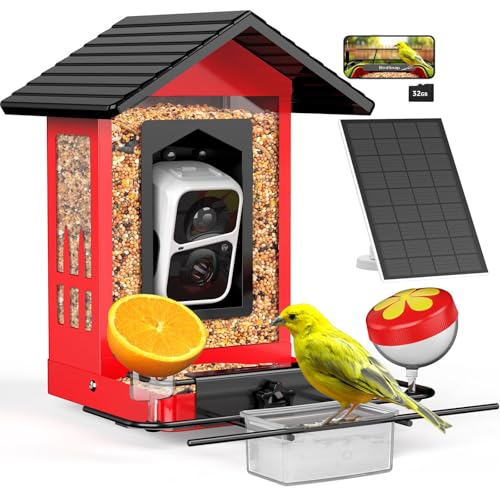 BirdSnap APS Metal Bird Feeder Metal, IP65, a 32GB card included and a 10,000+ species claim - the cheapest metal camera feeder here that ships with local storage. | A metal body with a memory card in the box | $69.99 - View on Amazon #ad Price checked October 17, 2026. How this is funded |
| 3 |  HEAPETS Smart Bird Feeder 2K, solar and AI identification at the bottom of the market - and the word 'weatherproof' doing the work a rating should. | The cheapest listing here that still names a resolution |
1. The most published specifications under $100
BirdSnap Smart Bird Feeder
Four figures this category usually withholds - a solar wattage, an ingress rating, a Wi-Fi band and a free AI tier - on a sub-$100 listing.
#ad Price checked October 17, 2026. How this is funded
Count the published figures: resolution, solar wattage, ingress rating, Wi-Fi band, night vision and the billing arrangement. That is six, on a listing under $100. The dearest Birdbuddy publishes fewer.
The two that change a purchase are the ingress rating and the band. IP65 is a real standard with a defined test behind it, and a stated 2.4GHz saves you the setup failure that sends most of this category back to the retailer - read the Wi-Fi guide before you order anything in this bracket.
What is missing is the sensor and the battery, which is the normal gap. 2K with an unpublished sensor is still an unknown quantity in bad light, and that is the honest limit of what this listing lets you conclude.
| Video resolution | 2K live videoSource: BirdSnap smart bird feeder - manufacturer listing on Amazon, retrieved 17 October 2026 |
|---|---|
| Solar panel rating | 3WA published wattage. Most of this category gives you the word 'solar' and no number.Source: BirdSnap smart bird feeder - manufacturer listing on Amazon, retrieved 17 October 2026 |
| Ingress rating | IP65Dust-tight and protected against water jets. Most of this category publishes no rating at all and says 'weatherproof' instead.Source: BirdSnap smart bird feeder - manufacturer listing on Amazon, retrieved 17 October 2026 |
| Wi-Fi band | 2.4GHzStated outright rather than left to be discovered during setup, which is the commonest cause of a return in this category.Source: BirdSnap smart bird feeder - manufacturer listing on Amazon, retrieved 17 October 2026 |
| Night vision | Stated on the listingSource: BirdSnap smart bird feeder - manufacturer listing on Amazon, retrieved 17 October 2026 |
| AI species identification | Free AI bird recognitionDescribed as free in the listing title. No species count is given on this model.Source: BirdSnap smart bird feeder - manufacturer listing on Amazon, retrieved 17 October 2026 |
| Sensor size | Not published |
| Battery capacity | Not published |
| Seed capacity | Not published |
| Species identified | Not publishedThe metal model in the same range claims 10,000+; this one claims no number. |
What it does well
- Publishes six specifications at a price where most listings publish two
- Published IP65 ingress rating
- Names its Wi-Fi band rather than leaving you to find out
- 3W solar panel rating given as a number
- AI described as free rather than as a trial
What it does not
- No published sensor size, so the 2K claim has no context
- No published battery capacity or seed capacity
- 2.4GHz only, confirmed rather than hinted
- 'Free' AI recognition with no published species count on this model
- A smaller brand than the incumbents, on a device whose app is the product
Skip this: if you want 4K or a brand with years of app history behind it. This is a disclosure story at a low price, not the best camera in the category.
2. A metal body with a memory card in the box
BirdSnap APS Metal Bird Feeder
Metal, IP65, a 32GB card included and a 10,000+ species claim - the cheapest metal camera feeder here that ships with local storage.
#ad Price checked October 17, 2026. How this is funded
The included card is the specification that matters. A feeder that records to a card you already own is a feeder whose footage survives a billing decision, which is the whole argument of the no-subscription roundup.
Metal at this price is unusual and it is mostly a squirrel-and-weather answer rather than a picture-quality one. The 2K claim is the same as on the plastic model.
Oddly, this listing drops the Wi-Fi band the cheaper model in the same range states. Assume 2.4GHz, because essentially everything in this category is.
What it does well
- 32GB card included, so local recording works out of the box
- Metal body at a price where plastic is normal
- Published IP65 rating
- Solar
What it does not
- No published Wi-Fi band, unlike the brand's own cheaper model
- A 10,000+ species claim with nothing published behind it
- No published sensor, battery or seed capacity
- '3 DIY add-ons' is a count, not a list
Skip this: if you want the fullest disclosure in the range - the plastic BirdSnap publishes its band and its solar wattage and this one does not.
3. The cheapest listing here that still names a resolution
HEAPETS Smart Bird Feeder
2K, solar and AI identification at the bottom of the market - and the word 'weatherproof' doing the work a rating should.
This is what the bottom of the market publishes: a resolution, a power source, an unquantified AI claim and an adjective where a weather rating should be. Seven of the eleven lines in its spec table are gaps.
That is not an accusation of a bad product. It is a statement that you cannot tell, and at this price a lot of buyers are content with that trade - it costs less than a year of some brands' subscriptions.
The one gap worth minding is the billing. A listing that says nothing about a subscription has not promised you there isn't one, and the three-year cost arithmetic is what turns a cheap feeder into an expensive one.
| Video resolution | 2K HDSource: HEAPETS smart bird feeder - manufacturer listing on Amazon, retrieved 17 October 2026 |
|---|---|
| Power | SolarSource: HEAPETS smart bird feeder - manufacturer listing on Amazon, retrieved 17 October 2026 |
| AI species identification | AI bird ID claimedClaimed with no species count.Source: HEAPETS smart bird feeder - manufacturer listing on Amazon, retrieved 17 October 2026 |
| Alerts | Real-time app alertsSource: HEAPETS smart bird feeder - manufacturer listing on Amazon, retrieved 17 October 2026 |
| Ingress rating | Not publishedThe listing says "weatherproof design" and gives no IP number. That is a description, not a specification - the BirdSnap at a similar price publishes IP65. |
| Wi-Fi band | Not published |
| Sensor size | Not published |
| Battery capacity | Not published |
| Seed capacity | Not published |
| Storage | Not published |
| Subscription price | Not publishedBilling is not mentioned either way, which is the least reassuring of the three possible positions. |
What it does well
- Among the cheapest listings on this site that still names a resolution
- Solar
- Real-time alerts stated explicitly
What it does not
- No ingress rating - "weatherproof design" is an adjective
- Silent on subscriptions, which is worse than saying 'optional'
- No published Wi-Fi band, sensor, battery, seed capacity or storage
- AI identification claimed with no scope at all
Skip this: if a few dollars more is available. The BirdSnap sits in the same bracket and publishes an IP rating, a Wi-Fi band, a solar wattage and a free AI tier, and every one of those is a thing you can check.
What 'free AI bird recognition' means and does not mean
The listing describes identification as free. That is a statement about billing, and it is the most valuable kind of statement in this category because it is the one that compounds.
What it does not include is a species count on this model. The metal APS model in the same range claims 10,000+; this one claims no number at all. That is an odd inconsistency within one brand and it is not obviously a bad sign - a 10,000-species claim is a claim about a database rather than about accuracy in your garden, and what the numbers can honestly mean works through why the global species total makes those figures less impressive than they read.
What 'free' is worth over time is the thing to actually compute. The three-year subscription arithmetic is the page for that, and the pattern it finds is consistent: the cheap feeder with the recurring plan beats the dear feeder with no plan for about eighteen months, and loses badly thereafter. A sub-$100 feeder with free identification is on the right side of that line from the start.
What it does not publish
- Sensor size. The usual and most important gap. 2K with an unpublished sensor tells you the frame is large, not that the picture is good - and sensor dimension, not pixel count, decides how much light reaches the chip. Only one feeder on this site publishes one.
- Battery capacity. No mAh figure, so the 3W panel has no context. A good panel charging a small cell is not the same product as a good panel charging a large one. The battery life guide covers what the published figures across the category actually support.
- Seed capacity. No volume, so refill frequency is unknown.
- Night vision type. Stated as a feature, not specified as infrared or color.
Four gaps against six published figures is a better ratio than almost anything on this site. It is not a complete specification and nobody in this category offers one.
The metal model, and why it ranks second
The APS Metal BirdSnap is cheaper, has a metal body, includes a 32GB microSD card, publishes IP65, and claims 10,000+ species. On paper that reads like the better buy.
It ranks second because of what it drops. No Wi-Fi band - from a brand that states it on the cheaper model, which is a strange thing to stop doing. No solar wattage, only 'solar'. And its '3 DIY add-ons' is a count with no list.
The card is a genuine advantage and should not be dismissed. A feeder that records to local storage is a feeder whose footage survives any future billing decision, which is the whole argument of the no-subscription roundup. If that is your priority, take the metal one and accept less information.
Metal itself is worth less than it sounds. It is a weather and chewing answer rather than a picture-quality one, and the squirrel problem is solved by the pole rather than by the hopper - the squirrel-proof roundup is blunt about that.
Who should buy it
Somebody spending under $100 who wants to know what they are buying. That is a smaller group than it should be and this is the clearest answer for them.
It is also a sensible choice for anyone whose router has previously defeated a smart-home device, because the band is stated outright. And it is a reasonable first camera feeder, since free identification means there is no decision to regret in month four.
Who should not
Anyone who wants 4K. The 4K roundup collects the feeders that claim it, and several cost little more than this.
Anyone buying on brand longevity. These are app-dependent devices, and a feeder whose maker stops publishing the app is a plastic box with a dead camera in it. BirdSnap is a smaller name than Birdbuddy or Birdfy and that is a legitimate thing to weigh - Bird Buddy alternatives sets out the same trade across the field.
And anyone who already owns a feeder the birds use. Swapping it restarts the weeks it took them to accept it, and a camera you add to the feeder you already own costs less than this does.
The verdict
The best-documented feeder camera under $100 here, and the clearest demonstration that disclosure in this category has nothing to do with price. Six published figures, two of them real standards, one of them the Wi-Fi band that causes most of the returns.
Buy the plastic model for the information. Buy the metal one for the card. Do not buy either expecting a sensor size, because nobody at any price in this category will give you one.
Questions people actually ask
Is the BirdSnap bird feeder any good?
On published specifications it is the best-documented feeder camera under $100 on this site - 2K, a 3W solar panel, IP65, a stated 2.4GHz Wi-Fi band, night vision and free AI identification. We have not handled it, so that is a disclosure judgment rather than a performance one.
Does BirdSnap require a subscription?
The listing describes its AI bird recognition as free. The metal model in the same range includes a 32GB card, so it records locally too. Neither listing names a paid plan.
Which BirdSnap should I buy?
The plastic model if you want the fullest specification, including the Wi-Fi band and the solar wattage. The cheaper metal APS model if a 32GB card in the box matters more.
What does IP65 mean on a bird feeder camera?
Dust-tight, and protected against low-pressure water jets from any direction. It is a defined standard with a test behind it, which is why it is worth more than the word 'weatherproof' that most of this category uses instead.
Does the BirdSnap work on 5GHz Wi-Fi?
No. The listing states 2.4GHz, which is unusually honest - almost every feeder camera is 2.4GHz-only and most do not say so. The 5GHz roundup collects the handful that publish dual-band support.
How many bird species does BirdSnap identify?
The plastic model claims no number. The metal model in the same range claims 10,000+. A species count is a claim about a database rather than about accuracy in your garden.
Sources
- BirdSnap smart bird feeder - manufacturer listing on Amazon, retrieved 17 October 2026
- BirdSnap APS metal bird feeder - manufacturer listing on Amazon, retrieved 17 October 2026
- HEAPETS smart bird feeder - manufacturer listing on Amazon, retrieved 17 October 2026
- Wi-Fi Alliance: Wi-Fi CERTIFIED programs and frequency bands